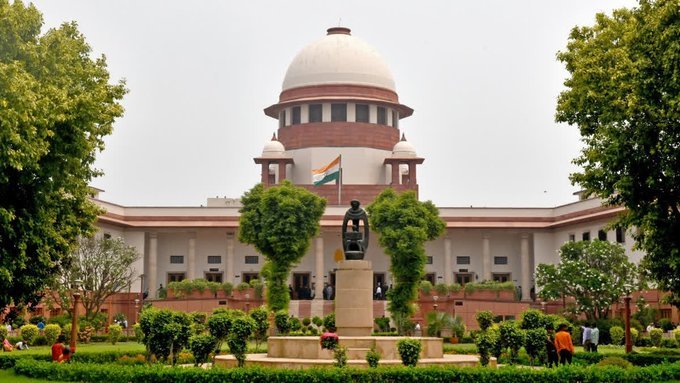
The Supreme Court underscored that the Election Commission must not only function independently but also command public confidence in its independence, as it questioned the Centre over the exclusion of the Chief Justice of India from the statutory panel that appoints the country’s top election officials.
BY PC Bureau
New Delhi/ July 31, 2026: The Supreme Court on Thursday questioned the Centre over the exclusion of the Chief Justice of India (CJI) from the panel responsible for appointing the Chief Election Commissioner (CEC) and Election Commissioners (ECs), observing that the Election Commission must not only be independent but must also be perceived as independent to maintain public confidence in the electoral process.
A Bench comprising Justice Dipankar Datta and Justice Satish Chandra Sharma was hearing petitions challenging the constitutional validity of the Chief Election Commissioner and Other Election Commissioners (Appointment, Conditions of Service and Term of Office) Act, 2023, which altered the composition of the selection committee for appointing members of the Election Commission.
Under the 2023 law, the President appoints the CEC and Election Commissioners on the recommendation of a three-member committee comprising the Prime Minister, the Leader of the Opposition in the Lok Sabha (or the leader of the single largest opposition party), and a Union Cabinet Minister nominated by the Prime Minister.
During the hearing, the Bench repeatedly questioned the rationale behind removing the Chief Justice of India from the selection process.
“The Election Commission is one of the most important constitutional institutions. It is not enough that it functions independently; it must also inspire confidence that it is independent,” the judges observed.
The Bench pointed out that the CJI continues to be a member of the selection committees for other key constitutional and statutory bodies, including the Director of the Central Bureau of Investigation (CBI) and the Lokpal. The judges asked the Centre what justified excluding the judiciary from appointments to the Election Commission, an institution entrusted with conducting free and fair elections.
The court was hearing the Centre’s request to refer the challenge to a larger Constitution Bench but reserved its order on the plea after extensive arguments.
Appearing for the Centre, Solicitor General Tushar Mehta defended the 2023 legislation, arguing that the law reflected Parliament’s considered judgment and that courts should not proceed on the assumption that constitutional authorities would act in bad faith.
“We cannot begin with the presumption that the Prime Minister will misuse his office. People must trust the Prime Minister. The office carries its own sanctity,” Mehta submitted.
He argued that if every executive appointment were viewed with suspicion, the functioning of the government would become unworkable, requiring external participation even in routine Cabinet decisions.
Attorney General R. Venkataramani echoed the government’s stand, contending that Parliament’s legislative wisdom should not be questioned merely because another model of appointment may appear preferable.
The controversy stems from a landmark judgment delivered by a five-judge Constitution Bench of the Supreme Court in March 2023. In the absence of a law enacted by Parliament, the court had directed that appointments to the Election Commission should be made by a committee comprising the Prime Minister, the Chief Justice of India and the Leader of the Opposition, describing the arrangement as an interim mechanism to safeguard the independence of the poll body.
READ: FIR against Meta India Head Over Morphed Posts on PM Modi
Later that year, Parliament enacted the 2023 law, replacing the Chief Justice with a Cabinet Minister nominated by the Prime Minister, a move challenged by several petitioners as diluting the autonomy of the Election Commission and giving the executive a dominant role in appointments.
During Thursday’s hearing, however, the Bench clarified that its observations should not be interpreted as casting aspersions on the Prime Minister or questioning the integrity of the executive.
“The issue before us is not the integrity of any individual. We are examining the institutional safeguards required for a constitutional body that oversees elections in the world’s largest democracy,” the Bench observed.
The Supreme Court reserved its order on the Centre’s request for a reference to a Constitution Bench. The outcome is expected to have significant implications for the process of appointing India’s top election officials and for the broader debate on ensuring the independence of constitutional institutions.