
Parole and furlough are legal rights subject to statutory conditions—but Ram Rahim’s repeated releases raise a troubling question: why does temporary freedom appear so accessible to a powerful Dera chief when other serious convicts often spend years fighting authorities and courts for leave?
Navin Upadhyay
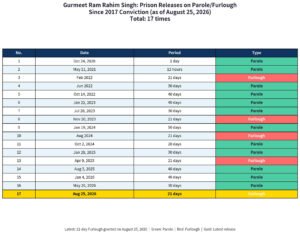
August 25: Gurmeet Ram Rahim Singh has walked out of Haryana’s Sunaria jail yet again. The Dera Sacha Sauda chief, convicted of raping two women disciples and serving a 20-year sentence, has been granted another 21-day temporary release. This is his 17th release on parole or furlough since his imprisonment, according to current reports. He has repeatedly been allowed to spend these periods at Dera properties, including the Sirsa headquarters.
The question is not whether a prisoner has rights. He does.
The uncomfortable question is whether those rights are being exercised with extraordinary generosity in one particularly high-profile case.
And that is where the Ram Rahim saga becomes less a story about one prisoner and more a test of India’s prison system.
Seventeen exits from prison
Ram Rahim was convicted in 2017 by a special CBI court for raping two women followers and sentenced to 10 years for each offence, with the sentences running consecutively. He was subsequently convicted in other criminal cases as well.
Yet his imprisonment has been punctuated by an extraordinary number of temporary releases.
His latest furlough is his 17th temporary release. The previous release, in May 2026, was a 30-day parole. Before that came another series of paroles and furloughs, including releases in 2025 and 2024.
The pattern has become so striking that the question of his temporary releases has itself become a recurring political issue. Several of his releases have also occurred around politically sensitive periods. His October 2024 parole came just days before the Haryana Assembly election.
That does not, by itself, prove that any particular release was politically motivated. Nor does the frequency alone establish that the Haryana government acted illegally.
But it does make a legitimate public question unavoidable:
Why does temporary freedom appear to come so readily to a powerful, controversial convict when ordinary prisoners often struggle to secure even a single period of leave?
What does the law actually say?
Haryana’s parole and furlough system is governed by the Haryana Good Conduct Prisoners (Temporary Release) Act, 1988, along with the applicable rules.
The distinction between parole and furlough matters.
Under Section 3 of the Act, temporary release can be granted on specified grounds, including the death or serious illness of a family member, certain marriages, agricultural operations and, importantly, “any other sufficient cause.” Such release generally does not count towards the prisoner’s sentence.
Furlough is different. Under Section 4, a prisoner sentenced to at least four years may become eligible after three years of continuous imprisonment, provided the statutory good-conduct requirements are met. The furlough period counts towards the sentence.
The law also contains safeguards. A prisoner is not entitled to release where the authorities are satisfied, on the basis of the District Magistrate’s report, that release could endanger state security, public order or create a reasonable apprehension of breach of peace.
So parole and furlough are not illegal favours. They are recognised mechanisms within the prison system.
That is precisely why Ram Rahim’s case deserves scrutiny: the issue is not whether the government has a legal power to grant temporary release. The issue is how that discretion is exercised, how frequently it is exercised, and whether the same standard is applied to everyone.
The law does not say a rape convict automatically gets no parole
There is an important nuance that should not be lost in the outrage.
Indian courts have generally recognised that the nature of the offence cannot automatically become the sole reason for denying parole or furlough in every case. A 2026 Delhi High Court judgment, referring to the Supreme Court’s jurisprudence, noted that authorities must balance the prisoner’s interests against those of society and consider factors such as conduct in prison, period already served and whether the prisoner is dangerous or poses a threat to public peace.
But states can adopt stricter rules.
Maharashtra, for example, amended its prison rules to exclude rape convicts from furlough eligibility, while retaining limited possibilities for parole. The Bombay High Court has also upheld the application of rules that disqualified certain rape convicts from parole and furlough.
In other words, there is nothing inevitable about treating every convicted prisoner in exactly the same manner.
The state has considerable responsibility to determine who can safely be released, under what circumstances and subject to what safeguards.
READ: Rape Convict Ram Rahim Granted Fresh Furlough, Heads to Dera
Where is the equality?
This is where the Ram Rahim controversy becomes especially troubling.
For an ordinary prisoner, parole or furlough can mean a long bureaucratic struggle: an application, police verification, reports from authorities, scrutiny of conduct, consideration of the reason cited and, in some cases, litigation after rejection.
The Haryana rules themselves contemplate police scrutiny and reporting. The 2007 rules prescribe, among other things, substantial sureties for prisoners convicted of rape and other heinous crimes.
There are prisoners who have had to approach courts simply to challenge the denial of temporary release.
The contrast is stark. In one Haryana case, a prisoner who had earlier absconded after parole was refused furlough and challenged the decision before the Punjab and Haryana High Court.
And elsewhere, courts regularly hear petitions from prisoners seeking temporary release on deeply personal grounds.
A striking example came from Delhi, where a convict in the Dhaula Kuan gang-rape case sought an extension of furlough because his minor daughter was battling cancer. The Delhi High Court sought a status report on the plea.
That is what makes the repeated Ram Rahim releases so difficult to explain away as merely routine prison administration.
The Bilkis Bano episode exposed the wider problem
India has already seen how politically explosive the temporary release of rape convicts can become.
In the Bilkis Bano case, 11 men convicted of gang rape and murder were released by the Gujarat government in 2022 under its remission policy. The episode generated enormous public outrage and eventually reached the Supreme Court. A Gujarat government affidavit also revealed that at least 10 of the 11 convicts had collectively enjoyed substantial periods of parole and furlough before their release.
The lesson should have been obvious:
When the state gives extraordinary liberty to people convicted of extraordinarily grave crimes, the process must withstand the highest level of public scrutiny.
And then there is the political shadow
Ram Rahim is not an ordinary prisoner.
He heads a sect with a substantial following, particularly in Haryana and Punjab. His temporary releases have repeatedly generated political controversy because of the potential electoral influence of the Dera’s followers.
Again, this does not establish that the Haryana government grants him parole because of elections.
But repeated releases around politically important moments inevitably create that perception. The 2024 Haryana Assembly election was one such example, with his 20-day parole beginning only days before polling.
A government that wants to eliminate suspicion should therefore do something simple: make the reasons, recommendations and decision-making process behind every such release as transparent as the law permits.
If the decision is entirely based on objective statutory criteria, the government should have nothing to fear from transparency.
VIP treatment is the real issue
Calling Ram Rahim’s releases “VIP treatment” is ultimately a political and journalistic characterisation, not a legal finding. There is no court ruling establishing that Haryana unlawfully favoured him.
But the cumulative picture raises serious questions.
Seventeen temporary releases.
Repeated paroles and furloughs.
A powerful religious organisation waiting for him outside prison.
Repeated permission to stay at Dera establishments.
And a convicted rapist repeatedly returning to public life for weeks at a time while his 20-year sentence continues in the background.
The prison system is supposed to operate on rules, not status.
A poor prisoner with no political constituency should not have to fight harder for lawful temporary release than a powerful convict with thousands of followers.
That is the principle at stake.
Parole is not a privilege reserved for the influential. Furlough is not a reward for political relevance. And good conduct cannot become a VIP pass out of prison.
If Ram Rahim satisfies every statutory condition, the Haryana government has the authority to release him.
But if that is the explanation, the government should answer a very basic question:
Are the same standards, the same speed and the same generosity available to every eligible prisoner—including those convicted of rape and other serious crimes who do not have a powerful religious or political constituency?
Until that question is answered convincingly, every fresh Ram Rahim furlough will continue to look less like routine prison administration and more like a test of whether India’s criminal-justice system truly treats prisoners equally.