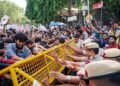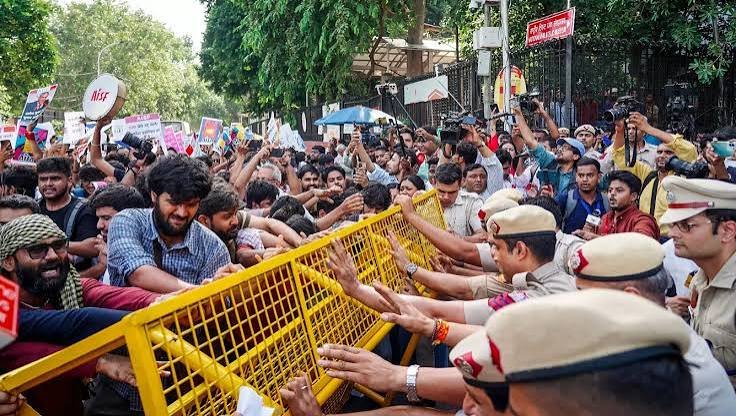
Delhi witnessed a third straight day of clashes and detentions as protesters tried to reach Jantar Mantar demanding the resignation of CEC Gyanesh Kumar. Police erected multiple barricades across central Delhi as student activists, opposition workers and protesters attempted to push through.
BY PC Bureau
October 4 : New Delhi witnessed another day of confrontation on Sunday as protesters repeatedly tried to break through police barricades to reach Jantar Mantar, while police detained opposition workers, student activists and demonstrators demanding the resignation of Chief Election Commissioner bernesh Kumar.
The confrontation, which began on October 2 over the Election Commission’s Special Intensive Revision (SIR) of electoral rolls, entered its third consecutive day with no sign of abating. What started as a protest against the revision exercise has increasingly turned into a wider battle over the right to demonstrate, police restrictions and allegations of excessive use of force.
The day’s confrontations unfolded across central Delhi, from Andhra Bhawan and Ashoka Road to Jantar Mantar and India Gate, with barricades, police personnel and security forces deployed at several points.
जो बस प्रदर्शनकारियों को हिरासत में लेने आई थी, उस पर प्रदर्शनकारी चढ़ गए हैं और उसके सामने घेरकर खड़े हो गए हैं।
#JantarMantar https://t.co/OhZz8sJGqA
— Hemant Rajaura (@hemantrajora_) October 4, 2026
Protesters push towards Jantar Mantar
The first major confrontation came near Andhra Bhawan Circle on Ashoka Road, where activists of the All India Students’ Association (AISA) marched towards Jantar Mantar despite police restrictions.
Multiple layers of barricades had been erected along the route. When protesters attempted to cross them, police moved in to stop them, leading to a brief clash.
Videos circulated on X showed AISA national president Neha Bora attempting to climb a barricade as police personnel tried to prevent her from crossing.
It was the third consecutive day that AISA and other groups attempted to reach Jantar Mantar despite prohibitory orders in force in the New Delhi area.
Police maintained that permission had not been granted for the marches and that restrictions had been imposed to prevent unauthorised assemblies and maintain public order.
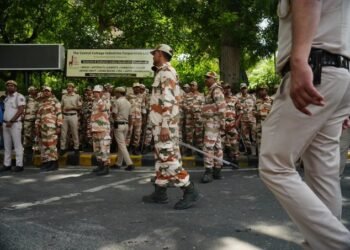
The authorities deployed thousands of personnel, including Rapid Action Force and other paramilitary units, besides drones and multilayered barricades along roads leading towards Jantar Mantar.
For the protesters, however, the restrictions have become part of the dispute itself.
Their central demand remains Kumar’s resignation over allegations concerning the SIR exercise, particularly the deletion and exclusion of voters from electoral rolls. The Election Commission has maintained that the revision is aimed at cleaning up electoral rolls and that officials should rectify inadvertent exclusions.
Neha Bora’s detention becomes another flashpoint
🚨Neha Bora has been picked up by Delhi Police in an unauthorised vehicle,
Without a single female police officer.
She needs a good protest strategist who can coordinate with the government and police so that she does not get detained this quickly. 🤫 https://t.co/smWoEiq9A2
— Krishna Yadav (@Control_Krishna) October 4, 2026
The confrontation escalated later when AISA alleged that Bora was taken away by police in an unmarked vehicle.
The organisation alleged that she was detained without a woman police officer accompanying her and said it was initially unaware of where she was being taken.
Bora’s account on X also questioned the circumstances of her detention, saying: “Where is Delhi Police taking Neha on their own? This is not detention, it is kidnapping!”
The allegation could not immediately be independently established.
But the episode added another layer to an already tense confrontation between protesters and the police.
Shameless moron should be immediately sacked from the force!
Modi’s Beti Bachao campaign at full force.. https://t.co/xeGOPCaKkM
— Vijay Thottathil (@vijaythottathil) October 4, 2026
Saurabh Bharadwaj detained at India Gate
While the AISA activists were confronting police near Jantar Mantar, another protest was taking place at India Gate.
AAP Delhi president Saurabh Bharadwaj and party workers gathered there demanding Kumar’s resignation. Police detained Bharadwaj and several other party workers.
A police officer said at least 25 AAP workers had been detained.
Bharadwaj later posted a photograph on X showing his shoes pointing upwards and alleged that police had turned him upside down while taking him away so that cameras could not capture his face.
“These r my shoes in the air,” he wrote.
He later alleged that police personnel had picked him up and thrown him “like a football”.
The allegation could not independently be verified from available footage.
AAP MLA Sanjeev Jha was also among those detained.
READ: Justice Bhuyan: Removing Millions From Rolls Would Strike at Heart of Constitution
Protest turns into a confrontation over police conduct
By Sunday, the dispute had moved well beyond the Election Commission and the SIR exercise.
Allegations concerning the treatment of women protesters and journalists during Saturday’s demonstrations had emerged as a separate flashpoint.
Three women journalists complained to Delhi Police alleging sexual harassment by police personnel during the October 3 protest.
Rahul Gandhi Ji’s soldiers are marching towards Jantar Mantar to mark their protest against Vote Chori.
Gyanesh-Modi-Shah it’s done bro! https://t.co/steypNzLnd
— Venisha G Kiba (@KibaVenisha) October 4, 2026
Delhi Police acknowledged receiving the complaints and said they had been transferred to the Crime Branch for a “fair and impartial enquiry”.
One journalist alleged that ACP Vivek Bhagat assaulted her while she was filming Bora’s detention. The allegation has not been established and remains subject to investigation.
The complaints triggered another protest outside Parliament Street police station on Sunday, with demonstrators demanding registration of an FIR.
The allegations also drew political reactions. Congress leader Shashi Tharoor criticised the reported treatment of women protesters, while other opposition leaders questioned the police response.
Leader of Opposition Rahul Gandhi also questioned Union Home Minister Amit Shah over the allegations, pointing out that Delhi Police comes under the Union Home Ministry.
The Press Club of India separately expressed concern over the treatment of journalists during the protests and called for journalists to be allowed to work freely.
Three days of arrests and confrontation
Sunday’s events followed two days of increasingly tense protests.
The confrontation began on Gandhi Jayanti, when police sealed off Jantar Mantar ahead of a planned demonstration demanding Kumar’s resignation.
Hundreds of people were detained on Friday as opposition politicians, students and activists attempted to reach the protest site. Among those detained were AAP leaders Atishi and Saurabh Bharadwaj, AISA’s Bora and activist Yogendra Yadav.
Police had imposed prohibitory orders under Section 163 of the Bharatiya Nagarik Suraksha Sanhita in parts of New Delhi. The restrictions prohibit gatherings, processions, demonstrations, picketing and dharnas without permission.
Three FIRs were subsequently registered in connection with Friday’s demonstrations, including allegations of disobedience of an order by a public servant, obstruction and use of criminal force against public servants.
The action did not deter protesters.
On Saturday, activists returned to the area. Around 150 people, including Bora, Yogendra Yadav and senior advocate Prashant Bhushan, were detained as they again attempted to reach Jantar Mantar.
By Sunday, they were back once more.
Central Delhi turns into a security zone
The scale of the police deployment reflected the authorities’ expectation of further mobilisation.
Thousands of personnel were deployed, including Rapid Action Force and other paramilitary units. Drones were used for surveillance and multilayered barricades were placed at several approaches to Jantar Mantar.
Police blocked or restricted movement from Tolstoy Marg, Janpath Road, Sansad Marg, the Kerala Bhawan side and other points around the protest zone.
The security operation repeatedly disrupted movement through central Delhi.
But it has also produced a cycle that is becoming increasingly difficult to contain.
The more heavily the approaches to Jantar Mantar are barricaded, the more protesters attempt to find alternative routes. Each attempt produces fresh detentions, new videos on social media and further allegations against the police.
For the authorities, the issue is one of maintaining public order and enforcing prohibitory orders.
For the protesters, the issue is increasingly about whether access to a designated democratic protest site can effectively be denied through restrictions and police deployment.
From SIR to a wider confrontation
Sunday’s clashes were therefore no longer simply about the Special Intensive Revision.
The protests have acquired several interconnected fronts: the Election Commission’s handling of electoral rolls, demands for Kumar’s resignation, allegations concerning the deletion of voters, the right to peaceful assembly, police accountability and the treatment of journalists.
The confrontation is also likely to continue.
The INDIA bloc has announced a joint protest outside the Election Commission’s office in Delhi on October 7, while youth and student groups have indicated further mobilisation.
For three days, the capital has witnessed the same increasingly familiar sequence: protesters approaching barricades, police pushing them back, political leaders being detained, videos appearing on X and fresh allegations emerging by evening.
What began as a demand for the resignation of the Chief Election Commissioner has now become a much broader confrontation over electoral accountability, the right to protest and the limits of police power in the capital.