Congress scored important victories in Jhalawar and Pali, but AAP’s takeover of Baran and the CPI(M)’s win in Nokha point to a more fragmented opposition landscape ahead of the 2028 Assembly polls.
BY PC Bureau
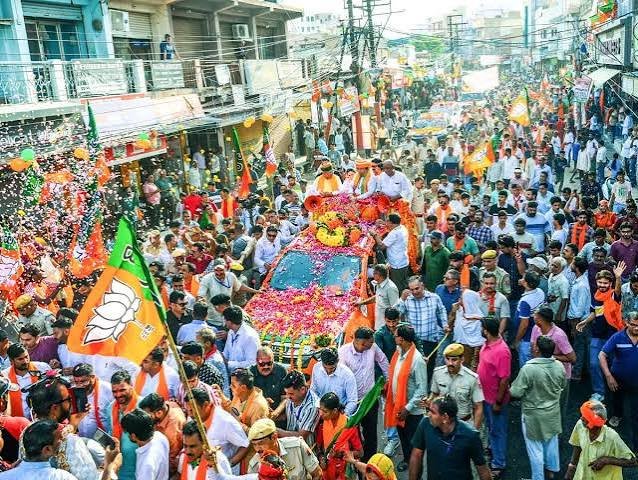
NEW DELHI/ September 14: Rajasthan’s civic election results have kept the BJP ahead but exposed cracks in its urban dominance—and, more significantly, raised questions about whether Congress can still claim the opposition space largely for itself.
The BJP remains the largest party after the counting of nearly all 10,244 wards, winning 4,179 seats against Congress’s 3,613. But the party’s losses did not automatically translate into Congress gains. Independents captured 2,273 wards, while smaller parties also made inroads.
The most politically significant breakthroughs came from the Aam Aadmi Party and the CPI(M). AAP won control of the Baran Municipal Council on its own, while the CPI(M) captured Nokha Nagar Palika. Both results came substantially at Congress’s expense.
That makes the verdict more complicated than a straightforward BJP-versus-Congress contest. The BJP is still ahead, but the opposition vote is becoming more fragmented.
Meanwhile, the vote-share figures from Rajasthan’s local body elections put the BJP at 35.45% and Congress at 34.47%, leaving a gap of just 0.98 percentage points, as claimed by the local Congress.
The BJP had a much wider lead over Congress in Rajasthan in the 2024 Lok Sabha election, when the gap in vote share was around five percentage points.
The latest civic figures could therefore give Congress some political encouragement ahead of the next Assembly contest, although local-body results cannot by themselves be treated as a forecast of the 2028 election.
For Congress, the key question will be whether it can sustain this narrow vote-share gap and convert it into a broader electoral challenge to the BJP.
A boost for Bhajan Lal Sharma
For Chief Minister Bhajan Lal Sharma, the results offer a measure of political reassurance.
Sharma took charge after the BJP’s 2023 Assembly victory, emerging ahead of several senior contenders, including former chief minister Vasundhara Raje. The civic verdict gives his government an opportunity to argue that it retains a broad urban base despite losing ground in several important centres.
The result is particularly useful for the BJP because the campaign unfolded amid criticism over issues including the NEET paper-leak controversy, protests linked to UGC rules and a public campaign focused on the condition of government schools.
None of these issues translated into a statewide civic setback for the ruling party.
Sharma thanked voters and BJP workers, describing the verdict as an endorsement of the government’s work over the past two and a half years under Prime Minister Narendra Modi’s broader “Viksit Bharat” agenda and the state’s “Viksit Rajasthan” campaign. He also claimed that 78% of the government’s public commitments had been fulfilled.
Congress gains—but also loses ground
Congress did manage several important victories. But the party cannot ignore where its lost ground went.
Baran and Nokha may not be among Rajasthan’s biggest civic bodies, yet the victories are politically significant because they show that voters dissatisfied with the BJP are not necessarily moving to Congress.
State Congress president Govind Singh Dotasra argued that the BJP had benefited from the usual advantage enjoyed by ruling parties in local elections. He claimed the BJP’s vote share had fallen to the mid-30s from its level in the last Lok Sabha election.
Dotasra also alleged biased delimitation and malpractice, claiming Congress could have won around 1,500 additional wards without such factors.
He pointed to Jaipur, where he said Congress was ahead in votes, and Ajmer, where Congress won 37 wards against the BJP’s 32. He also highlighted the party’s performance in several reserved categories and argued that the forthcoming panchayat elections would provide a more demanding test for the government.
Jhalawar and Pali deliver BJP setbacks
Some of Congress’s strongest performances came in areas with particular political resonance for the BJP.
In Jhalawar Municipal Council, Congress won 29 of the 45 wards. The area has long been associated with former chief minister Vasundhara Raje, who continues to represent Jhalrapatan as the BJP MLA.
Pali was another setback. In the 65-member civic body in the home district of state BJP president Madan Rathore, Congress emerged as the largest party with 29 wards. The BJP won 21, while Independents secured 15.
Congress also defeated the BJP in Rathore’s own ward, adding a symbolic sting to the result.
AAP finds an opening
For AAP, Baran represents more than another municipal victory.
The party won 31 of the 60 wards, giving it enough seats to form the municipal board without relying on another party. Congress won 18, the BJP nine and Independents two.
AAP secured 42 wards across Rajasthan—still a small number in statewide terms, but a significant development for a party that has struggled to establish a durable political base in the state.
The Baran result suggests that Congress cannot assume that anti-BJP voters will automatically rally behind it.
Independents emerge as kingmakers
The biggest surprise in the results may be the scale of the Independent vote.
With 2,273 wards, Independents are far from being marginal players. In several municipalities and corporations, they hold enough seats to determine who forms the governing board.
Bharatpur is the clearest example. Independents won 36 of its 65 wards, leaving both major parties dependent on negotiations.
The political bargaining has therefore only begun. In Bharatpur and other hung civic bodies, the ability to build alliances with Independents could matter as much as the results themselves.
BREAKING 🚨
पहली बार राजस्थान निकाय चुनाव का वोट शेयर सामने आया है।
कांग्रेस ने BJP को सिर्फ 0.98% के अंतर तक ला दिया है। 🔥
BJP — 35.45%
INC — 34.47%
वो भी तब, जब कांग्रेस विपक्ष में थी और संसाधनों की भारी कमी थी।FUN FACT 🤯
2024 लोकसभा चुनाव में, जब BJP को राजस्थान में… pic.twitter.com/6PgoQQAqmn
— INC NEWS (@TheIncNews) September 14, 2026
What the numbers mean for 2028
The next Rajasthan Assembly election is still more than two years away, making it too early to treat the civic verdict as a direct forecast of 2028.
But the political signals are already clear.
The BJP has retained its position as Rajasthan’s largest political force, but its losses in places such as Jhalawar and Pali show that local dominance cannot be taken for granted.
Congress, meanwhile, has to confront a more difficult problem than simply defeating the BJP. It must prevent its opposition space from being divided among AAP, the Left, Independents and smaller regional parties.
In 2023, the BJP won 115 Assembly seats with 41.7% of the vote, while Congress secured 70 seats with 39.58%. Congress now argues that the BJP’s vote share has fallen sharply since the last Lok Sabha election, although the final civic vote-share figures will provide a clearer measure.
For now, the BJP can claim the larger share of Rajasthan’s civic map. Congress can point to important victories. But the more consequential story may be what happened in between: voters looking beyond the two principal parties.
The BJP’s immediate challenge is to consolidate the areas where it lost control. Congress must recover votes that have begun moving elsewhere. And in the civic bodies where neither major party has a majority, the next political battle will be fought not at the counting tables but in the rooms where alliances are negotiated.