



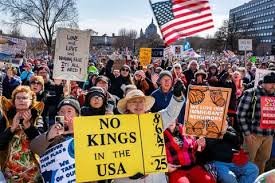
No Kings Changes Tactics in Fight Against Trump: From Los Angeles and New York to Washington, DC, and Salt Lake City, demonstrators organised rallies, voter-registration drives and marches to ballot drop boxes.
BY PC Bureau
October 18 — The “No Kings” movement returned to communities across the United States on Saturday, but with a strategic shift: instead of concentrating on massive street demonstrations against President Donald Trump, organisers sought to turn a year of protest mobilisation into votes ahead of the November 3 midterm elections.
Under the banner “No Kings: Vote Early,” the coalition organised more than 2,500 events across all 50 states and Washington, DC, according to organisers. The activities ranged from rallies and roadside demonstrations to voter-registration drives, letter-writing campaigns, community gatherings and organised walks to polling locations and ballot drop boxes.
The October 17 mobilisation was the movement’s fourth major coordinated day of action. It marked a change in emphasis for a coalition that has organised large demonstrations against what participants describe as “authoritarian” Trump administration.
This time, the message was directed less towards filling city streets and more towards getting eligible voters to cast their ballots early, where available, and participate in the midterm elections that will determine control of Congress.
The shift comes amid continuing disputes over voting access, federal immigration enforcement, civil liberties and the administration’s policies. Organisers argue that electoral participation is the next stage of the movement, while critics have questioned its claims of nonpartisanship, pointing to its progressive organisational roots and the more explicitly partisan messages displayed at some local events.
From mass demonstrations to electoral mobilisation
The latest campaign represents a tactical evolution for No Kings. Previous mobilisations drew millions of participants nationally, according to estimates cited by organisers. The October 17 events, by contrast, were deliberately designed to be more decentralised, with neighbourhood-level activities replacing some of the large, centrally organised rallies.
Organisers said the objective was to convert public engagement into electoral participation rather than judge the day solely by crowd size.
In New York, volunteers wrote postcards encouraging voters in battleground states to participate. Elsewhere, demonstrators held signs at busy intersections, organised voter-information sessions and accompanied participants to voting locations.
The strategy also reflects the approaching midterm elections, when all 435 seats in the House of Representatives and roughly one-third of the Senate seats will be contested. The outcome will shape Congress’s ability to scrutinise the administration and support or block its legislative agenda.
According to Stateline, more than five million ballots had already been cast by the time of the mobilisation, citing the University of Florida Election Lab. Early-voting arrangements differ by state, meaning that some October 17 events encouraged immediate voting while others focused on registration, voter education and planning for later dates.
Washington, DC: Hundreds gather for No Kings
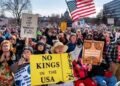
In the US capital, several hundred people gathered near the Lincoln Memorial, carrying signs urging Americans to vote early and protect their voting rights. Music and speeches formed part of the gathering, while some participants marched across Memorial Bridge.
The turnout was more modest than the enormous crowds associated with earlier No Kings demonstrations. But the event reflected the campaign’s new emphasis on reaching voters and encouraging participation before Election Day.
In Atlanta, local leaders also urged people to vote. The city was among the locations where the campaign linked its opposition to Trump administration policies with efforts to increase voter participation.
New York: VoteFest brings politics and community activity together
In New York City, hundreds gathered in Washington Square Park in Manhattan for a VoteFest featuring speeches, music, poetry and voter-registration activities.
The event brought together political messaging and community participation, with organisers encouraging eligible voters to make plans to vote in the midterms. Smaller gatherings and pamphlet-distribution efforts took place elsewhere in the city and the wider tri-state area.
In Queens, Indivisible volunteers wrote letters to voters in competitive states, urging them to cast their ballots early. The neighbourhood events illustrated the movement’s effort to make electoral mobilisation a local, practical activity rather than a one-day spectacle.
New York’s early-voting period was scheduled to begin on October 24, so the emphasis there was on preparation and voter outreach rather than immediate in-person early voting.
Los Angeles and California: Voting rights take centre stage
In downtown Los Angeles, thousands gathered at Gloria Molina Grand Park near City Hall for a rally and a march of roughly 1.5 miles, according to local reporting.
The demonstration combined calls for early voting with opposition to federal immigration enforcement and concerns about civil liberties. Smaller events were also reported across Los Angeles and Orange counties.
In the San Francisco Bay Area, participants used creative public displays to promote the campaign. At Ocean Beach, demonstrators formed a large human mural spelling out “VOTE”, while neighbourhood activities in Oakland and elsewhere encouraged residents to participate in the election.
The Bay Area mobilisation also reflected concerns about election administration and the possibility of federal interference. Those concerns have become a central theme of the broader debate over voting rights, although claims about specific threats remain contested.
Chicago: A more decentralised day of action
In the Chicago area, the latest mobilisation was more dispersed than earlier demonstrations, with no single large downtown rally dominating the day.
Events took place in suburbs including Evanston, Naperville, Highland Park, Deerfield and Skokie. Participants held signs at intersections, organised local gatherings and encouraged residents to vote early.
The smaller crowds at several locations contrasted with earlier mass rallies. Yet the decentralised format was consistent with the organisers’ stated aim of reaching people in their own communities and turning participation into practical electoral action.
The difference in scale also underscores an important distinction: the number of events held does not necessarily translate into a comparable number of participants or demonstrate the movement’s overall political reach.
Boston, Utah and smaller communities join the drive
In Massachusetts, organisers opted for neighbourhood events rather than another large gathering on Boston Common. Activities included community meetings, voter education, walks to early-voting locations and an immersive exhibit illustrating what organisers described as an authoritarian political playbook.
The approach contrasted with the much larger Boston demonstration in March 2026, for which organisers had claimed attendance in the hundreds of thousands. Those earlier figures were estimates rather than a nationally standardised count.
In Salt Lake City, around 2,000 people gathered at the Utah state Capitol before marching to a ballot drop box at the Main Library, where participants cast ballots. Additional events were reported in other Utah communities, including Provo, Park City, Ogden and Logan.
Other reported activities included a waterfront rally in Newburgh, New York; a march and performances in Reno, Nevada; demonstrations in Florida; and voter-visibility actions in Michigan, Illinois and numerous smaller towns.
The varied formats showed how the national campaign adapted to local voting schedules and community priorities.
No Kings Rallies as Americans express outrage over the state of the country https://t.co/NIbKV65uat
— Simon Ateba (@simonateba) October 17, 2026
Nonpartisan message, partisan fault lines
The No Kings coalition has presented the October 17 campaign as a nonpartisan effort to defend democratic participation and ensure that eligible voters understand their options.
The network includes organisations such as Indivisible and 50501, alongside other progressive groups and civic organisations. Its stated message is that political power belongs to voters and that early participation can help protect electoral rights.
However, the movement’s claims of nonpartisanship have attracted criticism. Some local events included explicitly pro-Democratic messages, while critics pointed to the progressive political orientation of several participating organisations.
The Trump administration also pushed back against the demonstrations. A White House spokesperson argued that the focus on the midterms showed that the movement was politically motivated, framing the election as a choice between Republican policies and those of the Democrats.
The disagreement highlights the political tension surrounding the campaign. Encouraging people to vote is a civic activity, but a movement organised in opposition to a president’s policies inevitably operates within a wider partisan contest.
The extent to which the events attract voters beyond the coalition’s existing supporters remains difficult to establish from attendance figures alone.
READ: Now Meloni Also Under Fire as Italy Erupts in Cost-of-Living Protests
Meta briefly suspends No Kings account
The mobilisation also encountered a social-media disruption. Meta acknowledged that the temporary suspension of the No Kings movement’s Instagram account on the day of action was an error caused by an automated system response to unusually heavy posting activity, according to Business Insider.
The account was subsequently restored. The episode prompted concerns among organisers about the reliability of digital platforms for communicating with supporters during major political events.
The incident added another dimension to a campaign increasingly dependent on digital networks to coordinate local events, circulate voting information and mobilise participants across a geographically dispersed movement.
Will the strategy translate into votes?
The October 17 events were generally smaller and more localised than previous No Kings mass mobilisations, according to reports from several cities. That does not necessarily mean the campaign was less effective: its stated objective was to encourage electoral participation, not simply maximise the size of street demonstrations.
But the practical impact remains uncertain. The number of events organised, the size of the crowds and the number of people who ultimately cast ballots are different measures of success. The movement’s influence will be clearer only when more complete turnout figures become available and its voter-mobilisation efforts can be assessed.
The shift also raises a broader question about protest movements in the United States: can sustained public opposition to a president’s policies be converted into lasting electoral engagement, particularly in closely contested congressional races?
For No Kings, the November 3 midterms will provide a crucial test of whether its nationwide network can translate public demonstrations into participation at the ballot box.
The movement’s message on Saturday was clear: the streets were only one arena for political action. Its organisers now want supporters to carry that energy into the voting process.
Whether that strategy produces a measurable increase in turnout—or a broader political impact—remains to be seen.



Comments 1