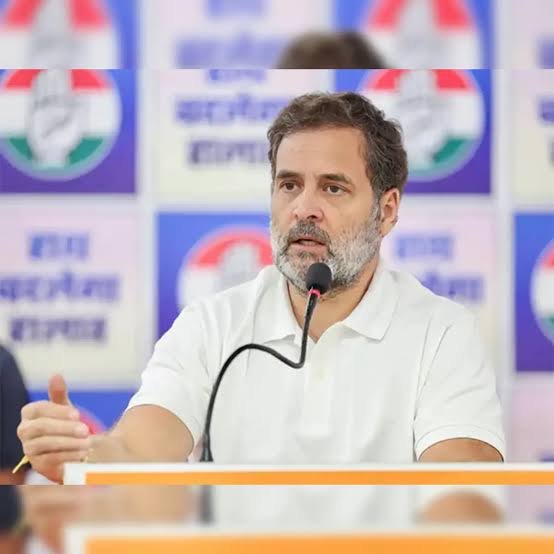
Backing the anti-NEET agitation, Rahul Gandhi condemned the police crackdown on student protesters, demanded action against officials responsible, and urged the government to withdraw cases filed against demonstrators.
BY PC Bureau
New Delhi, July 2026: Escalating his attack on the Narendra Modi government over the alleged NEET paper leak and the crackdown on student protesters, Leader of the Opposition Rahul Gandhi on Wednesday accused the Centre of presiding over a “rigged” education system that has betrayed millions of young Indians. Throwing his full weight behind the nationwide student agitation, the Congress leader demanded the immediate resignation of Union Education Minister Dharmendra Pradhan, calling him “corrupt, incompetent and the face of the entire crisis.”
Addressing a press conference at the AICC headquarters in New Delhi, Gandhi said the ongoing protests were not merely about a single examination or one paper leak but reflected the collapse of India’s education system, where honest students were paying the price for government failures.
“The students are not on the streets without reason. They are fighting against a rigged system. Their anger is justified because their future is being destroyed while those responsible continue to enjoy protection,” Gandhi said.
Renewing his demand for Pradhan’s removal, Gandhi alleged that the Education Minister had failed to ensure fairness, transparency and accountability in the country’s examination system.
“Dharmendra Pradhan is corrupt and incompetent. He has become the symbol of everything that has gone wrong with India’s education system. He should resign immediately,” Gandhi said.
VIDEO | Delhi: Addressing a press conference, Lok Sabha LoP Rahul Gandhi says, “So we are 100% in agreement with what every single student is feeling and what every single student is doing. And there must be some consequences for what was done a few days ago. It is not their… pic.twitter.com/y3u8RMd6Xp
— Press Trust of India (@PTI_News) July 22, 2026
‘One Paper Leak Every Month’
Citing what he described as alarming data, Gandhi claimed that at least 152 examination paper leaks had taken place across the country over the past decade—averaging more than one every month.
According to him, these leaks have affected nearly seven crore students and their families, forcing many candidates to repeatedly prepare for cancelled examinations while enduring financial hardship and mental stress.
“What is even more shocking is that despite so many paper leaks, there has not been a single conviction. Students are punished with re-examinations, but those who destroy their future walk free,” he said.
The Congress leader argued that the actual number of paper leaks could be significantly higher, alleging that many incidents never come to light.
READ: CJP Rejects Govt’s Offer for Talks at JP Nadda’s Residence
Education Turned Into an ‘Extortion Racket’
Gandhi also launched a blistering attack on the growing commercialisation of education, claiming that the current system benefits coaching centres and the affluent while pushing ordinary families into debt.
He alleged that families spend nearly ₹1.32 lakh crore every year on NEET coaching alone, almost matching the Union government’s annual education budget.
Across five major competitive examinations—NEET, JEE, UPSC, SSC and Railway Recruitment Board (RRB) exams—Indian families collectively spend an estimated ₹3.5 lakh crore annually on coaching and related expenses, he claimed.
“This is no longer an education system. It has become an extortion racket. The poor and middle class are forced to borrow money while only the rich can comfortably compete,” Gandhi alleged.
Backs Student Demands
The Congress MP expressed complete solidarity with the protesting students and endorsed their key demands, including:
- Immediate resignation of Union Education Minister Dharmendra Pradhan.
- Independent investigation into examination irregularities.
- Action against police personnel accused of assaulting student protesters.
- Withdrawal of criminal cases registered against students.
- A public apology from Prime Minister Narendra Modi over the alleged police brutality.
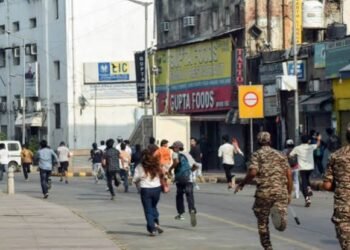
Referring to the police action against demonstrators during the CJP-led march towards Parliament earlier this week, Gandhi condemned what he described as the “brutal assault” on peaceful students.
“What crime did these young people commit? They were asking for a fair examination system. Instead of answers, they were beaten with lathis. This is not how a democracy treats its students,” he said.
‘I Don’t Care About a Few Punches’
Asked about being allegedly manhandled by police during Tuesday’s Congress protest outside the Prime Minister’s residence, Gandhi dismissed the incident as insignificant compared to the plight of students.
“It is an honour for me to become the voice of the students. I don’t care about a few punches. What matters is their future and their demand for justice,” he said.
He reiterated that the INDIA bloc would continue supporting students both inside and outside Parliament and demanded a full-fledged debate on the examination crisis during the Monsoon Session.
Political Battle Intensifies
Gandhi’s remarks came amid escalating political tensions over alleged examination irregularities, repeated paper leaks, student protests and police action in Delhi.
The Congress has sought to portray the controversy as a national crisis affecting millions of students, accusing the BJP-led government of failing to protect the integrity of public examinations.
The BJP, however, has rejected the allegations. Union Education Minister Dharmendra Pradhan accused Rahul Gandhi and the Congress of exploiting students for political gains and attempting to disrupt Parliament instead of participating in constructive debate. He maintained that the government remained committed to strengthening examination systems, reforming the National Testing Agency and ensuring transparency and accountability.
With Parliament witnessing repeated disruptions and protests continuing outside, the education crisis has emerged as one of the most contentious political issues of the Monsoon Session, setting the stage for an intensifying confrontation between the government and the Opposition.