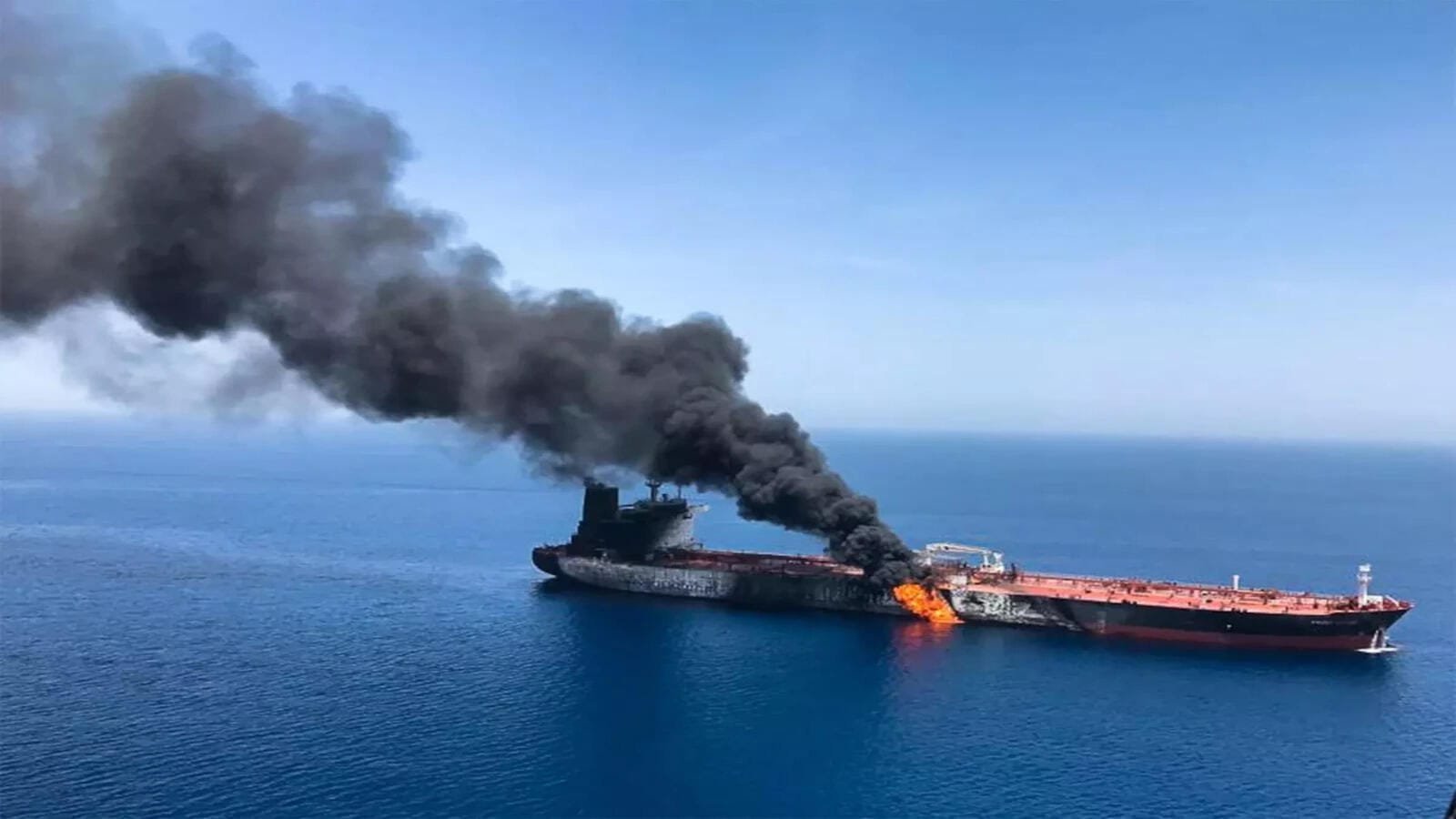
The attack has intensified the US-Iran confrontation, rattled global oil markets, and renewed fears of prolonged disruption to commercial shipping through the Strait of Hormuz, which carries nearly one-fifth of the world’s oil trade.
BY PC Bureau
July 14, 2026: One Indian seafarer was killed and eight crew members were injured after Iranian cruise missiles struck two UAE-owned oil tankers transiting the Strait of Hormuz on Monday, marking one of the most serious attacks on commercial shipping since the latest escalation in the US-Iran confrontation.
The vessels—Mombasa and Al Bahiyah—were sailing through the southern shipping lane in Omani territorial waters when they were hit. Fires erupted aboard both tankers but were later brought under control by the crews and emergency responders.
According to UAE authorities, the casualties included one Indian crew member killed and eight injured—six Indians and two Ukrainians, with four of the injured reported to be in critical condition. The deceased Indian sailor was serving aboard the Mombasa.
Iran Claims Tankers Ignored Warnings
Iran’s Islamic Revolutionary Guard Corps (IRGC) defended the strikes, claiming the vessels had ignored repeated maritime warnings, switched off their Automatic Identification System (AIS) transponders, and attempted to pass through what it described as a “mined route.”
Without naming the ships, the IRGC said two “offending” supertankers had been “successfully struck and disabled” after failing to comply with instructions issued by Iranian naval forces.
The claims could not be independently verified.
The United Arab Emirates strongly condemned the missile strikes, describing them as a blatant violation of international law and a direct threat to regional stability.
In a statement, the UAE Ministry of Defence said the country “reserves its full right to respond to this escalation and to take all necessary measures to protect its territory, its citizens and residents, in a manner that safeguards its sovereignty, security and stability.”
The ministry also said the UAE Armed Forces remain on the highest level of operational readiness and warned that any further attacks would be met with an appropriate response.
Iranian missile strikes on UAE tankers in the Strait of Hormuz killed two Indian crew and injured eight others. Attacks on commercial shipping in this critical chokepoint endanger global energy flows and seafarer safety. International action is needed to defend open sea lanes.…
— NewsAgnika (@NewsAgnika) July 14, 2026
READ: The Politics of Selective Outcry in Manipur Ethnic Conflict
The attack comes amid an increasingly dangerous confrontation between Iran and the United States over control of the Strait of Hormuz, the world’s most strategically important maritime oil corridor.
The narrow waterway carries roughly 20 percent of global oil and liquefied natural gas trade, or approximately 15-21 million barrels of crude oil every day. Any disruption immediately reverberates through global energy markets.
In recent weeks, the United States has intensified military operations targeting Iranian missile sites, naval assets and military infrastructure after Tehran stepped up attacks on commercial shipping.
On Monday, U.S. Central Command announced a third consecutive night of strikes against Iranian targets, saying the operations were intended to degrade Iran’s capability to threaten civilian shipping and international maritime traffic.
President Donald Trump described the campaign as “another major attack,” saying the United States was “hitting them very hard” and would continue operations until Iran’s offensive capabilities were significantly degraded. He also reiterated that Washington intended to maintain control over shipping security in the Strait and floated the possibility of charging transit fees for vessels benefiting from U.S. naval protection.
Strait of Hormuz: A Global Chokepoint
The Strait of Hormuz has long been regarded as one of the world’s most vulnerable maritime chokepoints.
At its narrowest point, the waterway is only about 33 kilometres wide, forcing commercial vessels into tightly defined shipping lanes that run close to Iranian territorial waters.
The region presents multiple security challenges, including:
- The threat of anti-ship cruise missiles, naval mines, drones and fast-attack boats.
- Navigation disputes arising from contested waters and temporary military restrictions.
- The possibility of rapid escalation involving regional navies, leading to prolonged shipping disruptions.
- Sharp increases in war-risk insurance premiums, forcing many shipping companies to suspend voyages or reroute vessels around the Cape of Good Hope, adding weeks to delivery schedules and significantly increasing transportation costs.
Oil Markets on Edge
The latest attack immediately rattled global energy markets.
Brent crude surged nearly 8 percent, climbing to around $81.92 per barrel, as traders priced in the possibility of further disruptions to Gulf oil exports.
Analysts warn that a prolonged closure of the Strait of Hormuz could remove between 14 million and 21 million barrels of oil per day from global markets.
Although Saudi Arabia and the UAE possess alternative export pipelines, these routes can handle less than half the normal volume transported through Hormuz, leaving global supplies highly exposed.
Market observers caution that a sustained disruption could push crude prices above $120 per barrel, with extreme scenarios potentially approaching $150 per barrel, triggering renewed global inflation, delaying central bank interest-rate cuts and placing additional pressure on energy-importing economies.
UAE authorities have consistently reported one Indian fatality and eight injuries, including six Indian nationals and two Ukrainians, with four of the injured in serious condition.
Iranian statements have focused on justifying the military operation and have not disputed the casualty figures.
The missile strike represents a significant escalation in the conflict and raises fresh concerns about the safety of commercial shipping through one of the world’s busiest maritime corridors.
With both Iran and the United States signalling that further military action remains possible, the security outlook for the Strait of Hormuz remains highly uncertain. Any additional attacks on commercial vessels could have far-reaching consequences for global energy supplies, international trade and financial markets.