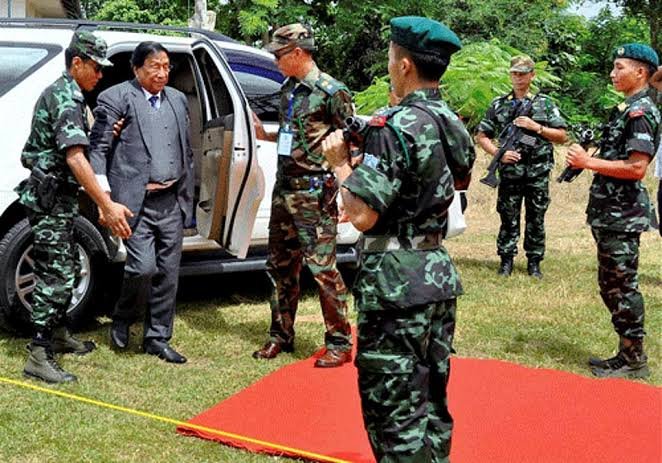
From the ₹18.85-crore Ukhrul bank robbery and the Hongbei killings to allegations involving Kuki-Zo victims and repeated extortion cases, the incidents raise a fundamental question: how effectively are the NSCN-IM ceasefire Ground Rules being enforced?
BY Navin Upadhyay
New Delhi
September 19, 2026: Nearly three decades after the Union Government and the National Socialist Council of Nagaland-Isak-Muivah (NSCN-IM) entered into a ceasefire in 1997, questions continue to be raised over alleged armed activity by NSCN-IM cadres in Manipur.
The issue is not simply whether individual cadres may have committed crimes. The larger question is whether conduct attributed to NSCN-IM cadres is compatible with the ceasefire framework and the Ground Rules agreed with the Government of India.
The ceasefire, which formally came into effect on August 1, 1997, was intended to create conditions for political dialogue and a peaceful resolution of the Naga issue. The Government of India has subsequently described the ceasefire as continuing alongside the political negotiations.
The Ground Rules prohibited offensive operations such as ambushes, raids, sniping and attacks causing death, injury or loss of property. They also addressed armed movement, road blockades, disruption of economic and essential services, intimidation and forcible collection of money.
The January 2001 Revised Ground Rules
The January 13, 2001 Revised Agreed Ground Rules between the Government of India and the NSCN-IM are particularly important in assessing alleged violations today.
The revised rules were designed to strengthen the ceasefire and create a conducive atmosphere for substantive political dialogue. They prohibited offensive operations, including ambushes, raids, sniping and attacks resulting in death, injury or property damage. They also required the NSCN to refrain from harassing civilians, blocking roads or communications, disrupting economic and developmental activity, or interfering with essential services.
The rules further required the NSCN to notify its camps to the Ceasefire Monitoring Group. They laid down restrictions on the movement of armed cadres between designated camps and prohibited the public parading of armed cadres in populated areas, public transport and highways.
READ: NSCN (I-M) Ceasefire extended
READ: NSCN-ceasefire-3 NSCN (I-M)-GOI-ground-rules. JPG
Significantly, the revised rules also dealt with forcible collection of money and intimidation. Although NSCN representatives denied that such practices were taking place, the issue was specifically addressed in the ceasefire arrangements.
The importance of the provisions was reinforced when the ceasefire was extended in June 2001. The Government of India and NSCN-IM expressly agreed that the revised Ground Rules would be observed “both in letter and in spirit.”
That makes the 2001 framework an important benchmark for examining subsequent allegations involving armed camps, movement of cadres, extortion, attacks or disruption of civilian life.
Against that backdrop, a series of incidents in Manipur — including the ₹18.85-crore Punjab National Bank robbery in Ukhrul, allegations concerning civilian killings, extortion cases and reports of armed NSCN-IM activity — raise questions about compliance with the ceasefire framework.
₹18.85-Crore PNB Robbery in Ukhrul
On November 30, 2023, armed masked men entered the Punjab National Bank branch in the Viewland area of Ukhrul town, overpowered bank employees and security personnel and escaped with approximately ₹18.85 crore.
The case acquired a new dimension when the Ministry of Home Affairs transferred the investigation to the National Investigation Agency. The NIA subsequently filed a chargesheet alleging the involvement of NSCN-IM cadres in the robbery. The chargesheet named self-styled Lieutenant Colonel P. Joseph alias Jackson Phinao/Joseph Phinao among the accused. The Special NIA Court in Manipur subsequently took cognisance of the chargesheet.
If the prosecution case is established in court, the alleged use of armed NSCN-IM cadres in a bank raid involving the overpowering of employees and the theft of ₹18.85 crore would directly engage the ceasefire provisions concerning offensive operations and loss of property.
The case is particularly significant because the NIA’s allegations reportedly concern the use of the proceeds for militant purposes, including weapons procurement. That would raise an obvious question about the compatibility of such activity with a ceasefire intended to reduce armed operations and facilitate political negotiations.
Arrests, Extortion and the Kishan Killings
The record also includes cases in which NSCN-IM cadres were arrested in connection with alleged extortion, as well as one of the most serious cases involving the abduction and killing of government officials in Manipur.
In February 2009, NSCN-IM cadres abducted Kasom Khullen SDO Dr Thingnam Kishan Singh and five subordinate officials in Ukhrul district. Three were later released, but Kishan and two others, Yumnam Token Singh and Aribam Rajen Sharma, were killed.
The Manipur government told the Assembly that the preliminary investigation pointed to extortion as the motive, with the abductors demanding money. The NSCN-IM subsequently acknowledged the involvement of its cadres and identified Hopeson Ningshen as the mastermind.
Ningshen was arrested by the CBI and convicted and sentenced to life imprisonment by a special CBI court in 2014. The Delhi High Court upheld the conviction in 2019.
The case has since entered another judicial stage, with the Supreme Court suspending Ningshen’s sentence pending his appeal. The suspension of a sentence does not amount to an acquittal; the conviction remains under challenge.
There have also been repeated arrests of persons identified by authorities as NSCN-IM cadres in alleged extortion cases, including cases involving alleged collection of money from transporters.
Such arrests, by themselves, do not establish guilt. But they are relevant to the ceasefire framework because the Ground Rules specifically addressed forcible collection of money and intimidation.
The Hongbei Killings
The killing of four cadres of the Naga Army’s Eastern Flank at Hongbei in Kamjong district on March 28, 2026, raises another question about armed activity involving personnel alleged to be linked to NSCN-IM.
According to the Eastern Flank’s account, its cadres were intercepted by a group that included NSCN-IM personnel, and 2nd Lieutenant Mathotmi of Shihai Khunou allegedly ordered his men to open fire. Four cadres — Sochipem Phungshok, Zairay Vasah, Bahnle Ahlahpya and Thansomi Washi — were killed. The Eastern Flank subsequently alleged that the operation could not have been undertaken merely on the initiative of a junior officer and raised questions about possible involvement of higher NSCN-IM leadership.
The NSCN-IM denied that its leadership had ordered the operation, describing the incident as a “botched operation” and saying those responsible would face action. It subsequently constituted a six-member inquiry commission to investigate the killings.
The competing accounts mean that responsibility for the killings remains contested. But the incident is nevertheless relevant to the ceasefire question because it involved an armed confrontation in which personnel identified with the NSCN-IM were allegedly involved.
The question for the ceasefire mechanism is therefore straightforward: when armed personnel linked to a ceasefire signatory become involved in a deadly armed confrontation, what mechanism exists to determine responsibility and enforce the agreed Ground Rules?
Involvement in Kuki-Zo Civilian Killings
Questions have also been raised by Kuki-Zo organisations over alleged NSCN-IM involvement in killings in Manipur’s Naga-inhabited areas.
On March 11, 2026, two Kuki civilians, Thenkhogin Baite and Thangboimang Lunkim, were killed and another person was injured at Thawai Kuki village in Ukhrul district. Kuki organisations alleged that suspected NSCN-IM cadres had abducted the three.
The allegations prompted demands for an impartial investigation. The Manipur government subsequently said the case would be handed over to the NIA.
However, the case has also generated competing accounts. The Tangkhul Naga Long Working Committee questioned the allegations and the transfer of the case to the NIA, while Kuki organisations maintained that NSCN-IM cadres were responsible.
The NIA’s official case listing currently identifies RC-03/2026/NIA/IMP, but its published case description does not itself establish NSCN-IM involvement. It describes the underlying case as involving suspected Tangkhul Volunteers, the destruction of poppy plants and the burning of huts at the Thawai Kuki Hill Range.
Kuki-Zo civil society organisations have nevertheless alleged NSCN-IM involvement in nearly two dozen killings of Kuki-Zo cadres and civilians over the past five to six months. The allegations, if substantiated, would raise serious questions under the ceasefire provisions prohibiting offensive operations and conduct resulting in death or injury.
Extortion and Collection of Money
The ceasefire framework is particularly clear on another issue: forcible collection of money.
The original Ground Rules recorded the Government of India’s concern over forcible collection of money and intimidation of individuals, including government officials. The revised 2001 framework retained restrictions intended to prevent such practices.
This provision is particularly relevant to allegations of “taxation” and extortion in Manipur.
Where police arrest persons identified as NSCN-IM cadres in alleged extortion operations, the cases should be investigated and adjudicated on their individual evidence. But where such activities are established as organisational activity, they would raise a direct question under the ceasefire Ground Rules.
READ: March 11 Ukhrul Killings: NSCN-IM Nailed in Police Report, MHA Order
READ: NSCN (I-M) Demotes Two Officers Over Shootout That Left Four Dead
The Question of NSCN-IM Camps in Manipur
The presence of NSCN-IM cadres and alleged camps outside Nagaland is another contentious issue.
The Ground Rules provided for the notification of NSCN camps to the Ceasefire Monitoring Group and established arrangements governing designated camps and the movement of armed cadres.
The revised rules also placed restrictions on the public display of weapons and the movement of armed cadres outside designated arrangements.
This makes reports of NSCN-IM armed camps or temporary structures in Manipur particularly relevant to the ceasefire debate.
The question should therefore be framed precisely:
Which NSCN-IM camps, if any, in Manipur have been formally recognised under the ceasefire-monitoring mechanism, and under what authority are armed cadres permitted to operate outside designated camps?
That is a question for the Government of India and the ceasefire-monitoring mechanism to answer.
A Ceasefire Cannot Become a Shield for Armed Activity
The significance of these incidents goes beyond individual criminal cases.
The 1997 ceasefire was intended to suspend armed confrontation and create space for political negotiations. The Ground Rules were subsequently strengthened to regulate the conduct of armed cadres, camps, movement, civilian interaction and the functioning of the monitoring mechanism.
The incidents cited above therefore raise a broader question about implementation and enforcement.
The PNB robbery has resulted in an NIA chargesheet against alleged NSCN-IM cadres. The Hongbei episode involved allegations against NSCN-IM-linked personnel, followed by an internal NSCN-IM inquiry. The Thawai killings resulted in an NIA investigation amid sharply conflicting accounts. The Kishan case resulted in convictions at the trial and High Court stages, although the conviction is now under appeal.
These cases are not legally equivalent. An allegation is not a conviction; an arrest is not proof of guilt; and an investigative finding is not a final judicial determination.
But credible allegations involving a ceasefire signatory cannot simply be ignored.
Where Is the Ceasefire Monitoring Mechanism?
The original ceasefire framework envisaged a monitoring mechanism to oversee implementation of the Ground Rules. The revised framework subsequently strengthened arrangements concerning designated camps and the movement of armed cadres.
The central issue, therefore, is not merely whether allegations of violations exist. It is what happens when credible allegations emerge.
If armed robbery, civilian killings, extortion or unauthorised armed activity are established as actions of NSCN-IM cadres, the ceasefire framework requires investigation, determination of responsibility and enforcement of the agreed rules.
A ceasefire is not a licence for armed activity. It is a framework for stopping it.
For the peace process to retain credibility, the Ground Rules must have practical meaning whenever credible violations are established — including in Manipur and other areas where NSCN-IM cadres operate.