As cybercrime networks expand inland, the junta struggles to control territory, trade and criminal activity—leaving China to balance its fight against scams with its strategic dependence on Myanmar’s military rulers.
BY PC Bureau
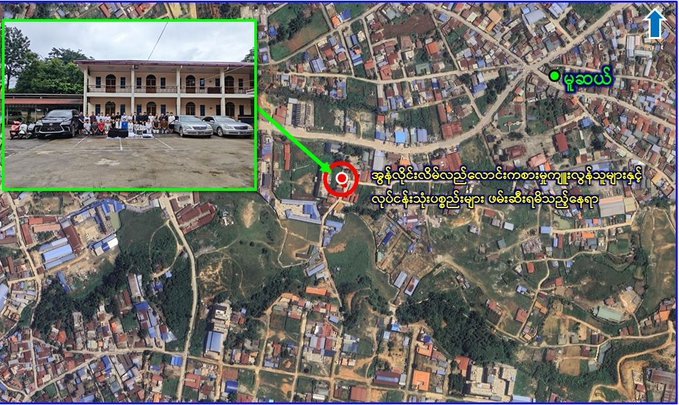
September 5, 2026: Chinese-linked cybercrime networks are moving deeper into Myanmar, exposing a new and troubling dimension of the country’s widening breakdown under military rule. A raid on an alleged online fraud centre in Mandalay this week has raised concerns that scam operations once concentrated in remote borderlands are adapting to pressure by relocating into major cities.
According to a reprot in The Irrawaddy, authorities raided a compound in Maha Aung Myay Township, Mandalay, on Wednesday and arrested at least 10 people, including Chinese nationals. Computers, mobile phones and cash were reportedly seized from premises linked to a jade trading company. The military authorities have not publicly commented on the operation, while local residents described it as the first raid of its kind in the city.
For years, Myanmar’s notorious scam industry operated largely from fortified compounds in areas bordering China and Thailand. Chinese-run syndicates have recruited or trafficked workers into these compounds, forcing them to carry out romance scams, fake investment schemes, cryptocurrency fraud and other forms of online deception targeting victims across Asia, Europe and the United States.
#China declared Myanmar’s cyber-scam crisis “completely eradicated” in 2025. A year later, the networks are spreading deeper into Shan State. 46 raids in 8 months arrested 2,400+ people, over 2,000 of them Chinese nationals #WhatsHappeningInMyanmarhttps://t.co/7N1bKHxZqG
— Hafsah Diallo (@HafsahD19) September 3, 2026
But the geography of the industry appears to be changing.
Increased pressure on some border-based scam centres, including crackdowns encouraged by China, has made it more difficult for criminal groups to operate openly in their traditional strongholds. Instead of disappearing, however, some networks appear to be shifting towards Myanmar’s major urban centres, where shell companies, legitimate businesses and established money-laundering channels can provide cover.
The Mandalay raid is significant precisely because of its location.
Mandalay is not one of Myanmar’s remote frontier towns. It is the country’s second-largest city and a major commercial hub linking northern Myanmar with China and the rest of the country. The appearance of an alleged scam compound there suggests that the criminal economy surrounding Myanmar’s cyber-fraud industry is becoming less dependent on isolated territories controlled by militias and armed groups.
It also presents a dilemma for the junta.
The military has repeatedly promised to crack down on cybercrime and human trafficking, particularly after growing international pressure over the scam industry. Yet the proliferation of these operations has flourished amid the collapse of state authority following the 2021 coup.
The scam compounds have become one of the clearest examples of how Myanmar’s civil war has created space for transnational criminal enterprises. Armed groups control large stretches of territory, government authority is fragmented and corruption is widespread. Criminal organisations can exploit these gaps by moving people, money and technology across jurisdictions.
The victims are not confined to Myanmar.
Thousands of people from different countries have reportedly been trafficked into scam centres and forced to defraud strangers online. The targets, meanwhile, are spread around the world. What looks like a local criminal operation can therefore become part of a global fraud chain involving recruitment networks, cyber operators, cryptocurrency channels, money laundering and international financial transfers.
The emergence of such operations in Mandalay could indicate that the networks are becoming more resilient rather than being dismantled.
China’s complicated role
The scam crackdown also highlights China’s increasingly complicated relationship with Myanmar’s military rulers.
Beijing remains one of the junta’s most important external partners, providing diplomatic support while maintaining extensive economic and strategic interests in the country. At the same time, China has its own reasons for wanting the scam industry contained. Chinese nationals have been among those trafficked into scam compounds, while criminal networks operating along Myanmar’s northern border have become a significant security concern for Beijing.
China has consequently pushed Myanmar and armed groups along the border to take action against online fraud.
Yet Beijing’s relationship with the junta is not unconditional.
That was visible at the Shanghai Cooperation Organisation summit in Bishkek from August 30 to September 1. Chinese President Xi Jinping, Russian President Vladimir Putin and Indian Prime Minister Narendra Modi attended the gathering, but junta leader Min Aung Hlaing was absent.
Myanmar remains only a dialogue partner of the China- and Russia-backed grouping. The exclusion was particularly noticeable because China had given Min Aung Hlaing a prominent platform at last year’s SCO-related events in Tianjin.
The absence does not suggest that Beijing is abandoning the military regime. Rather, it underlines the transactional nature of the relationship. China can support the junta when doing so protects its security and economic interests while simultaneously keeping some distance from a government that remains internationally isolated.
That balancing act is becoming increasingly visible inside Myanmar itself.
On September 3, the Chinese Embassy organised a media and youth event at Yangon University that drew around 300 participants, according to organisers. Chinese officials invoked the traditional “pauk-phaw” concept of friendship between the two countries and called for closer cooperation.
The outreach comes at a time when public attitudes towards China have become more complicated. Beijing is simultaneously viewed as a powerful neighbour, an essential economic partner and, by some sections of Myanmar society, a supporter of the military authorities.
Chinese-linked scam operations add another layer to that resentment.
READ: Eight TN Studetns Killed as Car Rams Parked Lorry on Thrissur Highway
A junta taxing trade it no longer controls
The military’s struggle to maintain control over Myanmar’s economy is equally apparent in Kachin State.
On August 29, the junta opened a cargo inspection station at Maingnar, across the river from Myitkyina. The move came after key border crossings with China, including Kanpiketi and Lweje, came under the control of the Kachin Independence Army.
The crossings had been important commercial gateways for agricultural products, timber and rare earths moving towards China, as well as construction materials, electronics and consumer goods entering Myanmar.
With the traditional border routes outside its control, the junta is attempting to establish customs collection points farther inland.
For traders, this can mean another layer of taxation and inspection.
The symbolism is striking: an army that has lost control of important portions of the border is attempting to retain a share of the revenue generated by trade passing through territory it still controls.
For China, meanwhile, the situation is increasingly awkward. Kachin’s rare earths are strategically important to Chinese industry, while the borderlands have become a patchwork of military, ethnic armed-group and commercial interests.
A relationship built on necessity
Taken together, the developments reveal a Myanmar in which the boundaries between war, organised crime and international commerce are becoming increasingly blurred.
Chinese-linked scam networks are moving into cities such as Mandalay. The junta is trying to collect taxes from trade routes it no longer controls at the frontier. Beijing is simultaneously combating criminal networks that threaten Chinese citizens, protecting its commercial interests, cultivating influence among Myanmar’s youth and media, and maintaining working relations with a military regime whose legitimacy remains deeply contested.
The central story, therefore, is not that China is walking away from Myanmar.
It is that China’s influence and Myanmar’s criminal economy are expanding through a state whose authority is shrinking.
For Min Aung Hlaing, that presents an increasingly difficult contradiction. The junta needs Chinese economic and diplomatic support, but cannot fully control the territory through which Chinese commerce flows. It needs to demonstrate that it can suppress criminal networks, yet those networks have thrived amid the very fragmentation of state power created by the military’s war.
And for Beijing, the challenge is equally stark: it wants stability, secure borders and uninterrupted access to Myanmar’s resources and trade routes. But the deeper the country falls into conflict and criminality, the harder it becomes to separate legitimate Chinese interests from the illicit networks exploiting Myanmar’s disorder.
The Mandalay raid may therefore be more than a police operation. It could be an early sign that Myanmar’s scam economy is entering a new phase — one in which the criminal networks no longer need to remain hidden in the borderlands and are increasingly capable of operating in the country’s major urban centres.