By Navin Upadhyay
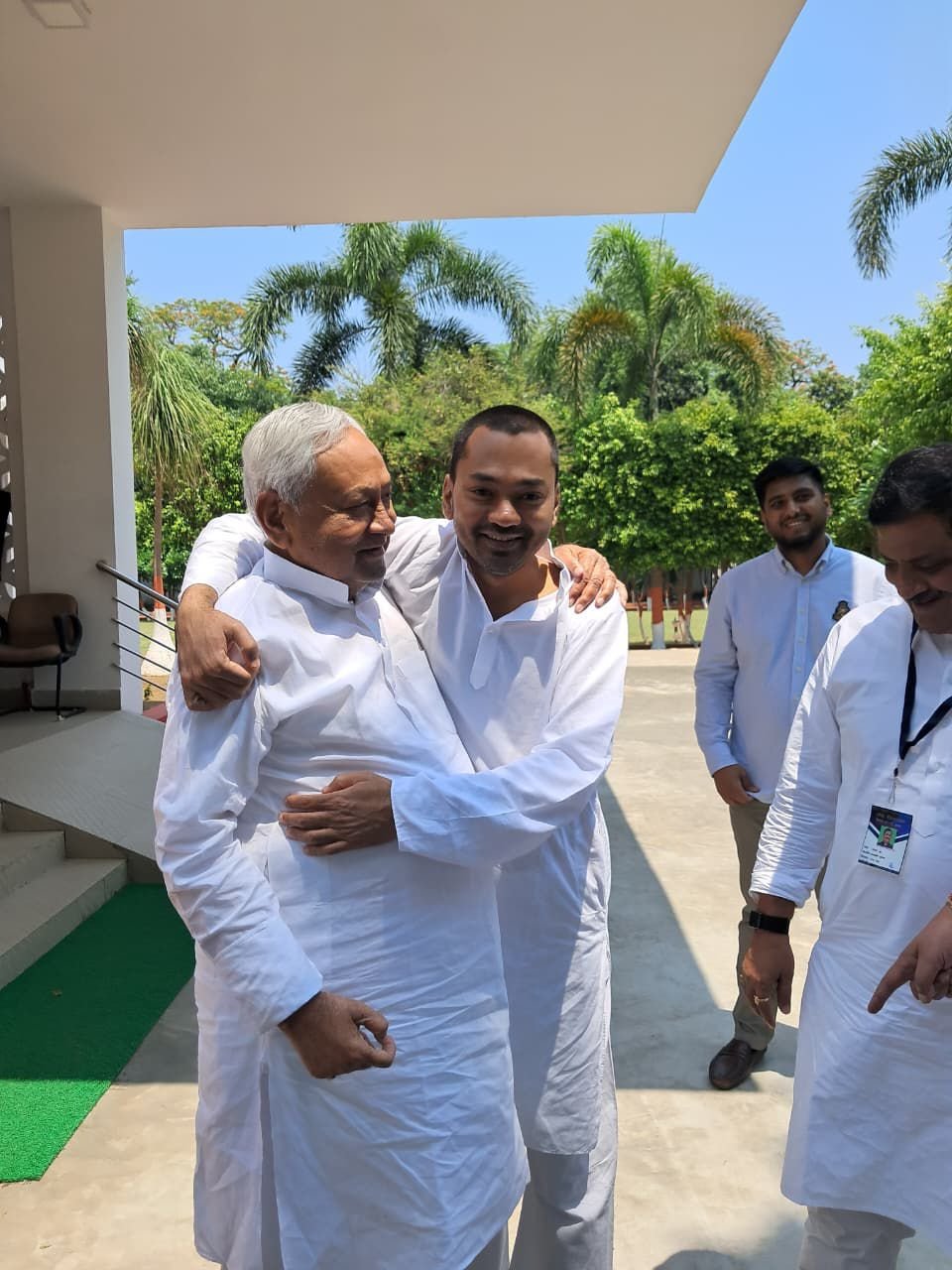
May 7, 2026: In Bihar’s ever-shifting political theatre—where alliances realign as swiftly as the Ganga changes course—Thursday’s cabinet expansion under Chief Minister Samrat Choudhary sent a carefully calibrated message. While Nitish Kumar, Bihar’s longest-serving Chief Minister, has moved to the Rajya Sabha, prompting speculation about a leadership vacuum in the Janata Dal (United), the induction of his son Nishant Kumar as a minister has signalled continuity rather than collapse.
Alongside 12 other JD(U) leaders in a 13-member quota within a 28-member cabinet—where the BJP holds 15 berths—the party has sought to project stability in a post-Nitish era that many had assumed would be marked by fragmentation and decline.
For years, Nitish Kumar’s leadership masked deeper structural fragilities within JD(U), a party built heavily around his personal authority, administrative reputation, and the carefully engineered social coalition of EBCs, Mahadalits, and women voters. His long-standing resistance to dynastic politics made Nishant’s entry into active politics in March 2026—and now into the cabinet—a significant departure from tradition.
The move comes at a moment of heightened uncertainty. Nitish’s shift to the Rajya Sabha triggered concerns within the party that, without a visible successor, JD(U) could splinter under pressure from the BJP’s organisational strength and the RJD’s caste-based mobilisation. Within this context, Nishant’s elevation is widely seen as a stabilising intervention designed to prevent defections and preserve internal cohesion.
At one level, it reflects classic political inheritance. But strategically, it is also an attempt to preserve the “Nitish model” of governance—a mix of welfare-driven politics, caste balancing, and administrative delivery that redefined Bihar’s post-Mandal landscape. By positioning Nishant as a new focal point, JD(U) hopes to retain its fragmented but loyal support base, preventing it from drifting towards either the BJP’s Hindutva consolidation or the RJD’s Yadav-centric revival.
READ: Militants Set Ablaze Villages Along Manipur–Myanmar Border
Within the party, Nishant is increasingly being projected as a generational bridge. Posters in Patna already describe him as a “young jansevak,” while insiders suggest he will soon take on a more active organisational role. His entry is intended not merely as symbolic succession, but as an attempt to provide a rallying point for cadres wary of uncertainty and factional drift.
Patna, Bihar: On JD (U) leader Nishant Kumar, JD(U) Bihar State President Umesh Singh Kushwaha says, “There has been a demand in our party for Nishant Kumar to be included in the cabinet. However, he has previously said that he will first understand and interact with the party… pic.twitter.com/Ck5pj5iZN1
— IANS (@ians_india) May 7, 2026
There is also a growing perception within sections of JD(U) that Nishant’s presence could serve as a counterweight to BJP dominance within the NDA. With the BJP holding a larger share of cabinet positions and greater organisational leverage, some JD(U) leaders see the Kumar family’s continued visibility as essential to preserving the party’s independent identity within the alliance.
Electorally, the calculation rests on Nitish Kumar’s enduring personal appeal among EBCs, Mahadalits, and women voters—sections that have historically credited his welfare policies over ideological positioning. Party strategists believe this reservoir of goodwill could gradually transfer to Nishant, especially if he succeeds in establishing a grassroots presence.
However, the challenges are substantial. Entering formal politics at 50, Nishant lacks the decades of cadre-building experience that defined his father’s rise. His effectiveness will depend on navigating internal rivalries, managing BJP’s dominance within the coalition framework, and translating symbolic inheritance into organisational strength.
Yet the symbolism of his induction—witnessed at the highest levels of the NDA leadership—underscores a broader political reality: JD(U) is not preparing for dissolution, but for adaptation.
Ultimately, Nishant Kumar’s entry into the cabinet is less about dynastic succession in isolation and more about institutional survival. It reflects a calculated attempt to ensure that the Kumar legacy—its social coalition, governance narrative, and political relevance—outlives its original architect.
Whether this strategy produces a durable post-Nitish JD(U) or merely postpones an inevitable transition remains uncertain. What is clear, however, is that the party’s political obituary has once again been deferred.