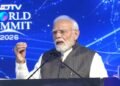
Xi Jingpuing called for a strategic, long-term relationship with India, while Modi stressed adherence to existing border agreements and a fair, mutually acceptable settlement of the boundary dispute.
BY PC Bureau
September 12: Prime Minister Narendra Modi and Chinese President Xi Jinping on Saturday signalled a cautious effort to stabilise India-China ties, but made clear that peace along the disputed border remains the key test of whether the thaw can go further. Meeting in New Delhi on the sidelines of the BRICS Summit, Modi stressed that existing agreements on the Line of Actual Control must be respected, while Xi said Beijing viewed relations with India from a “strategic and long-term perspective”.
The meeting, Xi’s first visit to India in seven years, came as the two countries seek to consolidate the limited improvement in ties after years of tension along the LAC. Xi said India and China could learn from each other, support one another and pursue common development. Modi, meanwhile, thanked China for its support during India’s BRICS chairmanship and called for deeper bilateral cooperation.
The message from New Delhi was nevertheless clear: improved political and economic ties cannot be sustained without stability on the border.
According to the Ministry of External Affairs, the two leaders reviewed progress since their previous meeting in Tianjin in August 2025 and reaffirmed the need to maintain peace and tranquillity in the border areas. They also reiterated their commitment to finding a fair, reasonable and mutually acceptable settlement of the boundary question.
Modi emphasised that the two countries needed to be guided by mutual respect, mutual sensitivity and mutual interest. He also stressed that existing agreements and understandings relating to the border must be observed.
That puts the LAC at the centre of the relationship even as both governments try to move beyond the tensions that followed the 2020 military confrontation in eastern Ladakh.
News Alert! In talks with Xi, PM Modi emphasised that peace and tranquillity in border areas remains essential basis for growth of bilateral ties: MEA.
News Alert! In talks with Xi, PM Modi stressed the need for both sides to observe existing agreements and understandings on… pic.twitter.com/X1t1YAYziK
— Press Trust of India (@PTI_News) September 12, 2026
Xi signals longer-term approach
Xi struck a more positive note, saying China viewed its relationship with India from a “strategic and long-term perspective”. He said the two countries could “fully learn from each other’s strengths”, support one another and work towards common development.
The Chinese leader also pointed to his long engagement with Modi, noting that the two leaders had met 21 times and reached a series of understandings during those interactions.
Beijing’s emphasis was on preventing differences from becoming a permanent obstacle to the broader relationship. But the unresolved boundary dispute remains the biggest constraint on that ambition.
#WATCH | PM @narendramodi and China President Xi Jinping meet for a bilateral meeting on the sidelines of BRICS Summit 2026.
PM Modi welcomed President Xi Jinping, thanked China for its BRICS support, and reaffirmed stronger bilateral ties.@BricsIndia2026 @MEAIndia #BRICS2026… pic.twitter.com/BTBGYJmLZj
— DD News (@DDNewslive) September 12, 2026
The two sides have made progress in restoring high-level contact and reducing some of the tensions that followed the Ladakh crisis. Yet the underlying territorial dispute has not been resolved, and military deployments and infrastructure development along the frontier continue to give the relationship a security dimension that cannot easily be separated from trade and diplomacy.
Doval-Wang talks provided backdrop
Saturday’s meeting also followed last month’s talks in Beijing between National Security Adviser Ajit Doval and Chinese Foreign Minister Wang Yi under the Special Representatives’ mechanism.
The discussions covered the boundary question, trans-boundary cooperation and the need to maintain peace along the LAC.
The Special Representatives’ mechanism is one of the principal channels through which India and China have sought to deal with the boundary dispute at the political and strategic level. Its revival has been part of the broader effort to prevent the border issue from overwhelming the entire relationship.
For India, however, engagement does not mean setting aside the boundary question. Modi’s emphasis on existing agreements suggested that the return to normal diplomatic engagement will continue to be tied to conditions along the LAC.
BRICS gives relationship a wider setting
The Modi-Xi meeting also took place against the wider backdrop of the BRICS Summit and a changing global balance of power.
Xi called for an “equal and orderly multipolar world” and argued that India and China, as two of the world’s most populous countries and major voices of the Global South, should contribute more to international peace, stability and development.
The BRICS declaration meanwhile backed a greater role for India in the United Nations and supported broader reform of the UN system, including stronger representation for developing countries.
READ: BRICS Declaration Sends Strong message to Trump, Israel
The convergence is significant because India-China competition is no longer confined to the border or bilateral trade. Both countries are also seeking greater influence in institutions shaping the emerging international order.
Yet cooperation in multilateral forums does not erase bilateral differences. India and China continue to compete strategically across Asia, while their positions on issues ranging from trade and technology to regional security remain different.
Thaw, but with limits
The significance of Saturday’s meeting therefore lies less in any breakthrough than in the attempt to prevent the relationship from slipping back into confrontation.
Both governments appear to have concluded that prolonged hostility serves neither side. Restoring political dialogue, increasing economic engagement and keeping military tensions under control can create space for a broader relationship.
But the border remains the hard test.
India’s position is that peace and tranquillity along the LAC are the foundation for the development of the wider relationship. China, while stressing strategic cooperation and common development, also wants ties to be viewed from a longer-term perspective rather than being dominated by the border dispute.
That leaves the two sides with a delicate balancing act: cooperate where their interests overlap, compete where they do not, and ensure that the unresolved boundary does not once again trigger a wider breakdown.
Saturday’s meeting suggested that both Modi and Xi want to preserve the thaw. It did not suggest that the fundamental differences have disappeared. For India, the message was particularly clear—the relationship can move forward, but the road still runs through the border.