The contrasting decisions have triggered questions over whether similar attacks on Assam Rifles are being subjected to different investigative standards in Nagaland and Manipur.
By Navin Upadhyay
The Centre has handed over the investigation into the July 13 IED attack on Assam Rifles personnel in Nagaland’s Chümoukedima district to the National Investigation Agency (NIA).
The decision, conveyed by the Ministry of Home Affairs on July 27 and announced by Nagaland Police on July 28, cites a scheduled offence under the NIA Act, 2008, and national-security implications.
The question is why a similar decision has not been announced for a deadlier Assam Rifles ambush in neighbouring Manipur just a week earlier.
On July 13, an IED believed to have been concealed in a roadside autorickshaw exploded near the Assam Rifles training centre at Shokhuvi in Chümoukedima.
Havildar Mohammed Iqbal was killed and four other personnel were injured.
The NIA will now investigate the case under the provisions of the central anti-terror law.
But on July 6, two Assam Rifles personnel were killed in an ambush in Manipur’s Ukhrul district.
Around 1.30–1.40 p.m., a convoy of the 40 Assam Rifles returning to its base at Shangshak came under attack near Nungshang Khong—also reported as Nungshangkhong or Nounshong Kong—on NH-202, about 16 km east of Ukhrul town.
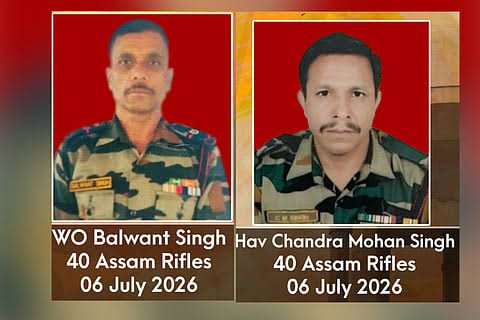
Warrant Officer Balwant Singh of Bageshwar and Havildar Chandra Mohan Singh of Pauri Garhwal, both from Uttarakhand, were killed.
The attackers used explosives followed by gunfire. Preliminary accounts said IEDs had been planted near a bridge, and an unexploded device was later recovered.
The attack was described as the fourth fatal ambush on security forces in Manipur that year.
Manipur Chief Minister Yumnam Khemchand Singh condemned the attack and said those responsible would be punished.
Security forces subsequently launched joint searches involving the Assam Rifles, BSF and Manipur Police. Several people were detained or arrested in related operations, triggering protests from local Naga organisations over the detention of civilians.
No group claimed responsibility for the ambush. The NSCN-IM denied involvement.
Yet there has been no public announcement transferring the Ukhrul case to the NIA. The investigation has remained with the Manipur Police.
This is where the contrast becomes difficult to ignore.
The contrast raises another question: why has neither the Manipur government sought an NIA probe into the July 6 ambush nor the Centre ordered one on its own, despite having the power to do so?
In Nagaland, the Union Home Ministry invoked Sections 6(5) and 8 of the NIA Act after determining that the Khopanala explosion involved a scheduled offence with national-security implications.
READ: Myanmar-Linked Drug Network: ₹20 Cr Trail Emerges in Mon
The Nagaland government and police have said they would complete the legal handover.
In Manipur, meanwhile, two Assam Rifles personnel were killed in an apparently planned attack involving explosives and gunfire on a national highway in a sensitive hill district.
— NagalandPolice (@DGP_Nagaland) July 28, 2026
Yet the case has not been similarly elevated to the NIA.
The difference is significant because Assam Rifles has repeatedly come under attack in Manipur. It also comes against a backdrop of criticism over whether serious cases involving security forces in the state have received the same investigative urgency as comparable cases elsewhere.
Critics of the Manipur government argue that condemnation and wreath-laying are not enough when central security personnel are targeted with IEDs and automatic weapons.
They say an independent and specialised investigation would help establish who planned and carried out the Ukhrul attack, particularly when the attackers have not been publicly identified.
They also point out that the Centre has transferred other cases from Manipur to the NIA when it considered such intervention necessary.
Leaving the July 6 ambush with the state police while transferring the July 13 Nagaland case, they argue, risks creating an impression of uneven standards. It also raises an uncomfortable question: Who is the Manipur government trying to shield by not seeking a central probe?
The Manipur government can counter that joint operations and arrests are already under way and that not every militant attack automatically meets the threshold for an NIA investigation.
Ultimately, the decision to transfer a case is a legal and administrative one, and the mere fact that two attacks involve the same security force does not by itself require identical investigative treatment.
But the sequence of events raises an obvious question.
Two Assam Rifles personnel were killed in Manipur on July 6.
One Assam Rifles jawan was killed in Nagaland on July 13.
The Nagaland case has now gone to the NIA.
Why not Manipur’s?