While Prime Minister Narendra Modi has urged dialogue and promised action against paper leak culprits, the extensive security measures, commercial disruptions and restrictions around the protest venue have sparked debate over the government’s handling of the youth-led agitation.
BY PC Bureau
New Delhi, July 25, 2026: The heart of the national capital remained under an unprecedented security lockdown on Saturday as authorities tightened restrictions around Jantar Mantar, where thousands of students affiliated with the Cockroach Janta Party (CJP) have been staging an indefinite protest demanding accountability for alleged examination paper leaks, sweeping reforms in the education system, and the resignation of Union Education Minister Dharmendra Pradhan.
What began as a student-led agitation over alleged irregularities in competitive examinations has evolved into one of the largest youth protests witnessed in Delhi in recent years, prompting extraordinary security measures that have disrupted normal life across central Delhi.
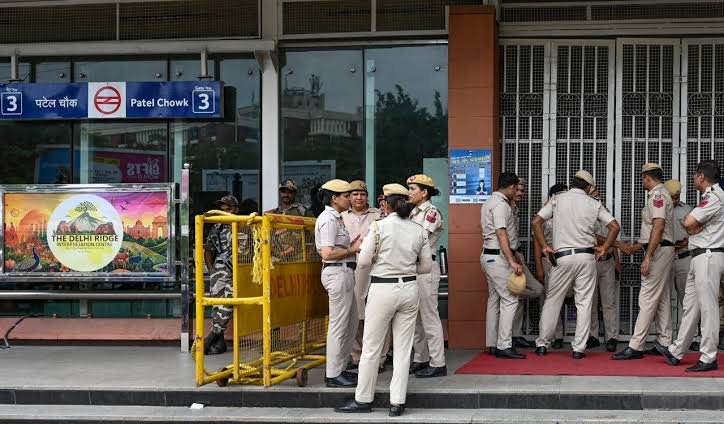
Large contingents of Delhi Police and paramilitary personnel continued to guard the protest venue and surrounding areas. Multi-layer barricades, anti-riot vehicles, water cannons and extensive security checks transformed the normally bustling administrative district into a virtual fortress.
Authorities have invoked prohibitory orders under Section 163 of the Bharatiya Nagarik Suraksha Sanhita (BNSS)—the provision that replaced the erstwhile Section 144 of the Criminal Procedure Code. The order prohibits unlawful assembly and empowers district authorities to impose restrictions where there is an apprehension of disturbance to public order.
While officials maintain the restrictions are preventive and intended to avoid violence, civil liberties advocates argue that prolonged prohibitory orders around peaceful demonstrations risk restricting citizens’ constitutional right to assemble peacefully.
Metro Stations Closed, Transport Severely Hit
The security clampdown has significantly affected mobility across the city.
Eighteen Metro stations in central Delhi remained either closed or operated with restricted entry and exit over successive days. Stations serving key government and commercial districts—including Patel Chowk, Janpath, Central Secretariat, Rajiv Chowk and nearby locations—were affected, forcing thousands of commuters to alter their daily travel plans.
Traffic diversions around Parliament Street, Connaught Place, Janpath and adjoining roads resulted in long queues, delayed public transport and congestion extending well beyond the immediate protest zone.
Office-goers, tourists and businesses alike bore the brunt of the restrictions as one of Delhi’s busiest commercial corridors functioned at only a fraction of its normal capacity.
अभिजीत दीपके :–
जंतर मंतर को बेरिकेड लगाकर बड़ी जेल बना दिया
जैमर लगा दिए
17 मेट्रो स्टेशन बंद कर दिए
CP की दुकानें बंद कर दी“एक धर्मेंद्र प्रधान को बचाने के लिए पूरी दिल्ली का जीना हराम कर दिया” pic.twitter.com/1rnx7U4WKC
— Cockroach Janta Party (@CJP_for_India) July 25, 2026
Businesses Forced to Wind Up Early
The economic impact has become increasingly visible.
Following police advisories, traders in Connaught Place—the capital’s premier commercial district—closed shops, restaurants and offices several hours before normal business hours to avoid possible unrest.
Liquor vends across Delhi were also directed to shut early ( 8 P.M. )over the weekend as a precautionary measure based on law-and-order assessments.
Retailers complained of declining footfall, cancelled bookings and substantial business losses, while restaurant owners reported sharp drops in evening customers owing to security restrictions and uncertainty over transport.
Digital Restrictions Add to Difficulties
Protesters also reported intermittent disruption of mobile internet connectivity and communication services around Jantar Mantar.
App-based food delivery, ride-hailing services and logistics operators faced operational restrictions after Delhi Police advised companies to regulate movement within prohibited zones notified under Section 163 BNSS.
Although police clarified that no blanket ban had been imposed on food deliveries, volunteers at the protest site said supplies frequently failed to reach participants because delivery personnel were unable to cross security barricades. Student volunteers were instead compelled to carry food, medicines and drinking water manually over long distances.
The communication disruptions further complicated coordination among protesters and organisers.
Government Sends Contrasting Messages
The government’s political messaging has increasingly come under scrutiny.
Prime Minister Narendra Modi has repeatedly adopted a conciliatory tone in his public outreach, addressing students directly through video messages, acknowledging their concerns over examination irregularities and assuring swift action against those responsible for paper leaks. He has promised reforms aimed at strengthening transparency and restoring faith in the examination system.
However, the administrative response on the ground has appeared considerably tougher.
The extensive deployment of security personnel, repeated imposition of prohibitory orders, transport restrictions and commercial shutdowns have fuelled criticism that the government’s actions do not fully reflect the conciliatory tone projected from the highest political level.
Student groups argue that while the Prime Minister has appealed for dialogue, authorities continue to treat peaceful demonstrators primarily as a law-and-order challenge.
Debate Over the Use of Section 163 BNSS
Legal experts note that Section 163 BNSS grants district magistrates broad preventive powers to prohibit assemblies when there is sufficient apprehension of danger to public tranquillity.
The provision allows authorities to restrict gatherings, processions and movement in designated areas for a limited period where necessary to prevent violence or maintain public order.
Supporters argue such powers are essential in a densely populated capital where protests can quickly affect Parliament, diplomatic missions and critical infrastructure.
Critics, however, contend that prolonged reliance on prohibitory orders risks becoming a substitute for sustained engagement with protesters, particularly when demonstrations remain largely peaceful. They argue that constitutional protections guaranteeing freedom of speech and peaceful assembly require governments to balance security concerns with democratic rights.
Student Leadership Keeps Movement Organised
Unlike many spontaneous demonstrations, the Jantar Mantar agitation has displayed a structured organisational framework.
The Cockroach Janta Party, founded by youth activist Abhijeet Dipke, has established volunteer committees responsible for crowd management, medical assistance, sanitation, food distribution and communication.
Student leaders have repeatedly instructed participants to avoid confrontation with police, maintain discipline and ensure that the protest remains peaceful despite growing frustration over the government’s response.
Volunteers coordinate shifts, distribute drinking water and medicines, manage donations and assist participants arriving from different states. The decentralised leadership structure has enabled the movement to sustain itself despite logistical challenges and restrictions around the protest site.
READ: MEA Says No Info on Foreign Funding, Blow to CJP Smear Campaign
The movement has also relied heavily on social media platforms to mobilise support, coordinate volunteers and circulate updates, making it one of the most digitally driven student protests in recent years.
The protests have steadily evolved beyond demands related solely to the alleged NEET paper leak.
Students are increasingly framing the movement as a broader campaign seeking transparency in competitive examinations, greater accountability of public institutions, protection of merit, employment opportunities and comprehensive reforms in recruitment and testing mechanisms.
Solidarity demonstrations have emerged in several cities, while the developments at Jantar Mantar continue to dominate political discourse and social media.
As the agitation enters another crucial phase, the government faces the challenge of balancing public order with democratic engagement. Whether the coming days witness meaningful dialogue or further tightening of restrictions may determine not only the trajectory of the protests but also public confidence in the government’s ability to address the concerns of a generation demanding greater transparency, accountability and institutional reform.