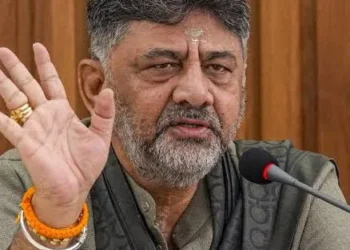
Calling for restraint, the Kuki Inpi Manipur has advised the state government to postpone the Chief Minister’s scheduled visit to Churachandpur, Kangpokpi and other Kuki-Zo areas until conditions become conducive for meaningful dialogue
BY PC Bureau
July 3, 2026: The Kuki Inpi Manipur (KIM), the apex traditional body representing the Kuki tribes in the state, on Friday urged Chief Minister Khemchand to postpone his proposed visit to Kuki-Zo dominated districts, warning that the prevailing security situation remains too volatile for such a high-profile political engagement.
In a strongly worded advisory issued from its headquarters in Lamka (Churachandpur), KIM said that while it appreciated the Chief Minister’s recent visits to other hill districts, the circumstances in Kuki-Zo areas were fundamentally different and demanded greater caution.
The Chief Minister is scheduled to visit Lamka (Churachandpur) on July 4 as part of his outreach to the hill districts.
READL: Myanmar-based Kuki-Zo Outfit Denies Role in Manipur Violence
However, KIM said the proposed visit comes at a time when tensions in Churachandpur, Kangpokpi and Tengnoupal remain unresolved despite months of efforts to restore normalcy following the ethnic violence that has gripped Manipur since May 2023.
“The prevailing situation in Churachandpur, Kangpokpi and Tengnoupal districts stands on a materially different footing,” the organisation said in its statement. “Ground realities in these areas remain highly sensitive and volatile, with underlying tensions yet to be meaningfully addressed or resolved.”
The organisation cautioned that the proposed visit could trigger strong public reactions and inadvertently become a flashpoint, further aggravating an already fragile law and order situation.
“Any such development would be grave and counterproductive to ongoing efforts aimed at restoring peace and normalcy,” the statement said.
KIM advised the Chief Minister to defer the visit until conditions become “demonstrably conducive for a safe, meaningful and constructive engagement with the public.”
The organisation stressed that postponing the visit should not be viewed as opposition to dialogue but as a necessary step to prevent avoidable confrontation and create an atmosphere more conducive to genuine political engagement.
The advisory also carried a broader political message, warning that any initiative perceived as ignoring the aspirations of the Kuki-Zo community—particularly its longstanding demand for a separate administration—could further deepen mistrust between the community and the state government.
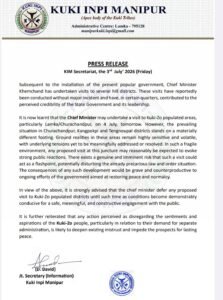
“The sentiments and political aspirations of the Kuki-Zo people must be acknowledged with sincerity,” the statement said, cautioning that actions perceived as dismissive of these concerns could undermine confidence-building measures and delay prospects for a durable political settlement.
KIM noted that the Chief Minister’s recent visits to several other hill districts had been conducted peacefully and had helped improve the government’s credibility in some quarters. However, it maintained that the situation in Kuki-Zo dominated districts could not be viewed through the same lens because of the continuing security concerns and unresolved political grievances.
Signed by D. David, Joint Secretary (Information) of the organisation, the statement urged the state government to prioritise confidence-building and meaningful dialogue before undertaking symbolic political visits to conflict-affected areas.
The appeal comes amid renewed efforts by the Manipur government to restore administrative normalcy across the state, even as ethnic divisions between the Meitei and Kuki-Zo communities continue to hamper reconciliation. Large parts of Churachandpur, Kangpokpi and Tengnoupal remain among the most sensitive districts in Manipur, with civil society organisations maintaining that lasting peace cannot be achieved without addressing the community’s political and security concerns.
The Kuki Inpi Manipur, regarded as the highest traditional and representative body of the Kuki tribes in the state, has consistently maintained that any meaningful peace process must be based on dialogue, justice and political safeguards acceptable to the Kuki-Zo people.