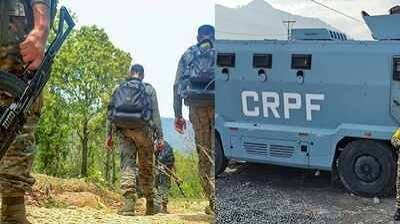
The CRPF has withdrawn a battalion of more than 1,000 personnel from Chhattisgarh’s Maoist-affected Sukma district and redeployed it to Manipur, where ethnic violence that erupted in May 2023 continues to pose a major security challenge.
By PC Bureau
November 16, 2026: The Centre is shifting additional security forces to Manipur as it recalibrates its deployment following the government’s claim that the Maoist insurgency has been eliminated. The Central Reserve Police Force (CRPF) has withdrawn an entire battalion of more than 1,000 personnel from Chhattisgarh’s Maoist-affected Bastar region and redeployed it to Manipur, where ethnic violence that erupted in May 2023 continues to pose a serious security challenge.
The withdrawal marks the first reported movement of a complete Central Armed Police Force battalion out of the Left Wing Extremism (LWE) theatre since the Centre announced in March that armed Maoism had been eliminated from the country.
The battalion was stationed in Sukma district, one of the principal centres of the Maoist insurgency in south Bastar. Its responsibilities had increasingly shifted from direct counter-insurgency operations to de-mining, detecting improvised explosive devices (IEDs) and clearing explosives planted along roads used by civilians.
According to security officials, the CRPF headquarters ordered the redeployment to strengthen the force’s presence in Manipur, where thousands of central security personnel have been deployed since the outbreak of ethnic violence between the Meitei and Kuki-Zo communities.
The latest movement is part of a broader redistribution of central forces towards the Northeast. Earlier, two battalions of the CRPF’s specialised jungle warfare unit, the Commando Battalion for Resolute Action (CoBRA), along with several regular CRPF units and personnel of the Rapid Action Force (RAF), were shifted to Manipur.
The arrival of another full battalion is expected to increase the security forces’ operational capacity. However, officials have also flagged the logistical challenges involved in accommodating additional personnel in a state where central forces are already heavily deployed. Instructions have reportedly been issued to ensure adequate accommodation and other facilities for the incoming troops.
READ: Bilkis Bano Case: SC Suspends Life Sentences of Two Convicts, Grants Bail
Chhattisgarh Security Grid Faces Adjustment
The CRPF has been at the forefront of India’s counter-Maoist campaign for decades. More than one lakh of its personnel have been involved in operations against Left Wing Extremism, with Chhattisgarh accounting for a substantial share of the force’s deployment.
Before the latest withdrawal, more than 25 regular CRPF and CoBRA battalions were stationed in Chhattisgarh, particularly in the Bastar division, which remained the insurgency’s strongest geographical base.
Following the transfer, CRPF headquarters has directed neighbouring units and the Chhattisgarh Police to take over the positions and responsibilities previously handled by the withdrawn battalion.
The move, however, has raised concerns within the state police establishment about the possibility of a temporary gap in the security network.
A senior Chhattisgarh Police officer pointed out that the battalion had been engaged in extensive de-mining and IED disposal operations in Sukma. These activities were particularly important in making roads and routes safe for civilian movement in areas that had witnessed repeated Maoist attacks.
Although the intensity of the insurgency has declined, the presence of landmines and improvised explosive devices continues to pose risks in parts of the former Maoist strongholds.
More Battalions May Be Withdrawn
The redeployment to Manipur could be the beginning of a larger restructuring of central security deployments.
A senior security official indicated that there was a proposal to withdraw at least three more paramilitary battalions from the anti-Naxal theatre in Chhattisgarh and Odisha.
These units could either be moved to Manipur or deployed to strengthen security along India’s international borders with Pakistan and Bangladesh.
The proposed withdrawals reflect the government’s assessment that the improving security situation in former Maoist strongholds has created scope for central forces to gradually hand over operational responsibilities to state police units.
The transition is also intended to allow the CRPF to deploy its manpower in areas facing other security challenges.
Manipur Remains a Major Security Challenge
The redeployment comes as Manipur continues to grapple with the consequences of the ethnic conflict that erupted on May 3, 2023. Despite changes in the state’s political and administrative arrangements and the extensive deployment of central forces, a durable political settlement between the warring communities remains elusive.
The conflict has claimed more than 300 lives, displaced thousands and left large parts of the state divided along ethnic lines. Security personnel continue to face challenges in maintaining law and order, preventing armed attacks and enforcing restrictions on the movement of weapons.
The transfer of another CRPF battalion underlines the Centre’s decision to reinforce its security presence in the state even as it reduces the deployment in the Maoist-affected regions of central India.
The larger question is whether additional manpower can address Manipur’s continuing security crisis without a parallel political process to resolve the underlying ethnic conflict. While the withdrawal from Chhattisgarh signals confidence in the decline of Maoist violence, the growing concentration of central forces in Manipur highlights the continuing difficulties in restoring normalcy in the Northeast.