A string of infrastructure failures across Uttar Pradesh, Uttarakhand, Assam, Himachal Pradesh and Maharashtra has sparked political criticism, public outrage and demands for stricter quality audits. As extreme weather intensifies, experts warn that India must build not just faster—but smarter.
By Navin Upadhyay
July 27, 2026: The southwest monsoon of 2026 has become an unforgiving stress test for India’s rapidly expanding infrastructure network. In just two months—from late May to the end of July—a string of bridge collapses, highway cave-ins, landslides and expressway failures has exposed alarming vulnerabilities in projects that were often inaugurated with great fanfare only months, or even days, earlier.
From Uttar Pradesh to Uttarakhand, Assam to Himachal Pradesh, and Maharashtra to Gujarat, roads have cracked open, bridges have collapsed, and newly constructed infrastructure has failed under the season’s first sustained rains. While extreme weather has undoubtedly played a role, engineers and infrastructure experts argue that the pattern of failures points to deeper structural problems: poor construction quality, inadequate drainage, weak slope protection, lax supervision, corruption in contracting, and a chronic neglect of long-term maintenance.
The consequences have been severe. Lives have been lost, thousands have been stranded, railway and road connectivity has been disrupted across several states, and public confidence in the country’s infrastructure push has taken a serious hit.
India has invested unprecedented sums in highways and bridges over the past decade under flagship programmes such as Bharatmala Pariyojana, the National Infrastructure Pipeline and the PM Gati Shakti initiative. The government has repeatedly showcased these projects as symbols of a modern, fast-growing economy. Yet the 2026 monsoon has revealed that building infrastructure quickly is only half the challenge; building infrastructure capable of surviving increasingly extreme weather may prove to be the greater test.
Tragedy in Uttar Pradesh: Six Workers Killed
The deadliest incident occurred in the early hours of May 29 in Uttar Pradesh’s Hamirpur district.
An under-construction bridge over the Betwa River collapsed during a violent storm, trapping labourers who had taken shelter beneath the structure to escape heavy rain.
Six workers were killed and three others sustained injuries.
District Magistrate Abhishek Goyal said the bridge slab collapsed around 2:30 a.m. while workers were sheltering underneath it. He noted that construction had been underway for nearly two years and that standard safety measures had reportedly been followed.
The tragedy immediately raised uncomfortable questions. Why were workers forced to take shelter beneath an unfinished bridge? Were weather warnings ignored? Did construction standards meet safety norms? Authorities ordered investigations, but the incident highlighted the human cost when infrastructure projects fail before completion.
Chief Minister Yogi Adityanath described the deaths as “extremely sad and heart-wrenching” and announced compensation for the victims’ families.
Northeast Floods Expose Ageing Infrastructure
June brought relentless rainfall across the Northeast, triggering floods and landslides that tested infrastructure built decades ago.
One of the most serious failures occurred in Assam’s Dhemaji district, where a major section of a railway bridge constructed in 1965 collapsed after floodwaters washed away the supporting riverbank.
The Northeast Frontier Railway clarified that the bridge itself had remained structurally sound but became unstable after heavy erosion undermined one of its piers.
Rail traffic between Archipathar and Simen Chapari stations had to be suspended indefinitely, disrupting connectivity across the region.
The collapse came as Assam battled one of its worst flood seasons in recent years, with more than 22,000 people affected in surrounding districts. Floodwaters submerged villages, damaged roads and cut off communities, demonstrating how extreme rainfall can rapidly overwhelm ageing infrastructure that was designed for very different climatic conditions.
A section of the approach road to the newly built ₹16-crore Dehradun–Paonta Sahib Highway bridge collapsed just 17 days after opening, following heavy monsoon rains and rising Tons River waters.#Dehradun #Uttarakhand #BridgeCollapse #Highway #Monsoon #HeavyRain #Infrastructure pic.twitter.com/BiMobS4R42
— Manchh (@Manchh_Official) July 28, 2026
Himachal Bridge Gives Way Under Heavy Vehicle
On June 24, another dramatic bridge collapse occurred in Himachal Pradesh’s Kinnaur district.
A 190-foot Bailey bridge carrying National Highway-5 collapsed while a fully loaded ten-wheel dumper transporting sand attempted to cross.
The truck plunged into the Sutlej River below, although remarkably the driver survived with only minor injuries.
State Revenue Minister Jagat Singh Negi rejected suggestions that the bridge itself was defective. Instead, he argued that the temporary Bailey bridge had a clearly specified weight limit which the overloaded vehicle exceeded.
According to officials, the bridge was unmanned, meaning compliance depended entirely upon drivers following the prescribed restrictions.
The incident nevertheless exposed a recurring challenge across India’s hill states: even structurally adequate infrastructure can become unsafe when enforcement is weak and overloaded commercial vehicles routinely violate regulations.
पुणे में 6 से 7 फीट धंसा नेशनल हाईवे-61#pune #punenews #nh61 #malshejghat #roadcollapse #highway #asiannewsbharat
[Pune Road Collapse, NH 61, Malshej Ghat, Karanjale Village, Ahilyanagar Kalyan Highway, Maharashtra] pic.twitter.com/KCK1tfOpaA
— Asian News Bharat (@Asian_newsBH) July 27, 2026
The Dehradun Bridge That Failed in Just 16 Days
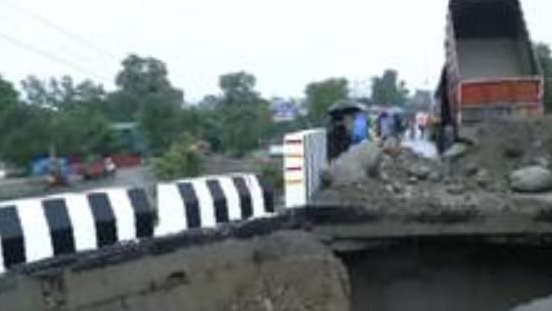
Perhaps no incident generated greater public outrage than the collapse of the approach road to a newly inaugurated bridge in Dehradun on July 28.
The ₹16-crore bridge over the Tons River at Nanda Ki Chowki, linking Prem Nagar with the Dehradun–Paonta Sahib Highway, had been inaugurated only on July 12.
Barely sixteen days later, a massive crater appeared beside the bridge after overnight rainfall washed away the soil supporting the approach road.
Videos showing the enormous sinkhole quickly spread across social media, prompting widespread criticism and ridicule.
District Magistrate Ashish Chauhan attempted to reassure the public by emphasising that the bridge’s main structure remained safe and that only the approach road had collapsed. Restoration work began immediately, with officials prioritising reopening traffic.
Public Works Department Secretary Pankaj Kumar Pandey attributed the damage to severe scouring caused by floodwaters changing direction during heavy rainfall. According to officials, erosion beneath multiple layers of soil and road-building material caused the approach section to cave in while leaving the bridge itself intact.
Opposition parties were unconvinced.
Congress leader Sangram Singh Pundir demanded a CBI investigation, arguing that it was unacceptable for infrastructure costing ₹16 crore to suffer such extensive damage less than three weeks after inauguration.
Regardless of whether the bridge structure itself was compromised, the episode became a powerful symbol of public scepticism about construction quality and accountability.
Expressways Also Came Under Pressure
Bridge failures were only part of the wider story. Several of India’s flagship expressways experienced significant monsoon-related disruptions.
Mumbai-Pune Expressway
Heavy rainfall during the first week of July triggered a large landslide near Tunnel 2 on the newly inaugurated Missing Link project, valued at approximately ₹6,695 crore. Traffic had to be diverted for nearly eighteen hours while debris was cleared. The incident revived concerns over slope stabilisation, retaining structures and geological assessments in mountainous terrain.
Ganga Expressway
In Uttar Pradesh, portions of a link road connected to the under-construction Ganga Expressway reportedly developed cave-ins following the first major spells of rain near Unnao. Although repairs were undertaken quickly, the damage fuelled criticism regarding drainage planning and soil compaction.
Delhi-Dehradun Expressway
Sections of the Delhi-Dehradun Expressway also witnessed potholes, erosion and surface failures after heavy rainfall, raising questions about pavement durability under monsoon conditions.
READ: CBI Chargesheets 13 in NEET-UG Paper Leak Case
Waterlogging Across National Highways
Elsewhere, prolonged waterlogging affected stretches of National Highway-51 in Gujarat, several roads in Delhi-NCR and other important corridors.
Although flooding is often blamed on unusually intense rainfall, urban planners argue that inadequate drainage design frequently turns heavy rain into infrastructure failure.
Infrastructure Failures Turn Into a Political Flashpoint
As videos of damaged bridges and washed-out highways spread across the country, infrastructure failures quickly became a political issue.
Opposition parties argued that the incidents reflected a growing gap between ambitious infrastructure announcements and the quality of execution on the ground. They accused governments of prioritising rapid inaugurations over engineering standards and independent quality audits.
The controversy widened after potholes and cave-ins appeared on stretches of the Delhi–Dehradun Expressway during the first heavy rains. Congress national spokesperson Dr Shama Mohamed questioned the quality of construction, writing on social media: “What more proof of corruption do we need? It is open loot and plunder in every department.”
The National Highways Authority of India (NHAI) rejected suggestions of structural failure, explaining that the affected stretch involved temporary waterlogging before permanent drainage infrastructure had been fully commissioned. Officials said repair work was completed promptly and insisted that the expressway remained structurally safe.
While opposition leaders demanded greater accountability, engineers cautioned against drawing sweeping conclusions from individual failures. They argued that each incident required independent technical investigation to distinguish between construction defects, maintenance lapses, design shortcomings and the impact of increasingly intense rainfall events.
Social Media Delivers a Harsh Verdict
If political leaders questioned accountability, social media delivered ridicule.
The Dehradun bridge became one of the country’s most discussed infrastructure stories, with videos of the collapsed approach road attracting millions of views across X, Facebook and Instagram. Users coined the phrase “₹16 crore, 16 days” to mock the project’s remarkably short lifespan, while memes compared the bridge’s durability to disposable consumer products.
Across platforms, citizens questioned whether some public works were being inaugurated for political optics rather than after rigorous engineering validation. Hashtags such as #BridgeCollapse, #InfrastructureFail, #MonsoonAudit, #QualityMatters, and #TaxpayersMoney trended intermittently as fresh images of damaged highways and flooded roads surfaced from different states.
Civil engineers, architects and urban planners also entered the debate, arguing that public discussion should move beyond assigning blame after every collapse. Many stressed that India’s infrastructure standards must evolve to account for more intense rainfall linked to climate change, with stronger drainage systems, better slope stabilisation and more rigorous third-party quality inspections.