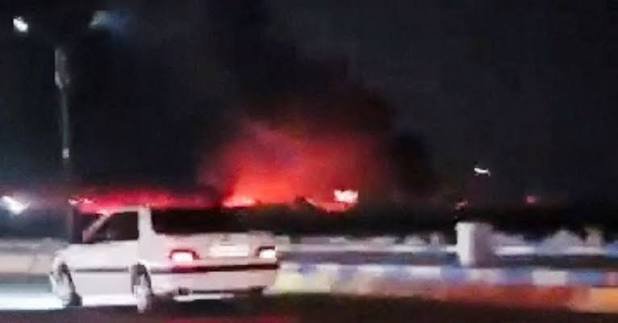
Iran’s retaliation came hours after the United States launched its biggest airstrikes since the April ceasefire, targeting more than 80 Iranian military sites following attacks on commercial ships in the Strait of Hormuz.
BY PC Bureau
July 8, 2026: The fragile ceasefire between the United States and Iran teetered on the brink of collapse on Wednesday after Tehran claimed it had launched coordinated missile and drone attacks against 85 US military installations in Bahrain and Kuwait, marking one of the most serious escalations since the two sides agreed to halt hostilities in April.
The claimed retaliation came just hours after the United States carried out its largest military operation against Iran since the ceasefire, launching precision airstrikes on more than 80 Iranian military targets along the Persian Gulf coast. Washington said the strikes were in direct response to Iranian attacks on three commercial vessels transiting the Strait of Hormuz, one of the world’s most strategically important maritime chokepoints.
The rapid exchange of military action has raised fears that the hard-won ceasefire could collapse entirely, pushing the region back toward full-scale conflict.
Iran has Fired BALLISTIC MISSILES Toward the U.S. Base in Bahrain
Reports of EXPLOSIONS at the U.S. Fifth Fleet Base and Al-Isa Airbase in Bahrain
This is in retaliation for the U.S. strikes on southern Iran.
CENTCOM completed a new round of offensive strikes against Iran,… https://t.co/2ATffvVcKs pic.twitter.com/EqmcCwVBKu
— Ryan Rozbiani (@RyanRozbiani) July 8, 2026
Iran Claims Retaliatory Strikes
Iranian state media said the Islamic Revolutionary Guard Corps (IRGC) targeted US military facilities in Bahrain and Kuwait in retaliation for American airstrikes and Washington’s decision to tighten sanctions on Iranian oil exports.
The attacks allegedly struck 85 US military sites, although neither the Pentagon nor authorities in Bahrain and Kuwait immediately confirmed the scale of the assault.
Bahrain, which hosts the headquarters of the US Navy’s Fifth Fleet, activated nationwide missile warning sirens multiple times during the morning, urging residents to immediately move to designated shelters.
Emergency authorities also issued public alerts advising citizens to remain indoors until further notice.
No confirmed reports of casualties or significant damage were immediately available from either Bahrain or Kuwait.
US military officials said they were assessing the situation but declined to comment on Iranian claims regarding the number of targets struck.
US Says Strikes Were Meant to Cripple Iran’s Military Capability
The latest Iranian retaliation followed a sweeping US air campaign targeting Iranian military infrastructure in Bandar Abbas, Sirik, Qeshm Island and other strategic locations along the Strait of Hormuz.
US Central Command said the operation targeted air defence systems, anti-ship missile batteries, coastal surveillance radars, drone launch sites, command-and-control facilities and dozens of fast attack boats belonging to the IRGC Navy.
American officials described the operation as an effort to prevent further attacks on international shipping and reduce Iran’s ability to interfere with commercial navigation through the Strait of Hormuz.
Washington also announced fresh restrictions on Iranian oil exports, accusing Tehran of using crude sales to finance military operations across the region.
US officials said the combined military and economic measures were intended to deter further Iranian aggression rather than trigger a broader war.
Funeral of Khamenei Overshadowed by Renewed War
The latest military escalation unfolded as millions of Iranians continued participating in state funeral ceremonies for former Supreme Leader Ayatollah Ali Khamenei, who was killed on February 28 during the opening phase of the US-Iran conflict.
The funeral, one of the largest public gatherings in Iran in decades, was expected to conclude on Thursday with Khamenei’s burial in Mashhad.
Rather than providing an opportunity for de-escalation, the ceremonies have become a platform for anti-American sentiment, with mourners repeatedly chanting slogans calling for the deaths of US President Donald Trump and Israeli Prime Minister Benjamin Netanyahu.
Iranian leaders have vowed to continue resisting what they describe as American and Israeli aggression.
Diplomatic Talks Face Collapse
Before the latest exchange of strikes, diplomats from both countries had been expected to resume negotiations following Khamenei’s burial.
The proposed talks were expected to focus on reopening the Strait of Hormuz to unrestricted commercial shipping, easing sanctions, and reviving discussions over Iran’s nuclear programme.
Those diplomatic efforts are now in serious jeopardy.
Officials in both Washington and Tehran have accused each other of violating the recently signed memorandum of understanding that temporarily halted military operations.
Analysts warn that continued retaliation by either side could effectively end any remaining prospects for diplomacy.
Shipping Crisis Deepens
The latest escalation follows attacks on three commercial vessels near the Strait of Hormuz earlier this week.
According to maritime security agencies, projectiles struck an LNG carrier and two oil tankers operating near Omani and UAE waters, causing fires aboard one vessel and minor damage to the others.
Although no casualties were reported, the incidents have renewed concerns about the safety of one of the world’s busiest energy corridors.
Nearly one-fifth of global seaborne crude oil and liquefied natural gas exports pass through the Strait of Hormuz, making any disruption a major threat to international energy supplies and global markets.
Trump Questions NATO Support
Adding another layer of uncertainty, President Donald Trump publicly criticised NATO allies over what he described as their inadequate support during the latest confrontation with Iran.
Speaking alongside Turkish President Recep Tayyip Erdoğan ahead of the NATO summit in Ankara, Trump said the crisis had served as a test of alliance solidarity.
The remarks reflected Trump’s longstanding criticism that NATO members rely excessively on US military power while contributing insufficiently to collective security.
READ: US Pounds 80 Iranian Military Targets as Gulf Crisis Spirals
Regional Conflict Expands
The confrontation comes amid an increasingly volatile Middle East, where multiple conflicts continue to overlap.
Israel remains engaged in military operations against Iran-backed groups across the region, while Hezbollah, Hamas, Iraqi militias and Houthi forces continue to pose security challenges.
Gaza remains engulfed in a humanitarian crisis, Lebanon is pursuing a US-backed security arrangement with Israel, and European governments are debating additional diplomatic and economic measures related to the conflict.
With missile exchanges now extending beyond Iran and Israel to US military installations across the Gulf, security analysts warn that the region faces its gravest risk of a wider regional war since hostilities erupted earlier this year.
The coming hours are expected to be critical as Washington assesses Iran’s claimed attacks, regional militaries remain on high alert, and diplomatic channels struggle to prevent another full-scale conflict in the Middle East.