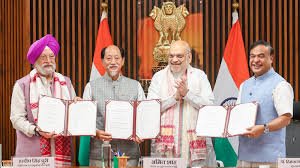
Vast untapped reserves, improved political cooperation and renewed investor interest are fuelling optimism about the Northeast’s oil prospects.
BY PC Bureau
June 12, 2025: The tripartite agreement between the Centre, Assam and Nagaland to facilitate oil and gas exploration in disputed border areas has rightly been seen as a political breakthrough. But it could also mark the beginning of a new chapter in India’s energy story.
By removing one of the biggest obstacles to exploration in the Assam-Nagaland border belt, the pact has revived interest in a region that launched India’s petroleum industry but has remained vastly underexplored for decades.
The question now is whether Northeast India can once again emerge as a significant contributor to the country’s energy security.
Where India’s Oil Story Began
The Digboi oilfield, discovered in 1889, established Assam as the cradle of India’s petroleum industry. The refinery commissioned there in 1901 continues to operate, a reminder of the region’s pioneering role in India’s energy landscape.
For much of the twentieth century, Assam stood at the heart of India’s onshore oil production. Oilfields in Digboi, Naharkatia, Moran and Lakwa became symbols of economic progress and industrial development.
Yet even as production continued, vast stretches of the Northeast remained untouched.
The reasons were many: difficult topography, dense forests, inadequate infrastructure, insurgency, environmental concerns and unresolved inter-state disputes. Exploration became expensive, risky and politically sensitive.
The result was an extraordinary contradiction. India’s oldest oil-producing region also became one of its least explored.
READ: Celebrated Shooting Coach Jaspal Rana Passes Away at 49
The Hidden Treasure Beneath
Ask geologists about the Northeast, and they speak with a mix of excitement and frustration.
Excitement because few regions in India possess comparable geological potential.
Frustration because much of that potential remains locked underground.
The Assam-Arakan Basin—spanning Assam, Nagaland, Arunachal Pradesh, Tripura, Mizoram and parts of Manipur—is considered one of India’s richest sedimentary basins. Together with the Upper Assam Shelf, it is estimated to contain prognosticated hydrocarbon resources of around 5,040 million tonnes of oil equivalent (MMTOE).
Only about 44 per cent of this estimated resource base has so far been converted into established reserves.
In other words, more than half of the Northeast’s petroleum wealth may still be waiting to be discovered.
The implications are enormous.
At a time when India imports nearly 85 per cent of its crude oil requirements, every domestic discovery carries strategic significance. The Northeast could emerge as an important piece in India’s energy security puzzle.
Among the most intriguing prospects lies the Naga Schuppen Belt, a complex geological formation stretching along the Assam-Nagaland border.
To petroleum explorers, it is one of India’s most promising frontiers.
The fold-and-thrust structures of the Schuppen Belt are believed to possess ideal conditions for trapping hydrocarbons. Natural oil and gas seepages have been documented in the area for decades, but prolonged boundary disputes discouraged investment and delayed drilling activity.
The result was that one of India’s most promising hydrocarbon prospects remained largely untapped.
A Pact That Could Change Everything
The June 2026 agreement between the Centre, Assam and Nagaland may finally alter that trajectory.
By agreeing to a 50:50 revenue-sharing framework in the Disputed Area Belt, both states have chosen economic cooperation over prolonged deadlock. It is a rare example of development-driven federalism.
The pact does not settle the constitutional boundary dispute. Instead, it creates a practical mechanism that allows exploration and production activities to proceed while larger legal questions continue to be addressed.
Its significance cannot be overstated.
Oil exploration is a long-term business that demands stability. Investors seek clarity. Drilling programmes require years of planning and billions in capital expenditure.
The agreement offers something the region has lacked for decades: predictability.
Officials estimate that output from the disputed belt, currently around 1,000 to 1,500 barrels per day, could increase substantially if full-scale exploration resumes. A major commercial discovery could generate thousands of crores in revenue and alter the economic profile of some of the region’s least industrialised districts.
Beyond the Barrel
For the Northeast, the significance of oil extends beyond royalty payments and production targets.
Hydrocarbon development has the potential to generate skilled employment, improve connectivity and create demand for a range of ancillary industries—from logistics and engineering services to hospitality and training institutes.
Roads could be upgraded. Warehousing and transport networks could expand. Local businesses could benefit from increased economic activity.
In a region where industrialisation has often lagged behind the rest of the country, the economic multiplier effect could be substantial.
The Northeast’s strategic location as India’s gateway to Southeast Asia adds another dimension. Energy infrastructure developed today could complement wider trade and connectivity initiatives under the Act East Policy.
A successful hydrocarbon sector could support, rather than compete with, emerging sectors such as tourism, agriculture and cross-border commerce.
A historic tripartite MoU has been signed by Govt. of India, Govt. of Assam and Govt. of Nagaland ending a decades-long dispute in the Northeast and opening way for oil & gas exploration in the region. It stands out as an exemplar of India’s unity, where both the states give up… pic.twitter.com/1x7vfGnoKS
— Amit Shah (@AmitShah) June 12, 2026
The Challenges
Yet optimism must be tempered with realism.
The Northeast is ecologically fragile and culturally diverse. Its forests are biodiversity hotspots. Its rivers sustain millions. Land ownership patterns are often community-based and deeply intertwined with identity and tradition.
Any conversation about oil must therefore answer difficult questions.
How will local communities participate in decision-making?
Will they receive a fair share of the economic benefits?
Can exploration proceed without compromising environmental safeguards?
Will lessons be learned from extractive industries elsewhere in the world?
There are technical challenges too.
The geology of fold belts is notoriously difficult. Exploration costs are high, drilling risks substantial and seismic interpretation complex. Mature oilfields in Assam require enhanced recovery techniques to sustain output.
Even under favourable conditions, the journey from seismic surveys to commercial production can take years.
There are no guarantees in the oil business.
A Second Chance
And yet, moments such as these are rare.
For perhaps the first time in decades, politics, geology and economics appear to be aligned.
The Northeast is no longer being discussed merely as a region of untapped potential. It is increasingly being viewed as an active participant in India’s future energy strategy.
Public sector giants such as ONGC and Oil India Limited are expected to deepen their engagement, while private players may revisit prospects once considered too complicated to pursue.
More than a century after Digboi announced India’s arrival in the petroleum age, the Northeast stands at another crossroads.
Whether the latest opening leads to a genuine energy renaissance will depend not just on what lies beneath the ground, but on the choices governments, companies and communities make above it.
The oil may already be there. The harder task will be ensuring that its benefits endure long after the wells stop flowing.