The BCI said most students were “innocent” and should not suffer for the controversy surrounding their opposition to the reported invitation of CJI Surya Kant as NALSAR’s convocation chief guest.
BY PC Bureau
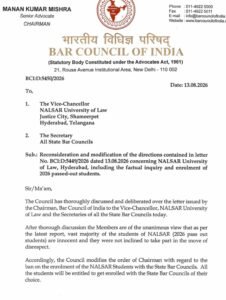
August 13, 2026: The Bar Council of India (BCI) on Thursday withdrew an order that had temporarily barred NALSAR University of Law’s 2026 graduating batch from enrolling with State Bar Councils, bringing a dramatic reversal to a controversy triggered by students’ opposition to the reported invitation of Chief Justice of India Surya Kant as chief guest for the university’s convocation.
The BCI’s decision came within hours of its earlier directive, which had said that no student graduating from NALSAR in 2026 could be enrolled as an advocate by any State Bar Council “till further orders.”
In its fresh communication, the BCI said all NALSAR students graduating in 2026 would be free to enrol with the State Bar Council of their choice. It stressed that students should not suffer “without any fault on his part” and said the matter itself had not been closed.
The Council said it would await an inquiry report from the NALSAR Vice-Chancellor before deciding whether any further action was warranted.
BCI says most students were not involved
The reversal followed an emergency discussion within the BCI after members reviewed the chairman’s earlier communication. The Council said the overwhelming majority of the 2026 graduating batch were “innocent” and had not supported any attempt to show disrespect.
The BCI nevertheless alleged that “a handful of teachers and outsiders” had instigated students. It did not identify those individuals and said the Vice-Chancellor’s inquiry would determine the facts.
The initial enrolment ban had triggered sharp criticism, with concerns that it could directly affect the professional careers and placements of students who were not personally involved in the controversy.
What triggered the dispute?
The controversy began after more than 450 students from NALSAR’s 2026 batch submitted a representation to the Vice-Chancellor, Registrar and other university authorities, asking them to reconsider the reported proposal to invite CJI Surya Kant as chief guest for the convocation.
The students acknowledged that neither the convocation date nor the choice of chief guest had been formally finalised. They said their representation was intended to record their concerns in advance.
Their objection centred on recent judicial proceedings involving the CJI. The students referred in particular to a July 23, 2026 hearing concerning alleged police action against protesters during a Parliament march from Delhi’s Jantar Mantar on July 20.
According to the students’ representation, the CJI declined to view video material relating to alleged police excesses, with the students attributing to him the remark that he was “not interested in videos” and did not have time to watch them. They also alleged that counsel’s submissions were curtailed.
The students further raised concerns over remarks they attributed to the CJI comparing Indian youth to “cockroaches.”
READ: Congress Demands PM Address Reports of Chinese Incursion
Students say objection was about constitutional values
The students stressed that their objection was not directed at the institution of the Chief Justice of India or the judiciary as a whole.
Instead, they argued that a law university had a responsibility to consider whether the conduct of a proposed convocation guest was consistent with the constitutional values it teaches—particularly access to justice, reasoned consideration of grievances and respect for citizens’ rights.
They argued that accepting degrees from a dignitary whose reported conduct appeared, in their view, dismissive of allegations of police brutality would conflict with the principles they had been taught at NALSAR.
The BCI’s initial decision to suspend their enrolment rights escalated the controversy, but Thursday’s subsequent withdrawal means that the 2026 graduates will not face an immediate bar on joining the legal profession.
The Council has, however, kept the larger issue open pending the NALSAR Vice-Chancellor’s inquiry, leaving the possibility of further action once the report is submitted.