Vijay’s Tamilaga Vettri Kazhagam secured support from Congress, VCK, Left parties, and IUML to cross the majority mark in the Assembly. Thousands of TVK supporters gathered across Chennai as Vijay took oath amid high security and a festive atmosphere.
BY PC Bureau
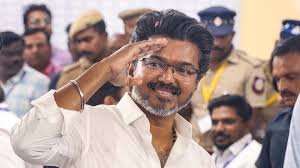
May 10, 2026: In a historic moment that has dramatically reshaped Tamil Nadu’s political landscape, Chandrasekar Joseph Vijay — popularly known as “Thalapathy” Vijay and founder-president of Tamilaga Vettri Kazhagam (TVK) — was sworn in as the Chief Minister of Tamil Nadu on Sunday, May 10, 2026.
The grand ceremony, held at Chennai’s Jawaharlal Nehru Stadium amid massive public celebrations, marked the end of nearly six decades of uninterrupted dominance by the Dravidian heavyweights — the Dravida Munnetra Kazhagam (DMK) and the All India Anna Dravida Munnetra Kazhagam (AIADMK). Vijay now leads Tamil Nadu’s first non-DMK and non-AIADMK government since the late 1960s, signalling a profound political realignment in the state.
The 51-year-old actor-turned-politician took the oath of office and secrecy alongside nine senior leaders from his party in the presence of thousands of jubilant supporters, political leaders, film personalities, and invited dignitaries. Tamil Nadu Governor Rajendra Vishwanath Arlekar administered the oath.
Congress leader Rahul Gandhi attended the ceremony and shared the stage with Vijay, underlining the Congress party’s crucial support in the post-poll coalition. Actor Trisha, widely seen as a close associate of Vijay and an influential figure within TVK circles, was also present at the event, adding to the star-studded atmosphere surrounding the swearing-in.
A Hard-Fought Path to Power
Vijay’s rise to the Chief Minister’s office followed nearly a week of intense political negotiations, multiple meetings with the Governor, and frantic efforts to secure the numbers required to prove majority support in the 234-member Tamil Nadu Assembly.
TVK emerged as the single-largest party in the April 2026 Assembly elections, winning 108 seats in a stunning debut for a party that was launched barely two years ago. However, the party fell short of the 118-seat majority mark on its own, forcing Vijay to seek post-poll alliances.
After days of negotiations, TVK secured the backing of the Congress, Viduthalai Chiruthaigal Katchi (VCK), Communist Party of India (CPI), Communist Party of India (Marxist) (CPI-M), and the Indian Union Muslim League (IUML). Together, the coalition commands the support of around 120 MLAs, giving Vijay a slender but workable majority.
#BREAKING | TVK Chief C. Joseph Vijay takes oath as the new Chief Minister of Tamil Nadu in a historic move.
Vijay is the first chief minister belonging to a non-Dravidian party since 1967 pic.twitter.com/HRwWw1HiA1
— WION (@WIONews) May 10, 2026
Vijay himself won from two constituencies — Perambur in Chennai and Tiruchirapalli East — and is expected to vacate one seat in accordance with election norms.
The Governor had initially declined to invite Vijay to form the government, citing insufficient proof of majority. Vijay reportedly met Raj Bhavan four times within five days before finally presenting the required letters of support, ending the post-election uncertainty.
Breaking Tamil Nadu’s Political Duopoly
The formation of the TVK-led government represents one of the most significant political developments in Tamil Nadu since 1967, when the Congress lost power and Dravidian parties began their uninterrupted dominance of state politics.
For nearly 60 years, power alternated almost exclusively between the DMK and AIADMK. Vijay’s victory has shattered that duopoly and opened a new chapter in Tamil Nadu’s political history.
Many political observers have drawn comparisons between Vijay and legendary actor-politician M.G. Ramachandran (MGR), who used his cinematic popularity to build the AIADMK into a formidable political force decades ago. Like MGR, Vijay leveraged an enormous fan following, carefully cultivated mass appeal, and a strong emotional connection with voters to transition from cinema into politics.
From Superstar to Statesman
Born on June 22, 1974, Vijay is the son of veteran filmmaker S.A. Chandrasekhar. Before entering politics, he was among the biggest stars in Tamil cinema, known for blockbuster films, mass appeal, and a fiercely loyal fan base that affectionately referred to him as “Thalapathy,” meaning commander.
In February 2024, Vijay formally announced his decision to quit films and focus entirely on politics, launching Tamilaga Vettri Kazhagam with promises of clean governance, social justice, anti-corruption measures, youth empowerment, employment generation, and inclusive development.
TVK campaigned aggressively across the state, particularly targeting young voters and first-time electors. The party positioned itself as a fresh alternative to traditional Dravidian politics, accusing both the DMK and AIADMK of corruption, dynastic politics, and governance fatigue.
The strategy yielded remarkable results. TVK secured nearly 35% vote share in its very first Assembly election, while the DMK was reduced to 59 seats and the AIADMK to 47 seats.
Outgoing Chief Minister M.K. Stalin has reportedly assured constructive opposition, acknowledging the public mandate for political change.
Celebrations Across Chennai
The swearing-in ceremony unfolded amid extraordinary scenes of celebration across Chennai and several other parts of Tamil Nadu. Thousands of TVK workers gathered outside the Jawaharlal Nehru Stadium waving party flags, bursting firecrackers, dancing to Vijay’s film songs, and chanting slogans in support of their leader.
Heavy security arrangements were put in place around the venue due to the massive turnout. Traffic movement in several central areas of Chennai was disrupted for hours as supporters thronged the streets to witness what many described as a “historic transition.”
Vijay, dressed in traditional white attire, received a thunderous reception as he arrived at the venue. Cultural performances celebrating Tamil pride and unity preceded the oath-taking ceremony, transforming the event into both a political and emotional spectacle.
READ: Gujarat Sailor Killed After Indian Dhow Sinks in Hormuz
Challenges Before the New Government
Despite the celebratory mood, Vijay’s government faces formidable challenges ahead.
The coalition’s majority remains relatively narrow, meaning the new administration will need to carefully manage alliances with ideologically diverse partners. Maintaining unity among coalition members could prove difficult over time, especially on issues related to social justice, language politics, federalism, and Centre-state relations.
The government is also expected to confront pressing economic and social challenges, including unemployment, industrial growth, inflation, urban infrastructure, education reforms, healthcare expansion, and rural distress.
Questions also remain about administrative experience within the new leadership. Critics argue that translating electoral popularity into effective governance will be Vijay’s biggest test.
Political analysts are closely watching the composition of the new Cabinet, which is expected to include first-time legislators, women leaders, and representatives from marginalised communities. TVK treasurer P. Venkataramanan and several young leaders are believed to be frontrunners for key portfolios.
A Defining Political Moment
Vijay’s swearing-in marks far more than a routine change of government. It reflects the evolving nature of Indian democracy, where celebrity influence, social media mobilisation, anti-incumbency sentiment, and youth-driven politics can combine to disrupt long-established political structures.
For millions of supporters who grew up watching Vijay as a cinematic hero, Sunday’s oath ceremony symbolised the merging of reel-life charisma with real political power.
Whether Vijay can successfully transform that emotional connection into long-term governance success remains to be seen. But for now, Tamil Nadu has entered an entirely new political era — one that could redefine the future of Dravidian politics and reshape the state’s power structure for years to come.