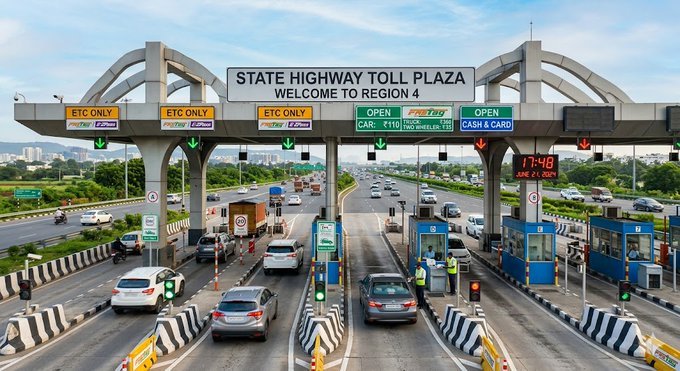
The introduction of tolls on Bihar’s state highways has added to public resentment, with many questioning why citizens are paying more despite repeated promises of welfare and relief.
By Navin Upadhyay
The reality check has arrived for Bihar’s voters. Eight months after returning the BJP-JD(U) government to power, the promises of prosperity and relief are colliding with rising costs and unfulfilled commitments. The introduction of tolls on state highways is the latest reminder that the promised heaven has receded, leaving many voters wondering whether they were taken for a ride.
Schemes that were projected as transformative—from financial assistance for women entrepreneurs to free electricity—have failed to deliver the relief voters expected. The latest decision to impose tolls on state highways has only reinforced the perception that while promises came easily, the burden ultimately falls on ordinary citizens.
Taken individually, each government initiative can be defended as a policy decision. Viewed together, however, they reveal a troubling pattern: generous announcements followed by partial implementation, hidden costs, or fresh financial burdens. The result is a growing sense among many Biharis that they have been taken for a ride.
READ: Assam Rifles Ambush: Finger Points to Naga Militants
The Missing ₹2 Lakh Promise
One of the NDA government’s most publicised commitments was its pledge to economically empower women.
Nearly 2.5 crore women were provided ₹10,000 each to start small businesses and income-generating activities. The scheme was widely celebrated as a landmark initiative for women’s empowerment.
But the government had also made another promise. Women who successfully established enterprises would receive ₹2 lakh as financial support to expand their businesses.
That promise remains largely invisible.
Months after the government completed a year in office, there is little evidence that women have actually received the promised ₹2 lakh assistance on any meaningful scale. Thousands of beneficiaries who started small ventures continue to struggle with inadequate capital, while the government’s flagship promise appears to have quietly disappeared from public discourse.
For many, the initial grant became little more than seed money without the promised institutional support needed to build sustainable businesses.
Free Electricity That Isn’t Really Free
The government’s announcement of 125 units of free electricity generated enormous goodwill.
However, the benefit has been substantially offset by changes in the tariff structure.
Electricity consumed during peak hours—from 5 p.m. to 10 p.m.—is charged at significantly higher rates, reportedly touching ₹10 per unit. Since this is the period when most households consume the maximum electricity, the revised pricing has pushed up monthly bills for many consumers.
The result is a contradiction that many households find difficult to understand. While the government advertises free electricity, consumers often end up paying higher bills because of increased peak-hour tariffs.
The policy may make commercial sense from the perspective of demand management, but politically it has diluted one of the government’s most visible promises.
Another Burden: Toll Tax on State Highways
The latest source of public resentment is the introduction of toll collection on Bihar’s state highways.
The new policy allows:
- A ₹250 monthly local pass for residents living within 20 kilometres of a toll plaza.
- A ₹2,500 statewide monthly pass for unlimited travel on all state toll roads.
- Exemptions for tractors and certain categories of government functionaries.
- Partial exemption for motorcycles.
While these concessions may reduce costs for frequent users, they do not change the larger reality that Bihar’s motorists are now being asked to pay to use roads that had historically remained toll-free.
For transporters, traders, daily commuters and ordinary travellers, the policy adds yet another recurring expense at a time when inflation has already increased the cost of living.
Facing mounting public criticism, Chief Minister Samrat Choudhary has clarified that the proposed highway toll will apply only to commercial vehicles. But this offers little comfort. After all, who owns and operates these vehicles? They carry vegetables, grains, construction material, medicines and consumer goods across Bihar. Transporters will inevitably factor the additional toll into freight charges, traders will pass on the higher costs, and consumers will pay more at the marketplace. In economic terms, the burden of the toll is unlikely to remain confined to commercial operators; it will eventually be borne by the people of Bihar through higher prices.
“सफेद नंबर प्लेट वालों को टोल नहीं देना होगा…” CM सम्राट चौधरी ने किया बड़ा ऐलान।
मुख्यमंत्री सम्राट चौधरी ने स्पष्ट किया कि बिहार में निजी (सफेद नंबर प्लेट) वाहनों से कोई टोल टैक्स नहीं लिया जाएगा।
उन्होंने कहा कि टोल टैक्स केवल पीले नंबर प्लेट वाले व्यावसायिक (कमर्शियल)…
— Harsh Vardhan (@imharshvdhan) July 7, 2026
There has been no significant progress towards the promised one crore jobs and employment opportunities, nor has the government rolled out its ambitious pledge of free education from KG to PG for poor students. The promised ₹1 lakh crore investment in agricultural infrastructure has yet to translate into visible projects on the ground, while the target of constructing 50 lakh new pucca houses remains far from realization.
Similarly, there is no evidence of a statewide skill census to map employment opportunities, Mega Skill Centres in every district, or the establishment of modern manufacturing units and ten industrial parks as promised in the election manifesto. Even the flagship promise of 125 units of free electricity has been overshadowed by higher peak-hour tariffs, prompting criticism that the relief has been substantially diluted.
Revenue Generation Disguised as Welfare?
These developments have fuelled speculation about the state’s fiscal health.
Bihar’s welfare commitments have expanded significantly, but the government’s own revenue resources remain limited. As expenditure rises, the administration appears to be relying increasingly on indirect revenue measures—higher electricity charges during peak hours and user fees such as highway tolls.
While governments are entitled to recover the cost of infrastructure and improve financial sustainability, the contradiction becomes politically significant when revenue-raising measures accompany claims of expanding welfare.
Citizens begin to ask whether they are ultimately paying for the benefits that are being presented as government largesse.
The Growing Credibility Gap
Perhaps the bigger issue is not the individual schemes but the widening gap between promises and delivery.
The ₹10,000 grant reached women, but the promised ₹2 lakh expansion support remains elusive.
Free electricity came with higher peak-hour tariffs.
Infrastructure development has now been accompanied by toll collection on state roads.
None of these measures, in isolation, may provoke widespread anger. Together, however, they create the impression that every promise comes with hidden conditions.
A Government Under Pressure
The Nitish Kumar-led NDA government has long built its political identity around governance and welfare. But one year into its new term, it faces a credibility challenge.
People judge governments not by announcements but by outcomes. Welfare schemes create lasting political goodwill only when commitments are fulfilled in full—not when they are diluted by subsequent policy changes or quietly abandoned.
The introduction of tolls, rising electricity costs and the apparent failure to honour the ₹2 lakh promise to women entrepreneurs have collectively raised uncomfortable questions about governance, fiscal management and accountability.
For many in Bihar, the issue is no longer whether the government made ambitious promises. It is whether those promises have translated into meaningful improvements in people’s lives—or whether voters were persuaded by assurances that have yet to materialise.