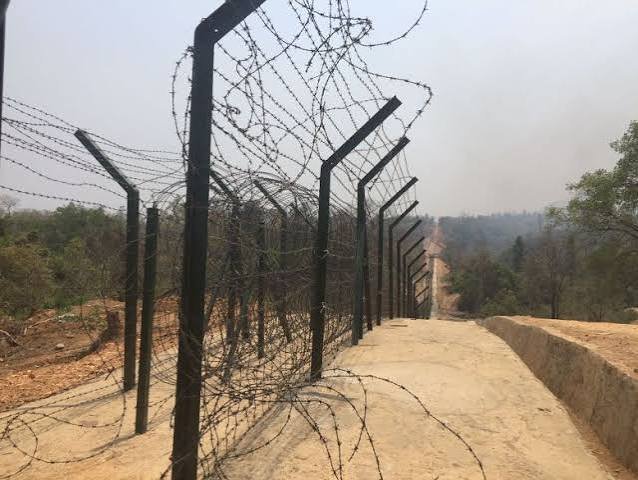
Calling the Centre’s move to scrap the Free Movement Regime “anti-Naga”, the NSCN (IM) has urged village chiefs and landowners to resist attempts to fence what it considers the Naga homeland.
BY PC Bureau
August 16: The proposed fencing of the India-Myanmar border has reopened a deep fault line in Nagaland, with the NSCN (IM) warning that any physical barrier erected across Naga-inhabited areas would further divide communities that have maintained social, cultural and familial ties across the international boundary for generations.
In a notification issued on August 15, NSCN (IM) Yaruiwo Q. Tuccu reiterated the organisation’s opposition to fencing through what it describes as Naga territory. The group said Nagas retain an inherent right to move freely across their ancestral homeland and maintained that an international boundary should not be allowed to sever traditional relationships between villages and families.
The NSCN (IM) also opposed the Centre’s decision to end the Free Movement Regime (FMR) with Myanmar, describing the move as “anti-Naga”. It argued that restrictions on cross-border movement would weaken longstanding cultural and social links among Naga communities living on both sides of the India-Myanmar boundary.
The organisation said the Naga people had maintained close links across the region long before modern international boundaries were imposed. According to the notification, border pillars subsequently divided communities that historically regarded themselves as part of one social and cultural continuum.
“Nagas are one wherever they are,” the notification said, while asserting that Nagas living in their traditional areas should not be treated as illegal immigrants merely because an international boundary now runs through their homeland.
Why the India-Myanmar border is so sensitive
The India-Myanmar border stretches for about 1,643 km through Arunachal Pradesh, Nagaland, Manipur and Mizoram. Unlike India’s heavily fortified western and eastern frontiers, much of this boundary has historically remained difficult to police because of its mountainous, forested terrain and the close relationship between communities on either side.
The boundary also cuts through areas inhabited by ethnic groups whose communities predate the modern borders of India and Myanmar. In Nagaland, for instance, the international boundary passes through Longwa village in Mon district, where the traditional village chief’s house has famously stood across the border. Similar cross-border ethnic and familial connections exist among communities in Manipur and Mizoram.
It is this historical reality that has made the Centre’s fencing plan particularly contentious in the Northeast.
The NSCN (IM) said it had no objection to fencing in other stretches if the objective was to combat illegal immigration, arms trafficking or other security threats. But it insisted that Naga-inhabited areas should not be fenced or partitioned in the name of national security.
The group also rejected what it described as the government’s offer of compensation to landowners whose land may be acquired or affected by fencing. It termed the compensation proposal a “cheap agenda” and urged village chiefs, landowners and custodians of Naga customary law, land and resources to remain vigilant.
The organisation warned village authorities against surrendering what it described as traditional rights in return for financial compensation.
“The present Naga generation must stand firm for the future Naga generation, just as our forefathers stood their ground for us,” the notification said.
Why the Centre wants the border fenced
For New Delhi, the issue is primarily one of border security. The government has argued that the largely unfenced frontier makes surveillance difficult and can be exploited for illegal movement, narcotics trafficking, arms smuggling and insurgent activity. In July 2026, Home Minister Amit Shah said the government was fencing the India-Myanmar border at an estimated cost of Rs 31,000 crore and described the project as part of a broader integrated border-security system.
Fencing, however, is not necessarily a simple continuous wall or barrier across every kilometre. The terrain includes mountains, forests, rivers and extremely difficult-to-access stretches. The Centre’s border-management policy also includes roads, border outposts, technological surveillance and other infrastructure in areas where conventional fencing may be difficult.
Actual fencing work has already begun in parts of Arunachal Pradesh. In June 2026, reports said work was progressing in Changlang and Longding districts, with the Border Roads Organisation executing the project.
Why Nagaland is resisting
Nagaland presents a particularly complicated case because the border cuts through Naga-inhabited areas and communities on both sides continue to maintain traditional relationships.
The Nagaland government has also opposed some aspects of the Centre’s border-control measures. In the state Assembly in September 2025, Deputy Chief Minister Y. Patton said there was no report at that time of active fencing along Nagaland’s 215-km stretch of the India-Myanmar border. Chief Minister Neiphiu Rio reiterated the state government’s opposition to the FMR changes and the Protected Area Permit regime.
The dispute therefore involves more than a security-versus-illegal-migration argument. For Naga groups, fencing raises questions about customary land, traditional mobility and the political meaning of a boundary that they argue divided communities that existed long before the modern nation-state.
READ: UGC-NET 2026: NTA Orders Re-Exam For Three Subjects Over Errors
What is happening in the other Northeast border states?
The India-Myanmar border runs through four Indian states — Arunachal Pradesh, Nagaland, Manipur and Mizoram. Each faces a somewhat different version of the fencing debate.
Arunachal Pradesh: Fencing work has already begun in parts of Changlang and Longding. The terrain is difficult, but the project is being implemented in selected stretches, including areas around Pangsau Pass.
Nagaland: Opposition has been particularly strong because the boundary intersects Naga-inhabited areas and traditional village networks. The state government has also expressed reservations about the Centre’s restrictions on traditional border movement.
Manipur: The border question is especially sensitive because of the state’s prolonged ethnic conflict and the arrival of refugees from Myanmar. The Centre has linked tighter border management and fencing to concerns over illegal migration and security.
Mizoram: The state’s social and ethnic links with communities in Myanmar have made it one of the strongest centres of opposition to measures perceived as restricting traditional cross-border movement. The FMR had particular importance for border communities whose families and economic networks extend into Myanmar.
The broader Northeast therefore faces a difficult balancing act: New Delhi wants a more secure and controllable international boundary, while many border communities fear that a rigid frontier could disrupt centuries-old social, cultural and economic relationships.
For the NSCN (IM), the issue goes further still. Its latest warning frames fencing not merely as a security measure but as another attempt to physically consolidate a division that the organisation says has already separated the Naga people.
The confrontation over the fence could consequently become another major test of the Centre’s relationship with Naga political groups at a time when questions of territorial identity, customary rights and the long-running Naga political settlement remain deeply intertwined.