Trump linked the Essar Group investment to his 50% steel tariffs, while the project gives Iowa Republicans a major manufacturing and jobs announcement ahead of the 2026 midterm elections.
BY PC Bureau
September 29: India’s Essar Group is putting $18 billion behind a sweeping US industrial expansion, with a planned $15 billion steel mill in Iowa emerging as the centrepiece — and the timing gives President Donald Trump a major manufacturing announcement in a state where Republicans face competitive 2026 midterm races.
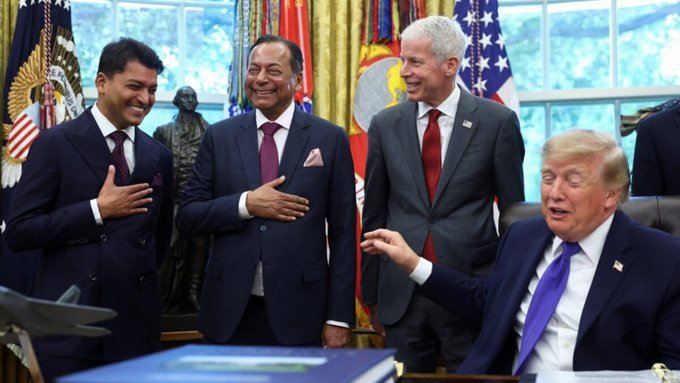
Trump announced the Iowa project on Monday at an Oval Office event attended by members of the Ruia family, which owns Essar. Its US subsidiary, Mesabi Metallics, plans to build the mill in southeast Iowa as part of an integrated domestic supply chain using iron ore from the company’s Minnesota operations.
Trump described the project as the largest steel plant in American history.
“Today we’re thrilled to announce that Mesabi Metallics will be building the largest steel plant in American history in the great state of Iowa,” Trump said.
Production is expected to begin in 2030. The first phase is planned at about 7.5 million tonnes of steel annually, with capacity eventually rising to roughly 10 million tonnes. The White House says the project will create about 6,000 construction jobs and 1,750 permanent Iowa jobs, while Mesabi’s Minnesota operations are also expected to generate additional employment.
🚨 BREAKING: President Trump is in the Oval Office announcing a historic $15 BILLION Iowa steel plant being constructed
6,000 construction jobs and $95 BILLION infusion into the economy
“The LARGEST steel plant in AMERICAN HISTORY.” 🇺🇸
American steel IS BACK!
The plant will… pic.twitter.com/eleNuVPKwF
— Eric Daugherty (@EricLDaugh) September 28, 2026
The broader Essar investment is expected to complete the company’s Minnesota iron-ore operation, creating a mine-to-mill supply chain inside the United States. The Minnesota mine is described by the White House as the first new US iron-ore mine in about 50 years.
Trump presented the investment as evidence that his tariff policy is rebuilding American manufacturing.
“The American steel industry is roaring back to life,” Trump said, attributing the investment to the 50% tariffs imposed on imported steel. “Everyone is building their plants here because they don’t want to pay tariffs.”
Mesabi Metallics Chairman Rewant Ruia thanked the administration for restoring what he called the importance of “building things in America”. CEO Joe Broking said the Iowa mill would supply steel for national defence, automobiles, shipbuilding, appliances, energy and infrastructure.
The Iowa political calculation
The announcement comes at a particularly consequential moment for Iowa Republicans. The state’s 2026 Senate race is an open contest following Joni Ernst’s decision not to seek another term, while the governorship is also open because Republican Governor Kim Reynolds is not seeking re-election. The Republican Senate candidate is Ashley Hinson, while Democrat Josh Turek is contesting the seat; Democrat Rob Sand and Republican Zach Lahn are running for governor.
The steel announcement therefore gives Trump and Iowa Republicans a tangible economic-development story to take to voters: billions of dollars of investment, thousands of construction jobs and more than 1,700 permanent positions.
That message is particularly relevant because economic concerns are prominent in the current Iowa electorate. A September Marist poll of 1,050 registered voters found that 46% said their family finances had worsened over the previous year, while 39% said they had remained about the same. The same poll found 41% approving and 58% disapproving of Trump’s job performance in Iowa.
The political significance of the announcement should therefore be distinguished from its actual economic timetable. The plant is not expected to produce steel until 2030. The construction jobs and associated spending could arrive much sooner, but the permanent manufacturing employment promised by the project is largely a future benefit rather than an immediate one.
The Senate contest illustrates why the announcement matters politically. Polling in September has shown a close race between Hinson and Turek, with individual surveys producing leads for both candidates. The RealClearPolitics average based on polls through September 23 put Turek at 45.0% and Hinson at 44.5%.
The steel project consequently gives Republicans an opportunity to frame the election around industrial investment, tariffs and domestic manufacturing rather than allowing the campaign to be dominated exclusively by dissatisfaction over prices, foreign policy or the Trump administration.
But there is another side to the equation. A $15 billion project announced by a foreign-owned company does not automatically translate into immediate voter benefits, and its principal manufacturing output is years away. The project’s economic impact will depend on construction actually proceeding, financing, infrastructure and labour requirements, and the eventual scale of operations.
Trump’s appearance with Iowa Republicans also makes the political context unmistakable. Senator Joni Ernst, Governor Reynolds and Representative Mariannette Miller-Meeks were among those associated with the announcement. Trump has also indicated that he plans to campaign in Iowa.
The project thus serves two purposes simultaneously: it is a major industrial investment by an Indian conglomerate and a highly visible demonstration of Trump’s economic message in a state with closely watched 2026 races.
READ: Former Nepal Chief Justice Taken From Home at Midnight, Held 12 Hours
From India to the American industrial belt
Essar was founded in India in 1969 by brothers Shashi Ruia and Ravi Ruia and has interests spanning metals and mining, energy, infrastructure, technology and retail. Its Indian assets include the Hazira steel complex in Gujarat and the Vadinar refinery.
The group has also expanded internationally, including its ownership of the Stanlow refinery in Britain and plans for low-carbon steel production in Saudi Arabia.
Mesabi Metallics, based in Nashwauk, Minnesota, acquired the Minnesota Steel operation in 2007 and controls more than 1.4 billion tonnes of iron-ore resources. Essar has invested heavily in developing the Minnesota operation.
The Iowa project now takes that strategy a step further — linking an Indian-owned company’s Minnesota iron-ore resources to a massive new steelmaking complex in the United States.
For Trump, however, the immediate significance is not 2030. It is the political symbolism of announcing one of the biggest industrial investments in US history in Iowa just weeks before voters decide control of key statewide offices and a closely watched Senate seat.