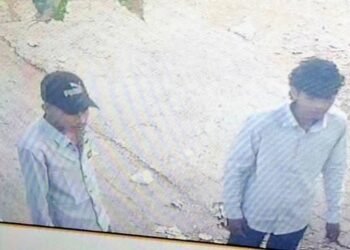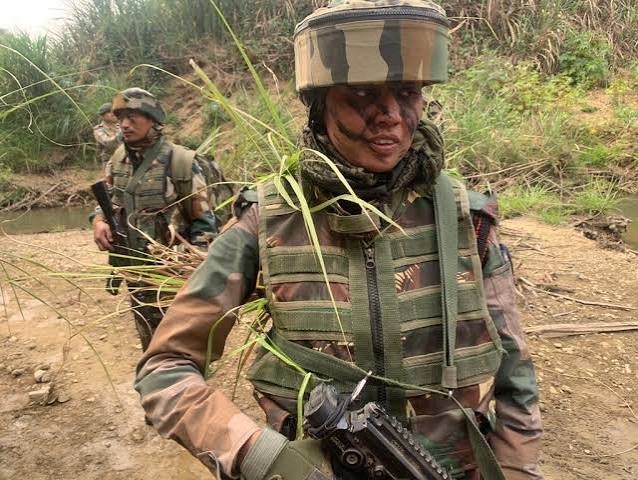
Security agencies suspect the NSCN-K-Yung Aung faction was behind the attack. The incident comes months after the outfit claimed responsibility for an assault on Assam Rifles personnel involved in border-fencing work in the same region.
BY PC Bureau
September 229: An Assam Rifles patrol came under attack along the India-Myanmar border in Arunachal Pradesh’s Changlang district early Tuesday, killing one personnel and bringing renewed attention to the militant challenge facing the region as India pushes ahead with its plan to fence the entire 1,643-km frontier.
The attack took place at about 6.30 am near Nampong Nallah under Nampong Circle, an area close to the Myanmar border where fencing and associated road construction are under way. The deceased has been identified as Havildar Jankhokai Kuki, 42.
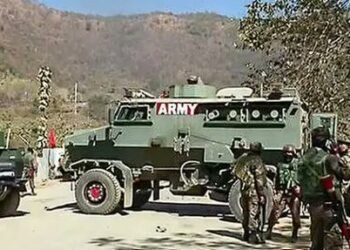
Preliminary reports indicate that the patrol was operating in the vicinity of the fencing works when it came under sudden fire. Security forces launched a search and area-domination operation following the attack, while surveillance was intensified along the border and adjoining forested areas.
Security agencies suspect the involvement of the NSCN-K-Yung Aung (NSCN-K-YA) faction. The attribution, however, will require formal confirmation by investigators.
The incident is significant because NSCN-K-YA has previously directly linked attacks in this belt to India’s border-fencing programme.
On March 26, three Assam Rifles personnel were reportedly killed in an attack along the Namgoi-Pangsau road in Changlang while troops were associated with work on the border fence. The NSCN-K-YA subsequently claimed responsibility, saying its Naga Army Tactical Unit had targeted personnel involved in the fencing. The outfit described the project as an “illegal” attempt to seal the traditional Naga frontier and warned of further resistance.
An earlier March 26 report said the exchange of fire occurred between Border Pillars 172 and 173 while Assam Rifles personnel were supervising fencing construction.
The latest attack therefore comes amid an increasingly contested security environment in the Tirap-Changlang-Longding (TCL) belt, where several insurgent groups have historically operated from, or maintained links with, bases and sanctuaries across the Myanmar border.
READ: M. F Husain Masterpiece ‘The Red Girl’ Draws ₹65 Cr at Auction
Who is NSCN-K-YA?
The NSCN-K-YA is a faction of the National Socialist Council of Nagaland-Khaplang, itself a product of the first major split within the NSCN.
The NSCN was formed in 1980 by Isak Chishi Swu, Thuingaleng Muivah and S.S. Khaplang after their break with the Naga National Council. The organisation sought an independent Naga homeland encompassing Naga-inhabited areas of India and Myanmar.
The NSCN split in 1988, with the Khaplang faction becoming NSCN-K and the Swu-Muivah faction becoming NSCN-IM. The Khaplang faction subsequently maintained its principal bases in Myanmar and remained outside the Indian government’s peace process.
Khaplang died in 2017, triggering a succession struggle inside NSCN-K. Khango Konyak initially took over, but the organisation split again in 2018 after Konyak was removed as chairman and Yung Aung, Khaplang’s nephew, emerged as its leader. The resulting faction became known as NSCN-K-YA. Contemporary reports described the split as having a significant India-versus-Myanmar Naga dimension, with Konyak representing the Indian side and Yung Aung being a Myanmar-based Naga leader.
The Yung Aung faction retained the hardline position associated with Khaplang and rejected the Indian peace process. Unlike several other NSCN-K splinters that subsequently entered ceasefires or peace arrangements with New Delhi, NSCN-K-YA has remained outside a ceasefire with the Indian government.
The organisation has operated primarily from areas of Myanmar’s Sagaing region and has used the difficult, forested terrain along the international boundary to maintain mobility. Security assessments have identified camps and operational links around areas including Haukyat, Khanmoi, Lohan, Kamai and Pangsau on the Myanmar side, with operations extending into the TCL districts of Arunachal Pradesh.
The faction has also been accused of extortion and attacks on security forces and government-linked infrastructure. In February 2026, for example, NSCN-K-YA was reportedly demanding a 20% “tax” on development funds from the Public Works Department in Longding district, according to a security assessment.
The group has also been linked to cooperation with other insurgent organisations, including ULFA-Independent. In August this year, suspected ULFA-I and NSCN-K-YA cadres opened fire on an Assam Rifles camp at Longvi under Nampong police station. No casualties were reported in that attack.
Why Arunachal is particularly sensitive
Changlang is not simply another segment of the India-Myanmar frontier. It lies within the TCL belt, which connects the insurgency-affected areas of eastern Arunachal Pradesh with Nagaland, Assam and Myanmar.
The border also remains vulnerable to illicit cross-border movement. In August, Assam Rifles and Arunachal Pradesh Police detained two Myanmar nationals in the Nampong area and seized about 130 grams of suspected heroin. In September, a joint operation in the Namgoi area recovered another 233 grams of suspected brown sugar and led to two arrests.
That makes the government’s strategy broader than simply stopping insurgents. Fencing is intended to improve control over militant movement, illegal migration, arms movement and narcotics trafficking, while the accompanying roads are intended to give security forces faster access to remote stretches of the frontier.
But the same infrastructure is confronting an armed group whose operating environment has historically depended on the porousness of that frontier.
ional boundary marked on maps.