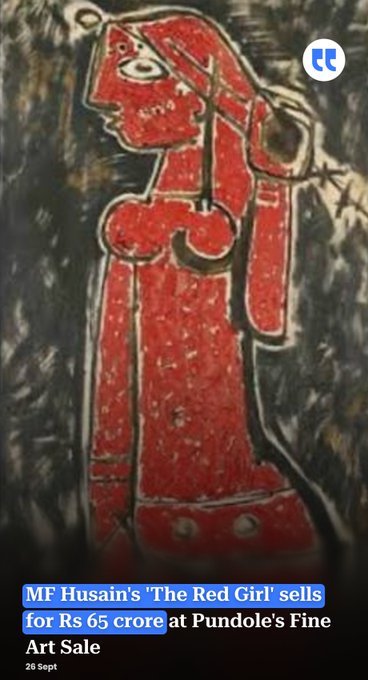
The painting, inspired by ancient Indian yakshi sculpture and Husain’s encounter with fragmented figures at New Delhi’s National Museum, emerged as the top lot among 81 works.
BY PC Bureau
New Delhi, Septmber 2026: A 1952 M.F. Husain painting that brings together the visual memory of ancient Indian sculpture and the radical language of post-Independence modernism has fetched ₹65 crore at auction, turning The Red Girl into the standout result of Pundole’s Fine Art Sale in Mumbai.
The oil on canvas, estimated at just ₹3–5 crore before the sale, sold for a hammer price more than 13 times its upper estimate at the September 24 auction at Hamilton House. The work was among 81 lots of modern and contemporary Indian art offered by Pundole’s.
Measuring 48 by 23⅞ inches, The Red Girl had been identified as one of the highlights of the sale. Its extraordinary result accounted for a substantial share of the auction’s overall value and underlined the premium collectors can place on early works by India’s modernist masters when rarity, provenance and historical documentation come together.
A modern woman in the image of an ancient yakshi
At the centre of the painting is a female figure rendered almost entirely in an intense earthy red. She is bare-breasted, wears an ornamental girdle around her hips and has a distinctive forehead ornament identified in the auction catalogue as a chatulatika.
The imagery evokes the yakshi figures of ancient Indian sculpture, particularly those associated with the Mathura tradition. The colour itself is significant: Husain’s deep red recalls the sandstone used in early Indian sculpture.
But The Red Girl is not an attempt to reproduce an ancient sculpture on canvas. Husain alters the proportions and posture of the figure, giving it a more rigid, constructed appearance. The lower limbs are treated almost as fragments, creating the impression of a damaged or incomplete sculpture.
That treatment has been linked to Husain’s encounter with ancient Indian sculpture during a visit to the National Museum in New Delhi with fellow Progressive artist F.N. Souza. The fragmentary stone figures he saw there reportedly left a strong impression on him.
The result was a distinctly modern reinterpretation of an ancient visual vocabulary: the sculpture is recognisable, but its forms are broken apart and reconstructed through Husain’s own language.
Painting an Indian modernism
The significance of The Red Girl lies partly in the moment when it was painted.
The early 1950s were a formative period for India’s modernist movement. Artists associated with the Progressive Artists’ Group were searching for ways to move beyond colonial academic conventions while developing a visual language that was modern but rooted in the country’s own cultural and artistic history.
Husain’s response was not to reject India’s past but to reinterpret it.
In The Red Girl, the reference to the yakshi, the sculptural treatment of the body, the earthy red and the deliberate suggestion of a broken ancient figure all become elements of a new modernist vocabulary. The work therefore operates simultaneously as an image of a woman, an echo of Indian sculpture and an experiment in modern painting.
A work with a documented history
The painting’s appeal also extends beyond its imagery.
The Red Girl was not an unknown work suddenly discovered on the market. Its history was documented relatively early in Husain’s career. It was illustrated in A.S. Peerbhoy’s Paintings of Husain, published by Thacker & Co. in Bombay in 1955, only three years after the painting was made.
Its provenance is also associated with Emanuel Schlesinger, an Austrian émigré and important Bombay patron who supported artists associated with India’s emerging modernist movement. Schlesinger’s collection included works by several artists of the period, and Pundole’s has previously handled works connected with his collection.
That combination — an early date, publication history and established provenance — helps explain why the painting attracted such a dramatic response despite its relatively modest estimate.
READ: Goldy Brar is now among the FBI’s Ten Most Wanted.
Not Husain’s auction record
The ₹65-crore result is a major price for Husain but does not establish a new auction record for the artist. Husain has previously commanded more than $13 million for a work at an international auction.
The significance of The Red Girl therefore lies less in setting a new absolute record than in the extraordinary gap between its estimate and its final hammer price.
A ₹3–5 crore estimate had placed the work within a considerably lower price bracket. The ₹65-crore result suggests that bidders were responding to qualities that are difficult to capture in a conventional estimate — particularly its early date, documented history, provenance and place within the development of Indian modernism.
Strong results across the sale
Husain was not the only artist to attract strong bidding at Pundole’s September sale.
Jangarh Singh Shyam’s 1999 Untitled, an acrylic on canvas estimated at ₹4–6 crore, fetched ₹18 crore. The work is a large 91⅜-by-69⅝-inch canvas and was among the sale’s other major attractions.
Works by S.H. Raza, Manjit Bawa and other major figures of Indian modern and contemporary art also featured in the 81-lot auction. The results came amid signs of widening interest in Indian art beyond a narrow group of established blue-chip names. Pundole’s itself had highlighted the increasing attention being paid to artists whose work and historical importance are attracting a broader collector base.
The result for The Red Girl nevertheless stood apart.
Painted more than seven decades ago, documented in print within a few years of its creation and rooted in Husain’s engagement with India’s sculptural heritage, the painting arrived at auction with a history that was already part of its value.
Its ₹65-crore hammer price shows how dramatically that combination of artistic importance, rarity, provenance and documentation can reshape the market value of an early modernist work.