Trump returned to the White House a day earlier than scheduled as Washington warned Americans of a volatile security environment and the possibility of rapid escalation in the region.
BY PC Bureau
September 20: Washington’s decision to issue fresh security alerts across the Middle East, coupled with President Donald Trump’s unexpected early return from Camp David, has set alarm bells ringing across a region already on edge over the widening conflict. Israel Prime Minister Benjamin Netanyahu has also cut short his U.S. trip and is returning to Israel.
Trump cut short his weekend at the presidential retreat in Maryland and returned to the White House on Saturday, a day earlier than scheduled. The White House did not immediately provide a reason for the change.
The timing was striking. Trump returned to Washington as the US warned Americans in several Middle Eastern countries of a volatile security environment and the possibility of rapid escalation, while a Houthi missile was fired towards the Saudi capital Riyadh and Iran publicly laid out conditions for reopening negotiations with Washington.
The US security alerts warned of possible flight cancellations, airspace closures and further attacks involving Iran and groups aligned with Tehran. Americans in the region were urged to reconsider travel, while those already there were warned to prepare for rapidly changing security conditions.
The warnings came hours after Saudi Arabia said its air defences intercepted a ballistic missile launched by Yemen’s Iran-backed Houthis towards Riyadh. Saudi authorities reported no casualties from the intercepted missile, although explosions and smoke were reported in the capital.
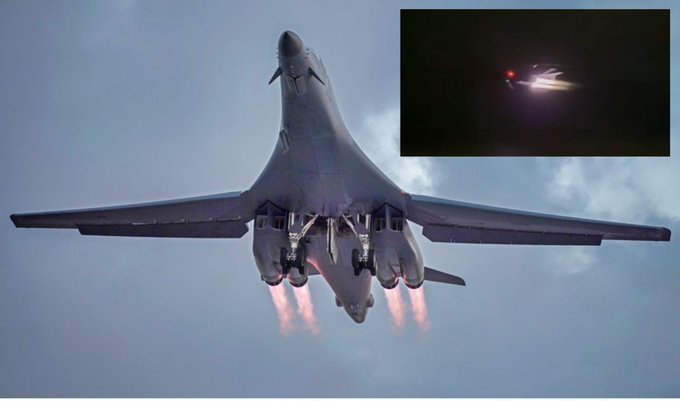
In the midst of all ths, a US B-1B Lancer bomber took off from RAF Fairford in the UK tonight in a heavy-afterburner departure, amid heightened tensions across the Middle East. The bomber’s destination and mission have not been officially confirmed, and the takeoff alone does not establish that it is heading for the region or indicate its weapons load.
Some reports have suggested that Washington could be preparing to resume major strikes against Ansarullah (the Houthis) in Yemen following the group’s reported attacks targeting Saudi Arabia. However, no US announcement confirming such an operation has been made.
MIDDLE EAST HIT with WAVE of US GOVERNMENT ALERTS in MATTER OF HOURS:
ISRAEL
IRAQ
OMAN
KUWAIT
JORDAN
LEBANON
BAHRAIN https://t.co/xYy31oUmoK pic.twitter.com/ch0NUg91L7— RT (@RT_com) September 19, 2026
Meanwhile, Iran has reportedly activated “CODE 100” — its highest alert level — across the IRGC, Army and security forces.
The Houthis claimed to have launched a broader barrage of missiles and drones against what they described as sensitive targets in Riyadh and Saudi Aramco facilities in Yanbu. Those claims have not been independently confirmed.
This too 👇🏼👇🏼 https://t.co/Qau3ZscY8S
— Susan ✨⚖️✨🕊️ ☮️ 💟🇺🇦 (@SusanInDelaware) September 20, 2026
Adding to the uncertainty, Iran said Qatar had conveyed seven conditions to Washington for restarting talks aimed at ending the war. Mohsen Rezaei, secretary of Iran’s Supreme National Security Council, said Tehran was awaiting Trump’s response.
READ: Iran Sets Terms for US Talks, Warns of “Decisive War”
Among the conditions publicly identified by Rezaei were an end to fighting on all fronts, the release of frozen Iranian funds and an end to the US naval blockade.
At the same time, Rezaei warned that Iran was prepared for what he called a “decisive war” if Washington rejected its demands, while insisting that Tehran remained interested in diplomacy.
The combination of military warnings, a new diplomatic offer from Tehran and Trump’s unexplained early return to Washington has intensified uncertainty over the next phase of the conflict.
The immediate question is whether the latest developments will push the United States and Iran back towards negotiations—or bring another round of military escalation closer.