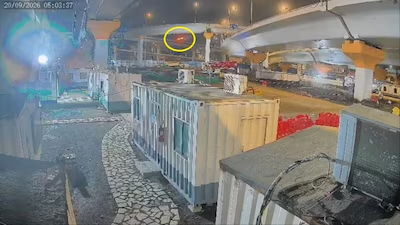
The crash occurred around 5.20 am near Lotus Jetty, opposite Lala Lajpatrai College, with preliminary information pointing to high speed and loss of control.
BY PC Bureau
September 20, 2026: Three people were killed and another was critically injured after a BMW travelling at high speed from Marine Drive towards Haji Ali crashed into a divider and fell from the elevated Mumbai Coastal Road near Lotus Jetty early Sunday morning. The accident occurred around 5.20 am, opposite Lala Lajpatrai College.
According to information from the Coastal Road Control Room, the driver allegedly lost control of the vehicle while travelling at high speed. The BMW crashed into the divider before plunging from the elevated stretch. Police are investigating the circumstances surrounding the crash.
All four occupants were taken to Nair Hospital. Doctors declared three of them brought dead, while the fourth occupant, a young man in his early 20s, remains critically injured in the trauma ward, according to hospital authorities. The deceased have been identified as Shanay Gajjal, 21, and Dhirya Seth, 17, while the identity of the third victim, believed to be around 25, was yet to be confirmed in the latest hospital update.
The crash has once again raised questions about speed management and crash protection on Mumbai’s high-speed Coastal Road. A July accident involving a speeding Porsche, which hit a divider before colliding with another vehicle and injured an eight-year-old boy, had already highlighted the risks associated with excessive speed on the route.
#Breaking 3 Dead As Speeding BMW Crashes On Mumbai Coastal Road, Falls Off BridgeThe car, a black BMW, was travelling from Marine Drive towards Haji Ali on the Coastal Road when the driver allegedly lost control.#Mumbai #MumbaiNews #CoastalRoad #BMW @MumbaiPolice pic.twitter.com/j2ZaPnWX4p
— Monu Lodhi 🇮🇳 (@monu_lodh) September 20, 2026
The Coastal Road is designed as a controlled-access, high-speed corridor, which means conventional urban traffic-calming measures are difficult to apply. The safety challenge is therefore less about slowing all traffic and more about preventing a speeding vehicle from leaving the carriageway or turning a momentary loss of control into a fatal fall.
The latest crash raises several questions for investigators and road authorities: Was the vehicle travelling substantially above the posted speed limit? Was the divider or crash barrier capable of containing a high-speed impact? Were warning signs and speed enforcement adequate at the location? And did the road’s design provide sufficient protection against a vehicle breaking through the edge barrier?
READ: Alarm Across Middle East as US Issues Fresh Alerts, B-1B Lancer Bomber Headed for the Region
These questions should be answered through the police investigation, CCTV footage, vehicle data and a technical inspection of the crash site rather than assumptions based solely on the severity of the accident.
The timing is also significant. The Coastal Road’s south section has seen a sharp increase in traffic since it began operating round-the-clock. Average daily traffic reportedly rose from about 34,500 vehicles to more than 62,000, an increase of about 81 per cent.
With traffic volumes rising, enforcement of speed limits, functioning surveillance cameras, adequate lighting, high-containment barriers and rapid emergency response become increasingly important.
The immediate cause of Sunday’s crash may ultimately prove to be excessive speed and loss of control. But the scale of the consequences makes a broader road-safety review relevant: on a high-speed urban corridor, a driver error lasting only seconds should not automatically become a fatal plunge.