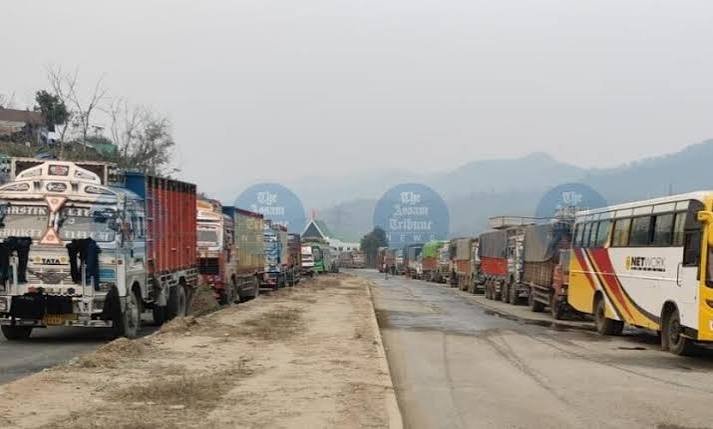
The United Naga Council has refused to lift its blockade of Manipur’s national highways, insisting that its four-point charter of demands must be addressed before normal traffic can resume.
BY PC Bureau
August 10: A day after Kuki leaders reportedly assured the Manipur government that they would facilitate free movement on national highways, the United Naga Council (UNC) has made it clear that its own blockade will continue until the state and Centre address its four-point charter of demands.
The announcement came after the first round of talks between the UNC and the Manipur government at the Senapati district headquarters on Monday. Although both sides described the meeting as cordial and agreed to continue negotiations, the Naga body ruled out withdrawing its prolonged blockade for now.
The government delegation, led by Deputy Chief Minister L. Dikho and Home Minister Govindas Konthoujam, held discussions with representatives of the UNC on the Naga body’s demands and the broader security situation in the state.
Government spokesperson Thokchom Radheshyam described the meeting as an “ice-breaker” and said the discussions marked the beginning of a series of negotiations aimed at finding a solution.
“Today, United Naga Council and Manipur government representatives led by the deputy chief minister and state home minister came here (Senapati) to discuss and find solutions to several issues. We had fruitful and cordial discussions,” Radheshyam told reporters.
He said both sides had agreed to continue the dialogue.
“Talks have just started, and results will come after a series of discussions. Still, today’s meeting was an ice-breaker. Let’s wait for the result,” he said.
UNC refuses to withdraw blockade
The UNC, however, emerged from the meeting with its position unchanged.
UNC president Ng. Lorho said the organisation had discussed possible ways of restoring peace with the ministers and legislators but remained committed to its four-point charter.
“We discussed with ministers and MLAs the way forward on how to bring peace. We discussed our four-point charter of demands, and we stick to it. Unless it is fulfilled, we will not end the blockade,” Lorho told reporters.
He said the government had appealed to the UNC to withdraw the blockade but indicated that the organisation could intensify its agitation if its demands were not addressed.
Lorho also insisted that subsequent rounds of negotiations should be held in Senapati rather than Imphal, signalling the UNC’s reluctance to shift the talks to the state capital.
The continuing standoff presents another challenge for the Manipur government, which is attempting to reopen channels of dialogue with rival ethnic groups and restore the movement of goods and people across the state.
Four demands at centre of dispute
The UNC has linked the lifting of the blockade to four principal demands.
These include:
- Abrogation of the Suspension of Operations (SoO) agreement with Kuki militant groups;
- Declaration of the Kuki National Front-President (KNF-P) as a terrorist organisation;
- Removal of the Deputy Chief Minister from office; and
- Arrest of KNF-P cadres allegedly involved in the killing of six Naga civilians.
The demand to terminate the SoO arrangement is particularly contentious because the agreement is a tripartite framework involving the Centre, the Manipur government and Kuki-Zo groups represented by the Kuki National Organisation and United People’s Front.
When asked about the UNC’s demand for scrapping the SoO agreement, Radheshyam said the state government was bound by the Centre’s position.
“That is the policy of the government of India. Manipur is part of India and we have to go by the policy and decision of the Centre,” he said.
The response effectively ruled out any unilateral decision by the state government on the SoO pact, leaving one of the UNC’s key demands dependent on the Centre.
Highway blockade hits supplies
The UNC’s blockade, which has been in place since June, has severely affected the movement of essential commodities into Manipur.
The state’s dependence on road connectivity for supplies means disruptions on the national highways can quickly translate into shortages and price increases. Reports of rising prices of food and other essential items have added to public pressure for the standoff to be resolved.
The highways connecting Manipur with neighbouring states are particularly important because they serve as the principal routes for transporting fuel, food, medicines and other essential commodities into the landlocked state.
The blockade has therefore emerged as both a political instrument and a major humanitarian concern, with ordinary residents bearing the immediate economic impact.
Read: NSCN (I-M) Burns Kuki Village in Manipur, Sending Peace Bid Up in Smoke
Parallel peace efforts
The UNC’s decision to maintain the blockade comes at a sensitive moment for Manipur’s broader peace efforts.
The government has been attempting to establish separate channels of communication with the state’s major communities after years of ethnic violence. The latest talks with the UNC were seen as an important first step towards engaging Naga representatives directly.
A day earlier, some Kuki leaders had indicated that they would support the restoration of free movement along national highways, raising hopes that the prolonged disruption of road traffic could ease.
The UNC’s latest position, however, means that the government’s immediate objective of restoring uninterrupted highway connectivity remains difficult.
The two sides have agreed to hold further discussions, but there is no indication yet that the UNC will suspend its blockade as a confidence-building measure.
For the moment, the Senapati talks have opened a channel for dialogue but failed to produce an agreement on the blockade. With the UNC insisting that its demands must be addressed before the road blockade is withdrawn, and the government maintaining that some issues—particularly the SoO agreement—fall within the Centre’s jurisdiction, the next rounds of negotiations will determine whether Monday’s “ice-breaker” meeting can translate into a concrete breakthrough.