President Abelardo de la Espriella has taken charge of the national response, with emergency teams deployed to rescue survivors and assess damage across the quake-hit region.
BY PC Bureau
August 10: Rescue teams were racing to reach people trapped beneath collapsed buildings in western Colombia on Monday after a powerful earthquake struck the region, killing at least 22 people and causing extensive damage across several cities.
The 7.4-magnitude earthquake, recorded during the morning near San José del Palmar in the department of Chocó, sent residents rushing into the streets and shook buildings hundreds of kilometres away in Bogotá. The tremor was also felt in neighbouring Ecuador.
The US Geological Survey placed the epicentre about 5 km east of San José del Palmar and at a depth of approximately 107 km. The earthquake occurred at 12:34 UTC, corresponding to the morning in Colombia.
The relatively deep origin of the quake may have limited some of its potential surface impact, but the force was still sufficient to bring down buildings and cause significant structural damage in populated areas.
Pereira bears the heaviest toll
The worst reported casualties were in Pereira, in Colombia’s coffee-growing region, where 18 people were killed, according to local authorities.
Three more deaths were reported in Manizales, while another person was killed in Buenaventura. Several people were reported trapped beneath rubble as emergency crews searched damaged buildings.
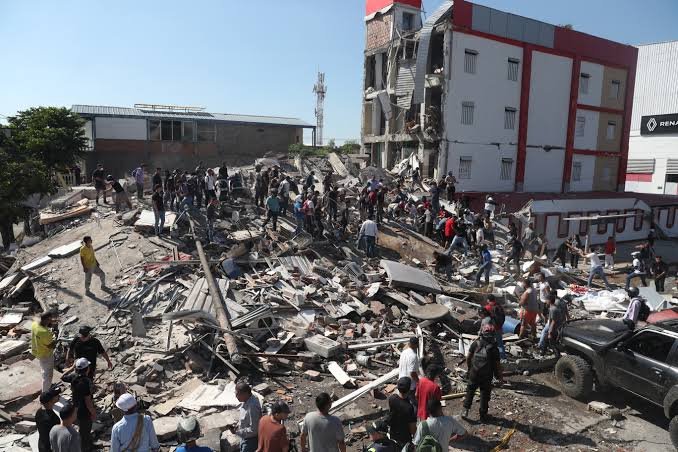
Images and videos emerging from affected areas showed damaged and collapsed structures, while residents gathered outdoors amid fears of further tremors.
In Cali, more than two dozen structures were reported to have collapsed, with rescue personnel working to determine whether people remained trapped underneath the debris.
In Manizales, a section of a tower belonging to a neo-Gothic cathedral was damaged in the earthquake, highlighting the breadth of the tremor’s impact across the country’s western and central regions.
NEW footage is circulating from a magnitude 7.4 earthquake that struck Colombia’s Pacific region today.
The epicenter was near San José del Palmar in Chocó department, at a depth of around 96 km.
It was felt strongly across much of Colombia—including Bogotá, Medellín, and… pic.twitter.com/X03limcIts
— Clash Report (@clashreport) August 10, 2026
Tremors felt across Colombia
The earthquake was felt well beyond the immediate epicentral area. Colombia’s disaster authorities said the shaking was reported across nine departments and all 32 departmental capitals.
In Bogotá, hundreds of residents evacuated buildings as alarms sounded and the ground shook. Authorities in the capital initially reported no major structural damage or fatalities there, although inspections were being carried out.
The tremor was also felt in neighbouring Ecuador, adding to concerns across the wider Andean region.
Authorities urged residents in affected areas to remain alert for aftershocks and to avoid entering damaged structures until they had been declared safe.
Rescue operations underway
Emergency services from several parts of the country were mobilised to support rescue and recovery operations.
Teams from Bogotá and Medellín were assisting local authorities, particularly in areas where collapsed buildings had left people trapped.
Airports in Pereira and Manizales were temporarily closed for safety inspections following the earthquake, according to reports.
Authorities were also assessing roads, bridges, hospitals, schools and other critical infrastructure to determine the extent of the damage and identify areas requiring immediate assistance.
With communications disrupted in some locations, officials warned that casualty and damage figures could change as emergency teams reach more remote communities.
President takes charge of response
Colombia’s newly inaugurated President Abelardo de la Espriella said he had taken direct charge of the national response and convened a unified command structure to coordinate rescue and relief operations.
The president sought to reassure affected residents that the government was mobilising resources.
“You are not alone. The state is present and taking action,” he said.
The government’s immediate priorities included rescuing people trapped in damaged buildings, providing medical assistance, restoring essential services and assessing the safety of critical infrastructure.
READ: Rahul Gandhi Slams Use of Force Against Students in Jharkhand
Colombia’s history of destructive earthquakes
Earthquakes are a recurring hazard in Colombia, particularly in the country’s western and central regions, which lie within a seismically active part of the Andes.
While tremors are relatively common, earthquakes above magnitude 6 are less frequent and can cause serious destruction when they occur near populated areas.
Colombia has experienced some devastating earthquakes in the past. The 1995 earthquake in the Pereira region, for example, killed 35 people and injured more than 250, while a major earthquake near Armenia in 1999 caused more than 1,000 deaths and devastated parts of the country’s coffee-growing region.
The latest earthquake has once again highlighted the vulnerability of densely populated urban areas and older structures to major seismic events.
No tsunami threat reported
Despite the strength of Monday’s earthquake, authorities did not report a tsunami threat. The epicentre was inland and the quake originated at considerable depth.
Officials nevertheless remained on alert for aftershocks and urged residents not to return to buildings that had suffered structural damage until safety inspections were completed.
The full scale of the disaster was still emerging late Monday, with rescue workers continuing to search damaged structures and officials conducting assessments across several departments.
For now, the focus remains on locating survivors and assisting those who have lost homes or relatives. With emergency operations still underway, authorities cautioned that the death toll and damage estimates could rise further.