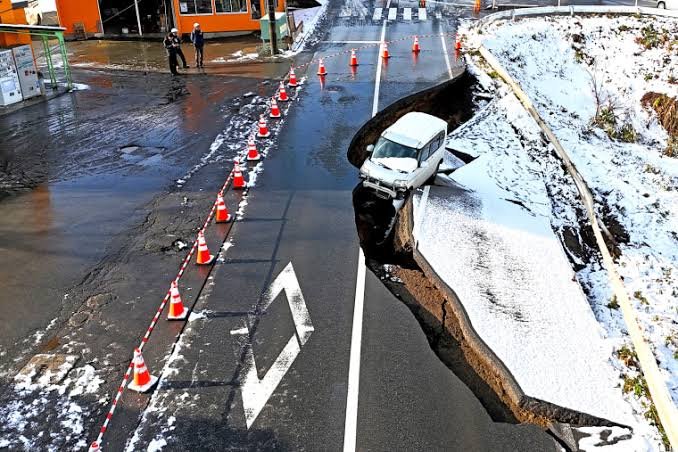
The shallow quake, which registered the maximum intensity of 7 on Japan’s seismic scale in parts of Kumamoto, prompted evacuation warnings for coastal areas and emergency alerts across much of Kyushu, though no major tsunami was reported.
BY PC Bureau
July 28, 2026:: Japanese authorities continued emergency response operations on Tuesday evening after a powerful magnitude 7.1 earthquake struck Kumamoto Prefecture on the southern island of Kyushu, triggering a tsunami advisory, widespread transport disruptions, power outages and a series of strong aftershocks. Officials have so far reported no immediate fatalities, while damage assessments are continuing.
The earthquake struck at 4:27 p.m. JST with its epicentre near Uki City at a shallow depth of around 10 kilometres, according to the Japan Meteorological Agency (JMA). The tremor registered the maximum Shindo 7 intensity in parts of Kumamoto Prefecture, including Uki City and Hikawa Town, making it one of the strongest earthquakes to hit the region since the devastating 2016 Kumamoto disaster.
🚨🌍 Powerful Earthquake Hits Japan! EVERYTHING Starts Shaking in Seconds 😨
Japan Earthquake Horrifying footage of the 7.1 magnitude quake is coming in right now #Japan #Earthquake #Tsunami #Breaking #BreakingNews #JapanEarthquake #NaturalDisaster #PrayForJapan #Alert… https://t.co/5AKORrpkiZ pic.twitter.com/f0JpL2iWNu
— Indian Observer (@ag_Journalist) July 28, 2026
Emergency earthquake warnings were issued across much of Kyushu, including Kumamoto, Nagasaki, Kagoshima, Fukuoka, Saga, Oita and Miyazaki prefectures, as millions of residents received alerts on their mobile phones and television broadcasts.
The JMA issued a tsunami advisory for the Ariake Sea and Yatsushiro Sea, warning that waves of up to one metre could reach affected coastlines. Residents in low-lying coastal areas were urged to move to higher ground and avoid beaches, ports and river mouths until the advisory is lifted. The U.S. Pacific Tsunami Warning Center said there was no tsunami threat beyond local coastlines.
⚡️ BREAKING: Powerful 7.1-magnitude earthquake strikes Japan, tsunami warning issued
The first tsunami waves have already reached the coast.
Around 45,600 households have been left without electricity.
There are currently no reports of fatalities or major damage. It is the… pic.twitter.com/1uVvIlD1Pw
— NEXTA (@nexta_tv) July 28, 2026
Prime Minister Sanae Takaichi appealed for calm and urged residents to remain away from coastal areas while aftershocks continue. She said the government had established an emergency task force to coordinate rescue operations, gather information from local authorities and assess damage.
Within minutes of the main shock, the region was struck by a succession of aftershocks, including a magnitude 6.1 earthquake in the Amakusa-Ashikita area. Numerous smaller tremors followed, prompting the JMA to warn that further strong aftershocks remain possible over the coming days.
The earthquake disrupted essential infrastructure across Kumamoto. Around 48,000 households lost electricity, while JR Kyushu suspended rail services across parts of the island as engineers inspected tracks and bridges for damage. Emergency inspections were also carried out on highways, airports and public facilities.
Japan’s Nuclear Regulation Authority said there were no abnormalities at nearby nuclear power plants following the earthquake, easing concerns about damage to critical infrastructure.
READ: Opinion: Who Gets to Lecture India’s Gen Z on Civility?
Emergency responders continued to inspect buildings, roads and public utilities late into the evening. While there were initial reports of structural damage in parts of Kumamoto, authorities said it was too early to provide a comprehensive assessment of casualties or economic losses.
The earthquake revived painful memories of the 2016 Kumamoto earthquake sequence, which claimed more than 50 lives, injured thousands and caused widespread destruction across the prefecture. The shallow depth of Tuesday’s quake and the maximum Shindo 7 intensity have heightened concerns about the possibility of additional damage if strong aftershocks continue.
Japan, located along the seismically active Pacific Ring of Fire, experiences some of the world’s most frequent and powerful earthquakes. Its sophisticated early-warning systems and stringent building standards are designed to reduce casualties, but authorities cautioned residents to remain vigilant, prepare for aftershocks and follow official evacuation instructions until the situation stabilises.