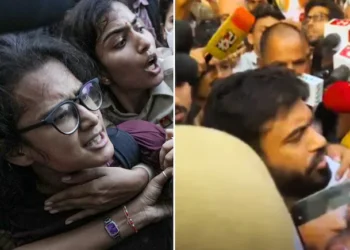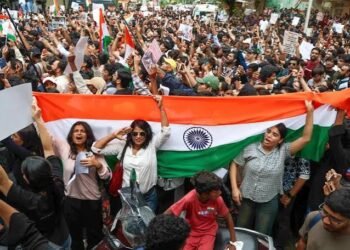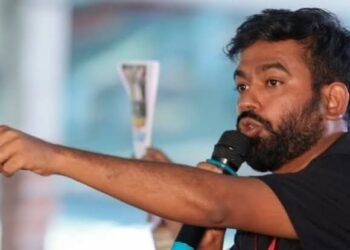
The Gen Z-led protests at Delhi’s Jantar Mantar over the NEET paper leak were often criticised for their irreverent language and unconventional style. But can those who have long normalised abuse, misogyny and dehumanising political rhetoric credibly claim the moral high ground on civility? This opinion piece examines the double standards shaping India’s public discourse.
By Navin Upadhyay
India’s Gen Z protested the NEET paper leak the way it inhabits much of public life—online, ironic and impossible to ignore. At Delhi’s Jantar Mantar, memes, mockery, profanity and, at times, outright abuse became as much a part of the movement as its slogans, prompting critics to dismiss it as spectacle rather than serious protest. Some of that criticism is justified. But before condemning these students for their language and methods, it is worth asking whether their critics possess the moral authority to lecture them on civility.
Every generation invents its own language of protest. India’s freedom movement spoke in Gandhi’s austere moral vocabulary. The JP movement drew strength from idealism and sacrifice. The anti-corruption agitation of 2011 relied on symbolism, nationalism and the language of constitutional reform. The student uprising at Jantar Mantar belonged to a different age altogether—powered not by pamphlets but by Instagram reels, not by carefully crafted slogans but by memes, satire and irreverence. It was loud, theatrical, often chaotic and unapologetically internet-native.
The Cockroach Janta Party (CJP), the satirical movement that emerged from the protests, deliberately embraced provocation as a political strategy. Some slogans were crude. Some placards were vulgar. Protest speeches often sounded more like stand-up comedy than political oratory. Critics pointed to the dancing videos, profanity, provocative posters and the waste left behind after weeks of occupation as evidence that India’s Gen Z had reduced politics to performance.
Those criticisms deserve to be taken seriously. Freedom of expression does not place anyone beyond criticism, and democratic protest carries responsibilities as well as rights. Protesters who deliberately court controversy cannot expect universal admiration, and a movement that consciously rejects conventional standards of decorum must accept that many citizens will judge it harshly.
But that is only half the story.
The more important question is whether those who rushed to condemn the students possess the moral authority to lecture them on civility.
The debate around Jantar Mantar has largely been framed as a contest between well-mannered defenders of public decency and an unruly generation that has forgotten the difference between dissent and abuse. That framing collapses the moment one examines the language employed by many of the movement’s fiercest critics. The same political and ideological ecosystem that accused the students of vulgarity has, for years, normalised personal abuse, communal insinuation, misogyny, dehumanising rhetoric and, in some cases, open advocacy of violence.
The issue, then, is not whether the students occasionally crossed the line—they did. The issue is whether civility can be invoked selectively: demanded of political opponents while quietly abandoned by one’s own side. That is the larger democratic question raised by the CJP protests.
The movement itself was born from an act of political appropriation. After Chief Justice Surya Kant’s controversial remarks describing certain unemployed youth as “cockroaches” and “parasites”, the students did something characteristic of digital-age politics: they reclaimed the insult. Rather than reject the label, they adopted it. The Cockroach Janta Party turned ridicule into identity and mockery into mobilisation, recognising—as protest movements elsewhere have—that satire often travels farther than solemnity and that memes can communicate political anger more effectively than speeches. One may dislike that style, but it was a conscious political choice rather than mere juvenile mischief.
Many of the responses, however, moved well beyond criticism of the movement’s methods and instead questioned the legitimacy, morality and even humanity of those who participated.
One of the sharpest attacks came from BJP MP Kangana Ranaut, who dismissed the protesters as “Generation Gutter”, described their videos as “puke-inducing”, and portrayed many of the women taking part as morally bankrupt and incapable even of becoming homemakers. Her criticism was no longer directed at what the protesters had done; it became an indictment of who they supposedly were. The debate shifted from behaviour to character, from political disagreement to cultural condemnation. That distinction matters because democracies depend on recognising the humanity of one’s opponents even while rejecting their arguments. Criticism addresses conduct; dehumanisation questions dignity.
Even more disturbing were the remarks of RSS ideologue T.G. Mohandas, who declared on his YouTube channel that, had he been responsible for handling the Jantar Mantar protests, he would have imposed a curfew, issued three warnings and then ordered the police to open fire. Some people would die, he said. Some would survive. Some would lose their limbs. The situation, he suggested, would be brought under control within hours. He compounded the controversy with remarks about women protesters that were widely condemned as misogynistic. Whatever one’s politics, there is a profound moral and constitutional difference between criticising a protest and advocating deadly force against demonstrators. Democracies are sustained by disagreement; they begin to erode when disagreement is answered with the language of coercion.
The same tendency appeared in subtler forms elsewhere. BJP MP Konda Vishweshwar Reddy defended the police lathi charge by arguing that other democracies would have responded even more harshly. RSS thinker S. Gurumurthy dismissed the CJP as unrepresentative of Gen Z, described elements within it as “criminals” and mocked the movement’s celebratory videos as evidence that it lacked seriousness. Across television debates and social media, protesters were repeatedly labelled anti-nationals, foreign agents, Deep State operatives and enemies of the nation. Individually, these remarks differed in tone and intent. Collectively, they revealed a common instinct: not merely to criticise dissent but to delegitimise it.
From spitting venom and filth on Bollywood for years, #kanganaranaut who herself was a home breaker is calling out genz for language and protesting girls as ‘ugly’ who cannot even be ‘homemakers’ . She herself had multiple relationships & is the biggest clown in the circus pic.twitter.com/4TIxoLLABp
— Ritu Agarwal (@RituAR) July 28, 2026
Nor was this an isolated episode. The vocabulary of Indian politics has, over the years, steadily shifted from disagreement to delegitimisation, from criticism to contempt and from argument to abuse. One need look no further than Parliament itself.
In September 2023, BJP MP Ramesh Bidhuri launched an extraordinary barrage of communal and personal insults against BSP MP Danish Ali during proceedings in the Lok Sabha. The outburst shocked members across party lines and became emblematic of the coarsening of parliamentary discourse. Parliament is expected to demonstrate that political disagreement can coexist with institutional dignity. When personal abuse and communal slurs become acceptable within the House itself, it becomes difficult to insist that civility is an indispensable democratic value only when students gather on the streets. Standards cannot begin at Jantar Mantar if they no longer exist in Parliament.
The same pattern has surfaced outside the House. During a televised debate in 2025, BJP national spokesperson Prem Shukla referred to Congress leader Surendra Singh Rajput as “tawaif ki aulad” (“son of a prostitute”) after being muted by the anchor. The remark reflected the growing normalisation of personal humiliation as a substitute for political argument. Assam Chief Minister Himanta Biswa Sarma has also repeatedly personalised his exchanges with political opponents, particularly Congress spokesperson Pawan Khera, illustrating how invective has increasingly displaced persuasion in mainstream politics.
The same tendency resurfaced during the CJP protests. BJP president Nitin Nabin described the demonstrators as “viruses” and members of the “tukde tukde gang”. These are not ordinary political insults. To describe fellow citizens as viruses is to portray them as a contagion rather than participants in democratic life. To label them members of the “tukde tukde gang” is not merely to disagree with them but to question their loyalty to the nation itself.
READ: ‘Filth and Ugliness’: Kangana Ranaut Slams CJP Protesters
Terms such as “anti-national”, “traitor” and “tukde tukde gang” have become so commonplace that many scarcely notice their significance. Yet these expressions do far more than offend. They delegitimise. They seek to place dissenters outside the moral and political community, encouraging citizens to regard them not as fellow Indians with whom they disagree but as internal enemies. Once political opponents are transformed into enemies of the nation, extraordinary responses begin to appear not merely permissible but desirable. That is why such language can ultimately be more corrosive than any profanity shouted from a protest stage.
Words also have consequences.
Hindutva activist Satyam Pandit, who identifies himself as president of the Hindu Veer Sena, was filmed allegedly confronting, abusing and slapping two students returning from the Jantar Mantar protests while questioning their names, religion and place of residence. He later expressed no remorse, insisting the students “should have been beaten on the first day”. Whether or not Pandit represents a larger political constituency is beside the point. His actions illustrate how rhetoric that portrays opponents as enemies can legitimise intimidation by private actors who believe they are acting in defence of the nation.
None of this suggests that abusive political language is the monopoly of one party or ideological tradition. Indian politics has, for decades, tolerated a steady coarsening of public discourse across party lines. Opposition parties, too, have often resorted to inflammatory language, personal attacks and hyperbole. The decline in civility is a broader democratic problem.
Yet the Jantar Mantar episode remains distinctive because many of those who most forcefully condemned the students’ language belong to the very political ecosystem that has, over many years, helped normalise the style of discourse it now professes to reject. That contradiction cannot simply be ignored.
None of this means the students behaved impeccably. They did not. Some slogans were crude. Some placards crossed the line into bad taste. Some participants appeared more interested in performative outrage than persuasive politics. Those criticisms are legitimate. But criticism loses credibility when it is applied selectively. Civility cannot become an occasional political weapon—invoked when opponents use offensive language and forgotten when one’s own allies do the same or worse. Standards enforced only against adversaries cease to be standards; they become instruments of political convenience.
There is also a constitutional principle at stake. Democracies have never demanded saintliness from protesters. Political movements throughout history have been noisy, abrasive and provocative. The suffragettes disrupted public meetings, anti-colonial movements mocked imperial authority, and student movements around the world have relied on satire and theatrical symbolism to command attention. Protest, by its very nature, unsettles. It is not designed to reassure those in power.
Those who exercise public authority, however, bear a different responsibility. Elected representatives, ministers, party office-bearers and influential ideologues speak from positions of institutional authority. Their words shape public attitudes, influence administrative behaviour and define the boundaries of acceptable democratic conduct. A student’s obscenity may offend, but a parliamentarian’s communal slur, a chief minister’s personal invective or an ideologue’s call for bullets can legitimise exclusion, intimidation and even violence. The two are neither morally nor politically equivalent.
The lasting lesson of the CJP protests is not that India’s Gen Z has discovered an unusually abrasive vocabulary. Every generation develops its own idiom of dissent. What should concern us far more is the ease with which those entrusted with political authority invoke civility as a weapon against critics while exempting themselves from the very standards they seek to impose.
If India genuinely wishes to restore dignity to its public discourse, the process cannot begin by lecturing students alone. It must begin with Parliament, political parties, television studios and those who shape the nation’s political imagination. Democracies survive not because protesters are always polite, but because those who wield power recognise that authority carries obligations greater than those borne by dissent.
The first duty of power is not to demand civility but to demonstrate it. Only then does its criticism of others carry moral force.