



With United Torah Judaism refusing to back Netanyahu, the opposition sees an opportunity to unseat the long-serving prime minister.
BY PC Bureau
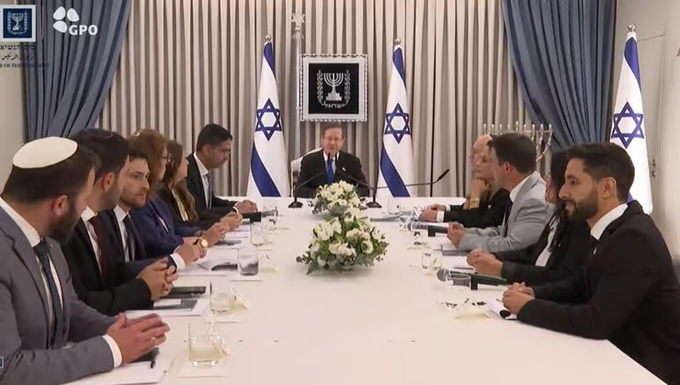
November 6: Israeli Prime Minister Benjamin Netanyahu grip on power appears to be slipping, with opposition leader Gadi Eisenkot emerging as the frontrunner to form the country’s next government. Representatives of 67 Knesset members backed the Yashar leader during consultations with President Isaac Herzog on Thursday, compared with 46 who recommended Netanyahu, according to The Times of Israel.
Herzog described the outcome as “clear” but said he would hold further discussions with party leaders before formally assigning the mandate to form a government on Sunday.
Eisenkot’s party, Yashar, urged Herzog to give him the mandate “as soon as possible”, pointing out that the 67 recommendations were the highest received by any candidate since 2015.
Netanyahu’s outgoing coalition secured 53 seats in the election. A significant setback came from United Torah Judaism (UTJ), the seven-seat ultra-Orthodox party, which declined to recommend either Netanyahu or another candidate.
The consultations have strengthened Eisenkot’s claim to lead the next government. However, securing a parliamentary majority remains a complicated task.
Eisenkot has the first mandate and will get the chance to form a government first, but the numbers behind his 67 show why he got it and why it will be hard to turn into a government.
1) The 67 splits into 48 from Zionist parties and 19 from Ra’am and the Joint List. Netanyahu has 46, or 53 with UTJ. Neither side has a Zionist-only majority, and Eisenkot is further from one.
2) Even with UTJ, Eisenkot’s Zionist parties reach only 55. He can’t get to 61 without the Arab lists unless Shas moves too. That explains why his camp talks about the Haredi parties, plural.
3) His four conditions keep Ra’am and the Joint List out of the coalition but leave room for their outside support. It is the 2021 Bennett-Lapid model, with the Arab parties outside the cabinet instead of inside it.
4) The universal service condition blocks the Haredi path. If he softens it, Likud says he dropped a condition. If he keeps it, UTJ stays out. Regev is already making that charge.
5) Taking the Knesset first is his strongest move. The Speaker controls the agenda, the votes and the committees, so Netanyahu gains less by running out the clock.
6) The Speaker vote needs 61, and he has 48 without the Arab lists. That first vote will show publicly who his majority depends on. The bloc still hasn’t agreed on a candidate.
7) Netanyahu stays prime minister through every failed round. Likud’s goal is to split the 48 by appealing to Bennett and Liberman, not to win Arab votes.
8) Eisenkot’s pledge to back military action only against “direct and immediate threats” raises the cost of Netanyahu opening a new front during the caretaker period.
9) Yashar! is using the US aid cutoff to argue that repairing ties with Washington requires a new government. That also justifies the “emergency” label.
Herzog controls the timing and the extension, and he is still pressing for power-sharing. If he leans toward a rotation, a narrow Eisenkot government becomes one option rather than the expected outcome.Eisenkot is running two strategies at once. Taking the Knesset needs Arab votes in the open. Courting the Haredim needs him to say he doesn’t rely on them. Both can work for a few weeks, but not past the first vote that requires 61. It looks like the best he can hope for is to block Netanyahu from forming a government and impose another election.
— Shaiel Ben-Ephraim (@academic_la) November 5, 2026
Despite his numerical advantage, Eisenkot faces substantial obstacles in assembling a coalition. The anti-Netanyahu camp is divided between a 48-member, four-party Jewish-led bloc and a 19-member grouping comprising two Arab-led parties.
All six parties recommended Eisenkot during the consultations. However, three of the Jewish-led parties have so far ruled out joining a government that includes the Arab parties.
According to The Times of Israel, Channel 12 reported that Yisrael Beytenu leader Avigdor Liberman, a longstanding opponent of Haredi participation in government, has softened his position. He is reportedly open to an alliance with UTJ if it helps remove Netanyahu from power.
Liberman has indicated that partnering with ultra-Orthodox factions would be preferable to relying on Arab-led parties. Reports have also pointed to a possible rotation arrangement between Liberman and Eisenkot, alongside negotiations over legislation concerning military conscription of Haredi men.
The new Knesset, scheduled to be sworn in on November 10, is also expected to elect a new speaker.
Ra’am, Yashar, the Joint List, Yisrael Beytenu and the Democrats have called for an early vote. The incumbent speaker, Amir Ohana of Likud, has said he will schedule a debate if at least 61 lawmakers formally request one.
Few Takers for Netanyahu: A Party-wise Look
Ra’am
Ra’am leader Mansour Abbas stopped short of explicitly describing Hamas as a terrorist organisation, one of Eisenkot’s stated conditions for coalition partners. However, he condemned terrorism, called for Hamas to be disarmed and removed from power, and expressed hope for a “good government”.
Abbas argued that the 2021 Bennett-Lapid government performed better than the outgoing all-right-wing coalition on security and civil matters. He rejected suggestions that Ra’am’s participation would restrict Israel’s ability to defend its citizens and questioned what he called repeated “loyalty tests” imposed on Arab parties.
The party’s No. 2, Yoav Segalovitz, described the prevailing political discourse as “toxic” and blamed Netanyahu for encouraging it. He contrasted the treatment of Arab parties with the conviction of Otzma Yehudit leader Itamar Ben Gvir for incitement and support for a Jewish terrorist organisation.
Joint List
Joint List chair Yousef Jabareen said Arab voters had demanded political change in response to racism, discrimination, crime and exclusion.
Acknowledging disagreements with Eisenkot, he described the political choice as “between what we see as bad and even worse”.
MK Ahmad Tibi said the Joint List was prepared to consider supporting a minority government from outside but would not provide parliamentary backing only to withdraw it shortly afterwards.
He pointed to the alliance’s 11 seats as a source of considerable political leverage, saying: “No parliamentary or political move in the Knesset can happen without the Joint List.”
B’Yachad
B’Yachad recommended Eisenkot but expressed reservations about broad unity arrangements.
MK Merav Cohen described him as “an extraordinary person” capable of forming a government but emphasised the need for political stability.
MK Ram Ben Barak said cooperation was possible with people holding different political views but not with those who rejected basic democratic equality.
Cohen recalled the scorpion-and-frog fable and her experience in the previous Netanyahu-Gantz unity government. She said repeated breaches of agreements had taught her that she had “learned not to do business with scorpions”.
Yashar
Former Shin Bet chief Yoram Cohen said Israel urgently needed a stable government and that high voter turnout reflected a clear public desire for change.
He said Yashar would first negotiate with its allied opposition parties to establish a core coalition. Other parties willing to accept its principles could subsequently join.
Cohen blamed Netanyahu personally, rather than the Likud party as a whole, for deepening political divisions through attacks on state institutions and remarks about Arab citizens.
Likud
Likud representatives called for a broad national government comprising Jewish-led Zionist parties.
Education Minister Yoav Kisch argued that Israel could not meet its challenges with a government dependent on Arab parties that he accused of supporting terrorism. He also accused the opposition of refusing to work with Likud.
Transportation Minister Miri Regev described Eisenkot’s prospective partners as a “disaster bloc” willing to govern alongside the Joint List.
Herzog challenged both the characterisation and the assertion that Eisenkot had committed to including the Arab-led parties in his government.
Likud representatives also questioned whether Yashar’s condition requiring coalition partners to recognise Hamas as a terrorist organisation had been clearly communicated during the consultations.
Incoming MK Talik Gvili appealed to political leaders to restore the national unity that existed at the beginning of the war.
Herzog is expected to conclude consultations with party leaders and announce his decision on Sunday. Eisenkot’s strong showing has put Netanyahu on the defensive, but the opposition still faces the difficult task of converting its numerical advantage into a workable governing majority.







Comments 1