Calling for sports to remain free from politics, Ashok Kumar said any decision to change India’s historic hockey colours must be taken only after consulting Hockey India and respecting fans’ sentiments.
BY Navin Upadhyay
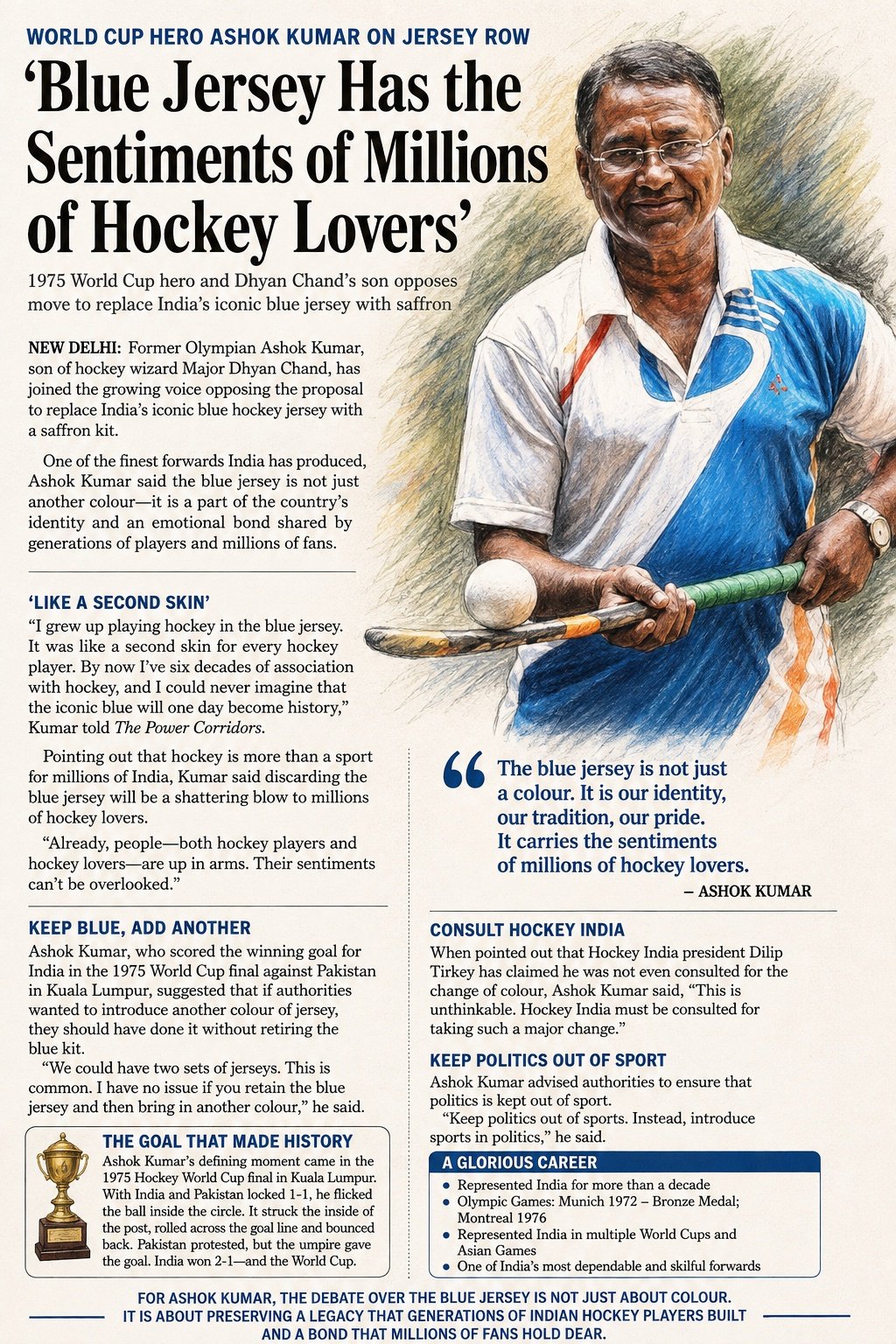
New Delhi, August 1, 2026: Former Olympian Ashok Kumar, son of hockey legend Major Dhyan Chand and the man whose goal won India its only Hockey World Cup title in 1975, has joined the growing chorus of voices opposing the reported move to replace India’s iconic blue hockey jersey with a saffron kit.
One of the finest forwards India has ever produced, Ashok Kumar said the blue jersey has been inseparable from Indian hockey for generations and abandoning it would sever an emotional bond shared by players and fans alike.
“I grew up playing hockey in the blue jersey. It became like a second skin for every Indian hockey player,” Kumar told The Power Corridors. “I have been associated with the game for nearly six decades, and I never imagined that the day would come when our iconic blue jersey might become history.”
Calling hockey more than just a sport for millions of Indians, Kumar warned that replacing the traditional blue strip would deeply hurt the sentiments of hockey lovers across the country.
“People—both former players and fans—are already up in arms. Their emotions cannot simply be ignored. The blue jersey is part of India’s hockey identity,” he said.
READ: Asmita Dey Scripts History with India’s First CWG Judo Gold
Kumar said there was no objection to introducing an alternate kit, provided the traditional blue jersey remained India’s primary playing strip.
I am deeply anguished to know that the legendary colour of the Indian hockey team’s jersey has been changed to saffron. The iconic shade of blue of the Indian hockey team is not just a colour. It is an emotion associated with the nation’s sporting heritage.
For decades, this… pic.twitter.com/4cgXOvpxdJ
— Naveen Patnaik (@Naveen_Odisha) July 30, 2026
“Most international teams have two sets of jerseys. If the authorities wanted to introduce another colour, they could have done so without discarding the blue one. Keep the blue jersey and add another colour as an alternate kit. I have absolutely no problem with that,” he said.
Referring to reports that Hockey India president Dilip Tirkey had not been consulted before the proposed change, Kumar expressed surprise.
READ: Jersey Row Deepens as Tirkey Seeks Answers, Leaders and Hockey Greats Object
“If Hockey India was not consulted, it is unthinkable. Such a major decision affecting the identity of Indian hockey must be taken only after consulting the national federation,” he said.
Kumar also cautioned against allowing political considerations to influence sporting decisions.
“Keep politics out of sports. Instead, bring sportsmanship into politics,” he remarked.
Ashok Kumar represented India for more than a decade after making his international debut in the early 1970s. He was a key member of the Indian team during a period when world hockey was becoming increasingly competitive.
He won a bronze medal at the Munich 1972 Olympics and represented India again at the Montreal 1976 Olympics. He also featured in multiple Hockey World Cups and Asian Games, earning a reputation as one of India’s most dependable and skilful forwards.
His place in Indian sporting history was cemented during the 1975 Hockey World Cup final in Kuala Lumpur. With the match against Pakistan locked at 1-1, Kumar scored the decisive goal that gave India a 2-1 victory and its first—and, to date, only—Men’s Hockey World Cup title. The goal remains one of the most celebrated moments in Indian hockey history.
For Kumar, therefore, the debate over the blue jersey is about far more than colour. It is about preserving a legacy that generations of Indian hockey players built while wearing the blue that came to symbolise the nation’s pride on the international stage.