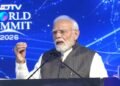
PM Modi used his BRICS address to underline India’s push for a stronger, more resilient and development-focused Global South, calling for greater cooperation in trade, technology, innovation and sustainable growth.
By PC Bureau
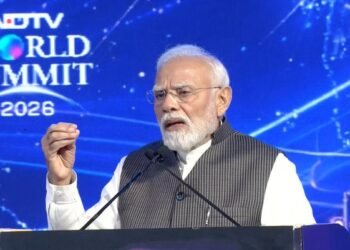
New Delhi, September 11, 2026: Prime Minister Narendra Modi on Friday sought to portray BRICS as a powerful and increasingly consequential platform for the Global South, telling the BRICS Business Forum in New Delhi that the grouping has grown dramatically since its creation two decades ago and now brings together economies representing around 40% of global GDP and nearly half the world’s population.
Speaking ahead of the 18th BRICS Leaders’ Summit at Bharat Mandapam on September 12–13, Modi said BRICS had evolved from a four-country grouping into a much larger family of emerging economies and partner countries. The 11 full members alone account for 49.5% of the world’s population, 40% of global GDP and 26% of global trade, according to the Indian government.
India is hosting the summit during its fourth BRICS chairship under the theme “Building for Resilience, Innovation, Cooperation and Sustainability.” New Delhi has sought to make the presidency less about geopolitical confrontation and more about practical cooperation in trade, technology, energy, food security, supply chains, finance and glaobal governance.
#WATCH | This forum, hosted in India, is the largest BRICS Business Forum to date. The theme of India’s BRICS chairmanship is ‘Building for Resilience, Innovation, Cooperation, and Sustainability.’ Over the past 12 years, India has made this mantra the foundation of its economic… pic.twitter.com/JFT5N9ZOuw
— DD News (@DDNewslive) September 11, 2026
Modi Pushes Trade, Technology and Innovation
Addressing what was described as the largest BRICS Business Forum so far, Modi emphasised the economic scale of the expanded grouping and the opportunities created by closer cooperation among member economies.
He highlighted the rapid growth of BRICS economies and pointed to startups and technology companies working in fields including artificial intelligence, education, healthcare, defence and space.
The Indian approach is to turn BRICS from a broad political platform into a mechanism capable of producing practical economic outcomes — including stronger supply chains, easier trade, greater investment and cooperation in emerging technologies.
The BRICS Business Forum itself has focused on trade and supply chains, investment, digital economy and development. Its recommendations are expected to feed into the leaders’ discussions and potentially into the summit declaration and subsequent work programmes.
Xi, Putin and Pezeshkian Bring Major Geopolitical Weight
The summit is bringing together leaders whose countries occupy very different positions in the international system.
Chinese President Xi Jinping is expected in New Delhi, while Putin and Iranian President Masoud Pezeshkian are among the other major leaders attending. South African President Cyril Ramaphosa and leaders from other BRICS countries and partner states are also participating.
For India, the presence of Xi is particularly significant. New Delhi and Beijing have been attempting to stabilise relations after years of military tensions along their disputed border.
At the same time, Russia’s war in Ukraine and continuing conflict in West Asia present BRICS with difficult geopolitical divisions. India wants the grouping to remain focused on development and cooperation rather than become an explicitly anti-Western alliance.
That balancing act will be one of the central challenges of the Delhi summit.
The Dollar, Payments and Trade
Another major issue confronting BRICS is how to make trade among members easier and less vulnerable to external financial pressures.
Several BRICS members have advocated greater use of national currencies and alternative payment mechanisms in cross-border trade. The objective is not simply to replace the US dollar overnight, but to reduce transaction costs and exposure to disruptions caused by sanctions, currency volatility and geopolitical tensions.
For India, the issue is particularly complicated.
New Delhi maintains extensive trade and strategic relations with Western economies while simultaneously conducting substantial trade with Russia, Iran and other BRICS members. India therefore has an interest in more flexible payment arrangements but also has little incentive to turn BRICS into a direct challenge to the dollar-based global financial system.
The broader objective is likely to be greater financial choice rather than a single BRICS currency.
An Expanded BRICS — With Bigger Economic Weight and Bigger Differences
BRICS now has 11 full members: Brazil, Russia, India, China, South Africa, Egypt, Ethiopia, Iran, Saudi Arabia, the United Arab Emirates and Indonesia.
Together they represent approximately 49.5% of the world’s population, 40% of global GDP and 26% of global trade, according to the Indian government.
The bloc’s expansion has dramatically increased its economic and geopolitical weight.
But size has also brought complexity.
China accounts for a huge share of the group’s economic strength. India and China remain strategic competitors. Russia and Iran face extensive Western sanctions. Gulf states such as Saudi Arabia and the UAE maintain deep economic relationships with Western countries while also participating in BRICS.
As a result, the bloc shares an interest in greater influence for emerging economies but does not necessarily share a common geopolitical agenda.
That diversity is both BRICS’ strength and its weakness.
India’s Fourth BRICS Chairship
India assumed the BRICS chair on January 1, 2026, marking its fourth presidency after previous chairships in 2012, 2016 and 2021.
New Delhi has placed resilience, innovation, cooperation and sustainability at the centre of its programme, with a strong emphasis on what it describes as a “Humanity First” approach.
The agenda covers economic resilience, food and energy security, healthcare, climate action, digital public infrastructure, artificial intelligence, startups and reform of multilateral institutions.
The Indian government has also positioned BRICS as an important platform for giving the Global South a greater voice in institutions such as the United Nations and international financial organisations.
READ: BRICS 2026: Modi, Putin Discuss Trade, Defence, and Energy as Global Leaders Gather in Delhi
Supply Chains and the Global Economy
Supply-chain resilience has become particularly important following the disruptions caused by the Covid-19 pandemic, the Ukraine war, tensions in West Asia and growing trade friction between major economies.
The BRICS Business Forum is examining ways to diversify supply chains, improve logistics and reduce bottlenecks in trade among member countries. A proposed BRICS logistics and supply-chain cooperation framework is among the initiatives under discussion, alongside mechanisms to connect startups and incubators across member countries.
For India, this presents opportunities in manufacturing, pharmaceuticals, technology, infrastructure, food processing and critical minerals.
The challenge is converting the huge combined market of BRICS into genuinely greater intra-group trade rather than allowing the bloc’s economic relationships to remain dominated by a few major bilateral partnerships.
Why the Delhi Summit Matters
The 18th BRICS Summit comes at a particularly difficult moment for the global economy.
The Ukraine war continues to affect energy markets and trade routes. Conflict in West Asia has created fresh uncertainty over energy supplies and shipping. Trade tensions and protectionist policies are putting pressure on developing economies, while competition between the United States and China is reshaping global supply chains.
Against this backdrop, India wants BRICS to emerge as a practical economic platform rather than simply a geopolitical counterweight to the West.
The test will be whether the expanded grouping can move beyond declarations and produce concrete cooperation on trade, payments, investment, technology, logistics and development.
For Modi, the summit also offers a rare diplomatic opportunity: within a short span, India is engaging with Putin, Xi and Pezeshkian while maintaining its expanding partnerships with Western powers.
That makes the Delhi summit about more than BRICS.
It is also a test of India’s ability to navigate an increasingly fragmented world — maintaining strategic autonomy while positioning itself as a major voice of the Global South.
And with BRICS now accounting for around 40% of global GDP and nearly half of the world’s population, what happens in Delhi is likely to matter well beyond the 11 countries that formally make up the bloc.