The CTA said Wangchuk’s comparison failed to reflect what it described as continuing restrictions on Tibetans’ rights, religious freedom and cultural identity under Chinese rule.
BY PC Bureau
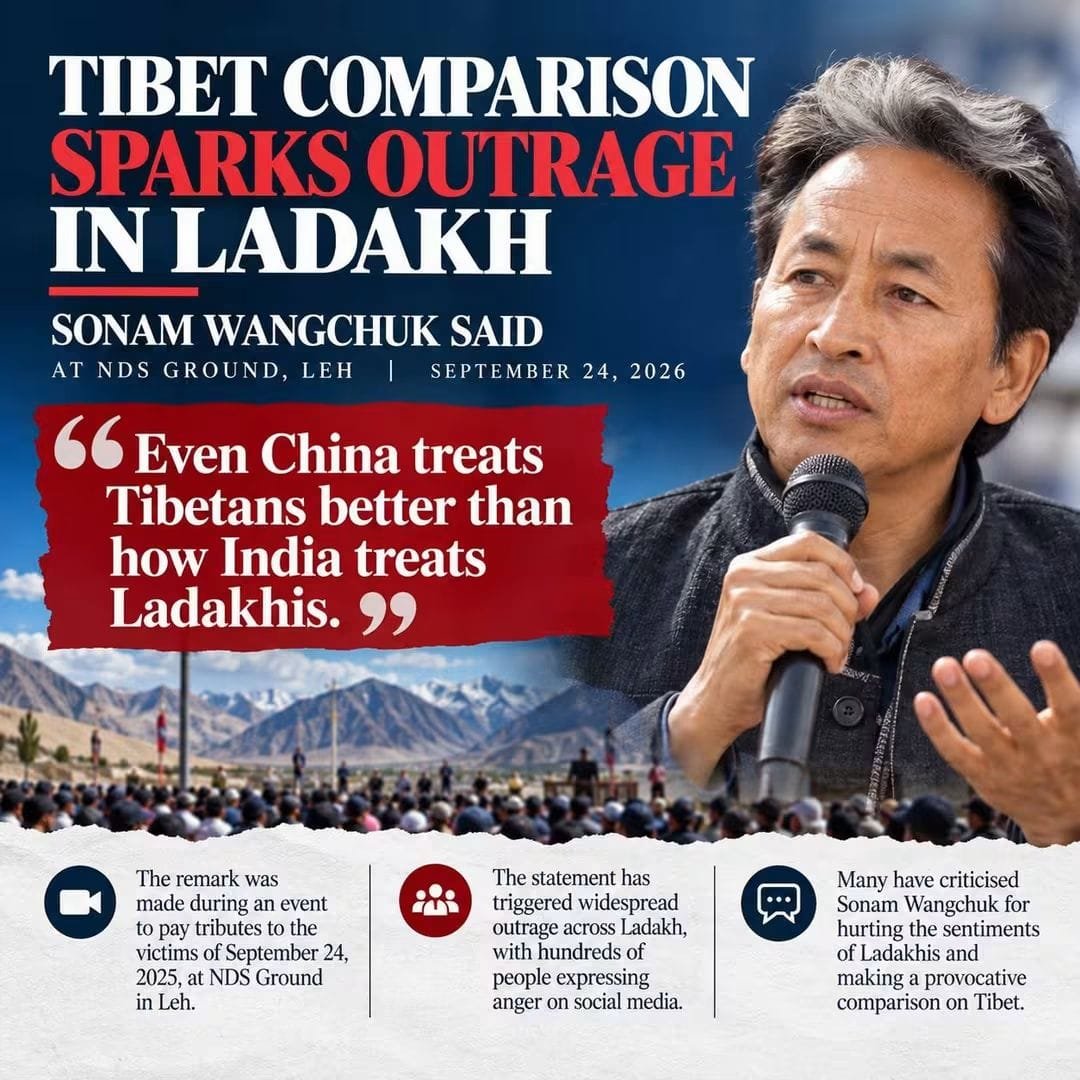
September 25: Sonam Wangchuk’s assertion that India is inflicting oppression in Ladakh that “even China is not doing in Tibet” has drawn a sharp response from the Central Tibetan Administration (CTA) as well as criticism from individual Ladakhi social-media users who said the comparison trivialised the situation in Tibet and diverted attention from Ladakh’s own concerns.
The CTA, in a statement signed by spokesperson Tenzin Lekshay, described Wangchuk’s remarks as “misplaced and inaccurate” and said they did not reflect what it described as the situation inside Tibet. The administration said Tibetans continue to face restrictions on fundamental rights and religious freedom and what it called measures aimed at eroding Tibet’s distinct cultural identity.
Wangchuk made the remarks on Thursday at the NDS Stadium in Leh, during a gathering marking the first anniversary of the September 24, 2025 violence in which four people were killed during protests over demands including statehood and Sixth Schedule safeguards. Leh observed a shutdown on Thursday. His comparison has since been reported widely.
Wangchuk said Ladakh had chosen India over China because it believed democracy would allow its people to live “with their heads held high”. He then said: “Today, the oppression India is inflicting in Ladakh, even China is not doing in Tibet.” He also demanded the resignation of Union Home Minister Amit Shah, sought publication of the judicial inquiry report into last year’s violence and alleged that security forces had used automatic weapons against protesters.
What the CTA said
The Tibetan administration in Dharamshala said Wangchuk’s analogy failed to distinguish between political grievances within a democratic system and conditions that the CTA says prevail under Chinese rule in Tibet.
Its response focused particularly on restrictions on religious freedom and Tibetan cultural identity, arguing that the comparison understated the circumstances faced by Tibetans.
CTA labels Wangchuk’s comparison of Ladakh situation with Tibet as incorrect.
Sonam Wangchuk said “and today such oppression is being carried out against Ladakh that even China is not doing to Tibet what is being done here.”
He is misguiding locals. #Ladakh #CTAcriticism #Leh pic.twitter.com/AEQHF4n06p
— Tanzin Stanzin (@tanzinstanzin1) September 25, 2026
Criticism from Ladakh
Several users identifying themselves as being from Ladakh criticised Wangchuk’s remarks on social media.
Some argued that comparing India with China overlooked the continuing impact of Chinese control on Tibet and the concerns of Tibetan refugees and religious figures living in India. Others said Wangchuk should focus on issues closer to home, including the concerns of Changthang nomads and alleged loss of grazing areas along the India-China frontier.
One user, Ladakh Nomad, argued that Wangchuk should visit Changthang and address the problems faced by nomads rather than invoke Tibet. Another, Stanzin Norbu, criticised the comparison between what the user described as a democratic India and China’s political system.
Other commenters objected to what they perceived as Wangchuk’s remarks about Tibetans, rinpoches and monasteries in India. Some accused him of raising sensitive Tibetan issues in a way that could create divisions within Ladakh’s Buddhist community.
Several comments also referred to alleged restrictions in Tibet, including limits on religious expression, the treatment of prisoners and the Dalai Lama’s status. These were individual social-media assertions and were not independently verified.
The criticism therefore came from two different directions: the CTA challenged Wangchuk’s description of conditions in Tibet, while some Ladakhi commenters argued that the comparison itself was misplaced and risked obscuring Ladakh’s own concerns, including land, grazing rights and the situation along the Chinese frontier.
READ: NSCN-IM Insists Flag, Constitution Non-Negotiable in Naga Peace Talks
Two separate Himalayan questions
Wangchuk’s remarks came amid a continuing campaign for greater political representation and constitutional safeguards for Ladakh following the September 2025 violence. The CTA, meanwhile, has long maintained that Tibet remains under Chinese rule and has documented what it regards as restrictions on Tibetan religious, cultural and political freedoms.
The dispute has consequently brought two distinct issues into the same debate: Ladakh’s demands for greater democratic and constitutional safeguards within India, and the CTA’s opposition to Chinese rule in Tibet.
The CTA’s intervention makes clear that it does not accept Wangchuk’s attempt to place the two situations on the same plane.