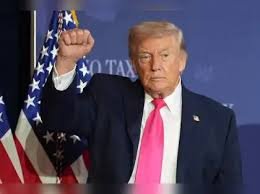
While Trump has publicly rejected any suggestion that US policy toward Iran is being shaped by the November elections, US officials cited by the Wall Street Journal say he remains sceptical that Tehran will accept his terms and expects military action could resume after the midterms.
BY PC Bureau
Iran’s seven-day ceasefire proposal has been rejected by US President Donald Trump, who has told aides that he expects American bombing of Iran to resume after the November midterm elections, according to a Wall Street Journal report citing US officials. Reuters said it could not immediately independently verify the WSJ report.
Under Tehran’s proposal, Iran would reopen the strategically vital Strait of Hormuz and resume nuclear negotiations with Washington. In return, the United States would lift its naval blockade of Iranian ports, ease sanctions on Iranian oil exports and observe a ceasefire extending to Lebanon.
Iranian Foreign Minister Abbas Araghchi said the seven-day timeline would begin as soon as Washington accepted the proposal. Initial steps would take four to five days, the Strait of Hormuz would reopen on the sixth day, and formal nuclear negotiations would begin on the seventh. Araghchi said the US measures required under the proposal were already contained in a June memorandum of understanding between the two sides. The offer was conveyed through Qatar.
FM @araghchi explains the seven-day plan to reopen the Strait of Hormuz if Iran’s conditions are accepted.
He said the seven-day period will begin once the United States accepts the plan. If that happens tomorrow, implementation will start immediately.
If the necessary steps… pic.twitter.com/PiKxMRllHj
— Tehran Times (@TehranTimes79) September 25, 2026
Trump has publicly said Iran is seeking a post-midterm agreement that would dismantle its nuclear programme. Privately, however, US officials told the Journal that Trump remains doubtful Tehran would accept his terms and has indicated that renewed US bombing is likely.
The extent of any renewed military action remains unclear. Trump is also said to be reluctant to restart major combat operations in part because Washington wants to conserve its dwindling stockpiles of munitions for other potential contingencies.
The Trump administration has informed Iran and regional mediators that the United States does not intend to lift its maritime blockade. US officials believe sustained economic pressure could eventually force Tehran to accept an agreement more favourable to Washington and its Gulf Arab partners. Negotiations through intermediaries are continuing, including over the nuclear issue.
At the same time, an American-led effort to keep oil tankers moving through the Strait of Hormuz has reduced the immediate pressure for a diplomatic settlement.
READ: Wangchuk Says India Worse Than China in Ladakh, Draws All-round Flaks
Why the Strait of Hormuz matters
The Strait of Hormuz is the narrow maritime passage between Iran and Oman connecting the Persian Gulf with the Gulf of Oman and the Arabian Sea. It is one of the world’s most important energy chokepoints because much of the oil and natural gas produced by the Gulf states must pass through it to reach global markets.
In 2024, roughly 20 million barrels of oil and petroleum products a day passed through the strait — equivalent to about one-fifth of global petroleum liquids consumption and more than a quarter of global seaborne oil trade. About one-fifth of global LNG trade also transited Hormuz, primarily from Qatar.
The significance of Hormuz is not simply the volume of energy passing through it. There are limited alternatives. Existing pipelines in Saudi Arabia and the UAE can bypass only part of the flow; the US Energy Information Administration estimates that the two countries’ relevant pipeline systems together have about 4.7 million barrels per day of capacity.
That makes any sustained disruption potentially consequential for the global economy. A serious interruption could tighten oil and LNG supplies, raise tanker and insurance costs and push up energy prices, with effects reaching far beyond the Middle East. Asian economies are particularly exposed because much of the LNG and oil moving through Hormuz is ultimately destined for Asian markets. In 2024, China, India and South Korea together accounted for 52% of LNG flows through the strait.
That is why Iran’s offer to reopen Hormuz is a major bargaining element rather than simply a regional shipping concession. Tehran is effectively linking access to one of the world’s critical energy arteries to the lifting of the US maritime blockade, sanctions relief and the resumption of nuclear negotiations.
At the United Nations General Assembly this week, Trump insisted that domestic politics would not influence his Iran policy.
“The Republican Party is running, and I’ll be helping them, but I am not running.”
He said he would give “absolutely no credence” to the election when deciding how to deal with Iran, adding that his priority was ensuring that Iran “will never have a nuclear weapon.”
The Strait of Hormuz therefore remains at the centre of both the military confrontation and the diplomatic bargaining. Iran has tied its reopening to sanctions relief and renewed negotiations, while Washington has so far indicated that it intends to maintain the maritime pressure. The standoff leaves the waterway as one of the principal pressure points in the wider US-Iran confrontation.