From a deadly operation near the Myanmar border to the case of foreign nationals accused of training anti-junta fighters in drone warfare, India’s response raises questions about militant networks, strategic interests and the consistency of its security assessments.
By Navin Upadhyay
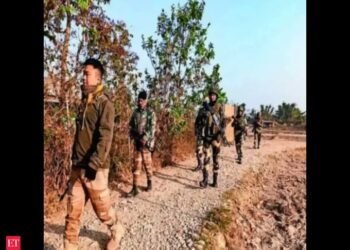
On May 14, 2025, Assam Rifles launched an operation near New Samtal village in Manipur’s Chandel district, close to the Myanmar border. Ten armed cadres were killed. The Army said its troops, acting on intelligence about the movement of armed cadres, came under fire and retaliated. Media reports, citing security sources, identified the dead as suspected members of the Kuki National Army-Burma (KNA-B), an armed group associated with resistance against Myanmar’s military junta.
More than a year later, the case of American national Matthew Van Dyke and six Ukrainian nationals raised a different but related question about India’s approach to armed groups operating across the border and pursuing same objectives. Arrested by the National Investigation Agency (NIA) in March 2026, the seven were accused of entering sensitive areas without the required permits, crossing into Myanmar and providing drone-warfare training to ethnic armed groups fighting the junta. Reports citing security sources linked the training to the Kuki-Chin Army, an armed group opposed to Myanmar’s military regime.
The contrast is striking. If the cadres killed in Chandel were indeed KNA-B members, they belonged to an anti-junta armed organisation. If the foreign nationals were training groups fighting the same military regime, why did the two cases produce such different outcomes? And what criteria does India use to distinguish between armed networks it considers a threat and those whose activities may align with broader strategic interests?
The comparison does not establish that the two cases involved the same organisation. Nor does it prove that the men killed in Chandel posed no threat to Indian forces. But it raises a question that deserves a clear answer: how does New Delhi assess the security implications of armed groups operating on both sides of the India-Myanmar border?
READ: Manipur’s Crisis of Justice: The Growing Valley-Hill Divide
The Chandel operation: Who were the men killed?
The May 2025 operation took place in a sensitive border region where ethnic armed organisations, insurgent networks and Myanmar’s civil war intersect. According to the Army, troops came under fire and retaliated, recovering weapons and ammunition.. The KNA-B is associated with resistance to Myanmar’s junta. If the men killed were its members, their opposition to the military regime would be relevant to understanding their role in the conflict—and their usefulness to the Indian establishment..
Of course, an anti-junta affiliation does not automatically make an armed group friendly to New Delhi. Its activities on Indian territory, possession of weapons, cross-border movements and links to insurgent organisations could all affect India’s security assessment. Equally, the fact that an armed group operates near the border does not, on its own, establish that its members were engaged in hostile activity against India.
The Van Dyke case: From terror allegations to an immigration chargesheet
NIA says it has “no objection” if US national Matthew VanDyke returns to America. His bail has been extended till Feb 24, 2027.
He was arrested in March over alleged Myanmar arms-training links—but UAPA charges were not filed in the chargesheet. https://t.co/DXTIxZVozv
— 𝐌𝐨𝐧𝐨𝐣𝐢𝐭 𝐒𝐢𝐧𝐡𝐚 (@MonojitSinha11) October 24, 2026
The case against Van Dyke and the six Ukrainians brings the question of India’s security criteria into sharper focus.
The NIA initially investigated the accused under the Unlawful Activities (Prevention) Act (UAPA), alleging links to ethnic armed groups and involvement in drone-warfare training. The agency also raised concerns about their movements through Northeast India into Myanmar and alleged connections between the groups they assisted and insurgent organisations operating in India. These were allegations under investigation, not findings of guilt.
In September 2026, the NIA filed a chargesheet under the Immigration and Foreigners Act, 2025, without including UAPA offences in that filing. The agency told the court that its investigation into possible offences under the anti-terror law remained open and that a supplementary chargesheet could follow if further investigation established an offence. The accused subsequently obtained default bail after the statutory period expired without a UAPA chargesheet.
Was Van Dyke’s release influenced by American pressure?
The question of possible American pressure cannot be dismissed, but neither can it be treated as an established fact. Congress leader Jairam Ramesh questioned whether the NIA’s decision to omit UAPA offences from its chargesheet followed the investigation’s findings or pressure from US authorities. Reports also said that US Ambassador Sergio Gor had raised the case with Foreign Secretary Vikram Misri. These developments prompted questions about whether diplomatic considerations played a role, but no publicly established evidence proves that Washington secured Van Dyke’s release.
The immediate legal basis for his default bail was procedural: the NIA had not filed a chargesheet under the UAPA within the applicable statutory period. Default bail is a legal safeguard, not an acquittal, and the investigation into possible anti-terror offences remained open. Was Van Dyke’s release solely the consequence of that legal safeguard, or did diplomatic pressure influence the course of the case? The available public record does not conclusively answer that question.
That leaves several questions. What was the precise identity of the groups receiving the training? What equipment and technical expertise were transferred? What evidence linked those groups to Indian insurgencies? And how did investigators distinguish between training intended to support resistance to Myanmar’s junta and activities that could threaten India?
The answers matter because drone warfare, assembly skills and jamming technology can have implications beyond the conflict for which they are ostensibly intended. But those risks must be assessed through evidence about the groups involved and their activities, rather than assumptions based solely on their opposition to the junta.
A strategic distinction—or an unexplained inconsistency?
The Chandel operation and the Van Dyke case are not legally equivalent. One was a military operation in which the Army said its troops came under fire; the other involved arrests, an investigation and judicial proceedings. Their different outcomes therefore do not, by themselves, demonstrate a double standard. Nor does the available public evidence establish that diplomatic pressure determined the NIA’s decision not to include UAPA offences in its
The central question is not whether India should support every group fighting Myanmar’s junta, or oppose every armed organisation operating near its border. It is whether the government applies consistent, evidence-based criteria when assessing their activities and their implications for Indian security.
That question matters acutely in Manipur, where cross-border militant networks and the wider Myanmar conflict can have direct consequences for local security. Without greater clarity about the identities, affiliations and activities of the groups involved, it is difficult for the public to understand why one set of armed cadres becomes the target of a military operation while foreign nationals accused of training anti-junta fighters proceed through a different legal process.
The contradiction, therefore, is not proof of a double standard. It is a question of accountability: what determines India’s treatment of armed groups in Myanmar’s conflict, and how consistently are those criteria applied when the consequences reach Manipur?