

Demonstrations brought together students, workers, trade unions and Yellow Vest activists across France. While many marches began peacefully, clashes erupted in Paris and other cities, prompting police to use tear gas and water cannons.
BY PC Bureau
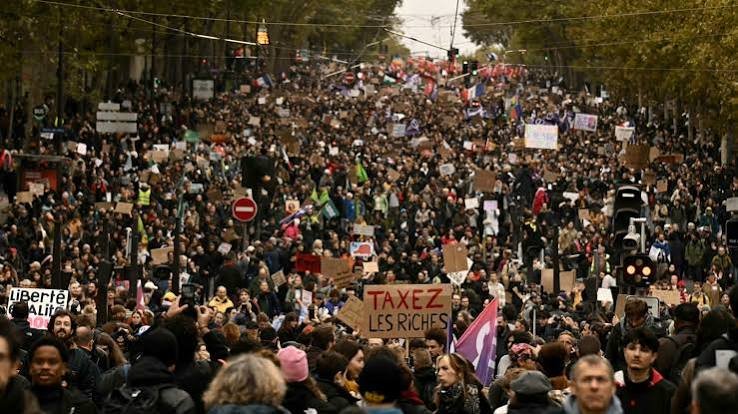
October 24: Hundreds of thousands of people marched across France on Saturday to protest rising living costs, economic inequality and deteriorating public services, as the government deployed 70,000 police and gendarmes in an extensive security operation aimed at preventing a repeat of the previous weekend’s rioting and looting.
The Interior Ministry estimated that around 410,000 people participated nationwide, including approximately 110,000 in Paris. Trade unions put the overall turnout at nearly twice the official figure, highlighting a continuing dispute over the scale of public discontent. Although many demonstrations proceeded peacefully, clashes erupted in Paris and several other cities as the day progressed.
The protests brought together students, workers, trade union members and activists associated with the Yellow Vest movement in France. Their grievances range from inadequate school funding and employment difficulties to housing costs, purchasing power and concerns about the quality of public services. What began with student demonstrations over school conditions has developed into a wider expression of anger over economic hardship and social inequality.
READ: Van Dyke Freed, 10 KNA-B Cadres Killed: The Contradictions in India’s Myanmar Policy
Clashes erupt despite extensive security deployment
Authorities deployed 70,000 police officers and gendarmes nationwide, 10,000 more than during the demonstrations on October 17. Police were supported by helicopters, drones, armoured vehicles and water cannon, while soldiers from the Sentinelle anti-terrorism operation patrolled sensitive locations in Paris.
France Interior Minister Laurent Nuñez urged officers to respond swiftly to attempts to attack businesses, public institutions and security personnel. The operation followed last weekend’s unrest, when widespread vandalism and looting damaged thousands of businesses and raised questions about the authorities’ ability to maintain public order.
BREAKING:
Paris, France, right now. https://t.co/bRoLwwC6ck
— Globe Eye News (@GlobeEyeNews) October 24, 2026
In Paris, the main authorised march attracted large crowds despite restrictions on its route. The procession, involving union members and demonstrators carrying flags and placards, was largely peaceful. However, near the end of the march, groups of hooded youths threw projectiles at police, who responded with tear gas and water cannon.
Clashes were also reported in Marseille, Lyon, Bordeaux and Grenoble, while police used tear gas in several other cities. In Marseille, some youths erected street barricades, set rubbish bins on fire and threw rocks and bottles at riot police. Reports of damage and confrontations emerged as the demonstrations continued into the evening.
The Interior Ministry said 135 people had been arrested nationwide by early afternoon. Police searches conducted before and during the demonstrations reportedly uncovered fireworks, ball bearings and other objects that authorities considered potential weapons. Arrest figures and the extent of damage varied across locations as events unfolded.
Macron tried to crackdown on the protests, but it backfired!
Hundreds of thousands of people have turned out across France today to send a clear message that the people won’t be silenced by Macron’s regime.
Neoliberalism is a failed ideology that has accomplished nothing except making the rich richer and tearing our world apart with imperialist wars all while emboldening neofascism. https://t.co/gpVHJ9pXYm
— Power to the People ☭🕊 (@ProudSocialist) October 24, 2026
Paris takes precautions against renewed looting
Much of central Paris adopted an unusually restrictive security posture ahead of the demonstrations. Shopkeepers boarded up storefronts, luxury retailers strengthened security and more than 20 metro stations were closed. Major cultural institutions, including the Louvre, the Musée d’Orsay and the Paris Opera, also shut their doors as a precaution.
Business groups had urged retailers to close after the previous weekend’s violence left shops damaged and goods stolen. The scale of the preparations reflected fears that criminal groups or violent individuals could exploit large crowds to target commercial districts and public buildings.
Authorities also changed the route of the main Paris demonstration, directing it away from central areas towards the southeastern outskirts of the capital. Police said the originally proposed route posed a risk of disorder because it passed through areas with businesses similar to those targeted during the October 17-18 unrest.
The decision drew criticism from left-wing political figures and protest organisers, who argued that restrictions made it harder to exercise the right to demonstrate. Jean-Luc Mélenchon, leader of the left-wing France Unbowed movement, criticised the last-minute changes and accused the authorities of creating obstacles for organisers.
Restrictions varied across the country. Some demonstrations were banned or confined to designated routes, while authorities in Marseille reversed an earlier restriction and permitted a union-led march. The measures intensified debate over how the government should balance public safety with the right to peaceful protest.
Student grievances expand into wider social movement across France
The current wave of demonstrations began with student protests over school conditions, staffing shortages and inadequate educational resources. It subsequently attracted workers and unions, broadening into a movement focused on living standards and the state of public services.
Student organisations are demanding more places in higher education, improved school facilities and additional teachers. They have also called for changes to the national university admissions system and greater financial support for students struggling with rent and everyday expenses.
Workers and other demonstrators have raised concerns about wages, housing affordability and the erosion of purchasing power. For many participants, the protests reflect frustration that economic pressures are becoming increasingly difficult to manage while public services face persistent demands.
The movement has also revived the visibility of Yellow Vest activists, whose protests first emerged in 2018 over fuel taxes and broader concerns about economic fairness. Their participation alongside students and trade unions has helped bring different grievances into a shared national mobilisation, although the movement remains diverse in its demands and political outlook.
The protests have not been confined to France. Demonstrations were also reported in neighbouring European countries, including Belgium and Italy, where public discontent has similarly centred on economic pressures and government policies.
Political tensions rise ahead of 2027 election
The demonstrations present another challenge for President Emmanuel Macron’s government as France approaches the 2027 presidential election. The unrest has put economic inequality, public spending, education and policing at the centre of national debate.
Government officials have argued that violent groups and looters have exploited legitimate demonstrations to attack businesses and public institutions. Left-wing politicians and some organisers, meanwhile, have accused the authorities of using the threat of disorder to restrict protests and failing to address the underlying causes of public anger.
Tensions were further heightened by a shooting west of Paris on Friday in which one person was killed and four others were wounded. Investigators reportedly suspected an Islamophobic motive, although the circumstances remained subject to investigation. The incident added to an already tense atmosphere as authorities prepared for the nationwide demonstrations.
A separate protest took place in Orléans against the far-right National Rally, which was holding a party congress in the city. The gathering added another political dimension to a weekend marked by disputes over public security, political extremism and France’s future direction.
The government faces the challenge of responding to widespread social grievances while preventing further attacks on businesses, public buildings and security personnel. The previous weekend’s disorder had already prompted a review of police tactics and raised questions about the effectiveness of security deployments.
Unrest remains a test for the government
Saturday’s demonstrations were marked by a contrast between large, largely peaceful marches and pockets of violence in several cities. The reinforced police presence appeared to limit the scale of disorder compared with the previous weekend, although clashes, arrests and property damage showed that the risk of further unrest remained.
The turnout also demonstrated that concerns over living costs, education and public services extend beyond a single group or issue. Students, workers, unions and other activists have brought different demands into the streets, creating a broad movement that is likely to remain a challenge for the government.
Whether the protests translate into concrete policy changes remains uncertain. For now, the demonstrations have intensified pressure on Macron’s government to address public concerns while restoring confidence in its ability to maintain order without unnecessarily restricting peaceful dissent.
With the presidential election approaching and economic pressures continuing to shape public debate, France faces a difficult balance between responding to social discontent and preventing further violence. The scale of Saturday’s mobilisation suggests that the underlying grievances have not been resolved.