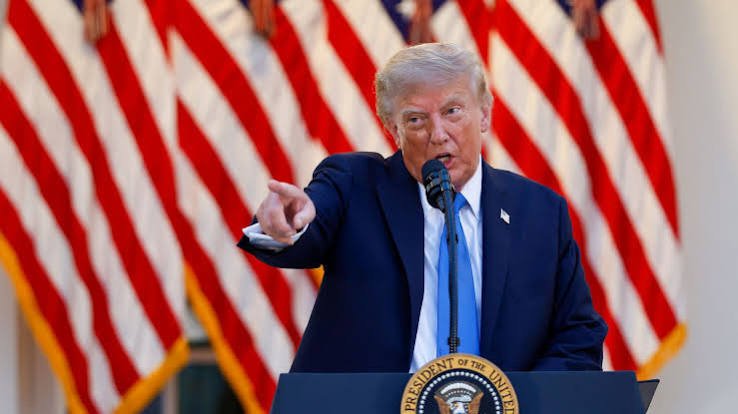
The election-linked cash promise has drawn comparisons with India’s “revdi” politics, with critics calling it an attempt to influence voters while Trump presents it as a dividend from America’s economic success.
BY PC Bureau
September 10, 2026: US President Donald Trump has promised to issue a $5,000 “Trump dividend” to every adult US citizen if Republicans retain control of both the House of Representatives and the Senate in the November 2026 midterm elections.
Trump made the pledge on September 9 during his keynote address at the Republican National Midterm Convention in Dallas, Texas, presenting the proposed payout as a reward for what he described as the economic success of his administration.
“If the Republicans win the House of Representatives and the United States Senate, both of them … because of our tremendous strength and success economically, I will issue a dividend to every adult citizen in the United States of America for $5,000,” Trump said.
The proposed $5,000 cash payment to every adult American is inviting comparisons with India’s pre-election “freebie” politics—but the analogy needs a qualification. He compared the proposed payment to a company distributing profits to its shareholders and said the money would have to be spent within the United States. “It must be spent in the United States of America,” he said, ruling out spending in countries including Canada, China and Germany.
A $1.2 Trillion-Plus Promise
The scale of the proposal is enormous. With roughly 245 million adult US citizens, a $5,000 payment to each would cost about $1.2 trillion. Depending on how eligibility is ultimately defined, the bill could be substantially higher.
Trump pointed to tariff revenues and broader economic performance as the potential source of the money. He has previously floated a $2,000 “tariff dividend”, while his administration has also announced other one-time payments, including the $1,776 “Warrior Dividend” for military service members.
🚨🚨BREAKING: If the Republicans win the midterms, President Trump just promised to pay $5k to every American adult out of the revenue generated by U.S. tariffs. pic.twitter.com/uCAsYdIioA
— American Principles Project (@approject) September 10, 2026
But the new proposal contains few details. Trump did not explain how the payments would be distributed, how eligibility would be verified, how Americans living overseas would be treated, or—most significantly—how the government would enforce his requirement that the money be spent inside the United States.
Nor can the president simply order such a programme into existence. Under the US Constitution, Congress controls federal spending. Any nationwide $5,000 payment would therefore require legislation authorising and funding it.
Even if Republicans retain both chambers, Congress would have to determine who qualifies, how the programme would be financed and whether tariff revenues would be sufficient. Any shortfall could require borrowing or the redirection of other federal revenues.
Campaign Promise or Vote-Buying?
The timing of the announcement has inevitably raised questions about whether the proposal amounts to an attempt to influence the midterm vote.
Trump made the pledge while urging Republicans to treat the 2026 elections as though he himself were on the ballot. Republicans also face the traditional midterm disadvantage confronting the party occupying the White House.
Critics have described the proposal as an election-season “bribe” or an attempt to buy votes, while supporters have portrayed it as a way of sharing the proceeds of tariffs and economic growth directly with ordinary Americans.
The distinction between a legitimate economic dividend and a politically motivated cash handout is likely to become a central issue if the proposal gains traction.
Trump Takes a Page From India’s ‘Freebie’ Politics?
The proposal also invites comparisons with India’s increasingly prominent “freebie” or revdi politics, in which governments and political parties promise direct cash transfers, subsidies and other tangible benefits to voters.
Indian governments have used direct-benefit schemes targeting women, farmers, newborns and other groups, while pre-election announcements of financial assistance and subsidies have become an established feature of electoral politics.
Trump’s earlier proposals—including the $1,000 “Trump Accounts” for newborns and the proposed $2,000 tariff dividend—had already prompted comparisons in India with the country’s direct-transfer model.
The new $5,000 proposal takes that logic to a vastly larger scale. Instead of promising a targeted welfare benefit, Trump is proposing a nationwide cash payout to virtually an entire adult citizen population, but making the pledge conditional on Republicans retaining both chambers of Congress.
The comparison is not exact: India’s welfare schemes are generally framed as social or economic policy, whereas Trump is explicitly tying this proposed dividend to a Republican electoral victory. But politically, both reflect the growing appeal of putting cash benefits directly in voters’ hands.
READ: Apple Unveils iPhone 18 Pro, Foldable iPhone, New Watches and AirPods; Raises Prices
What Happens Next?
For now, the “Trump dividend” remains a campaign promise rather than government policy.
Its implementation would depend first on Republicans retaining both the House and Senate, and then on Congress passing legislation to authorise and finance the payments.
The sheer administrative challenge would also be considerable. If around 245 million people were eligible, the government would have to process hundreds of millions of payments while attempting to enforce Trump’s unusual requirement that the money be spent domestically.
Yet the proposal has already achieved one immediate objective: it has injected a potentially transformative—and highly controversial—cash promise into the 2026 midterm campaign.
Trump calls it a dividend on America’s economic success. His opponents are likely to call it something else: a $5,000 incentive for voters to keep Republicans in power.