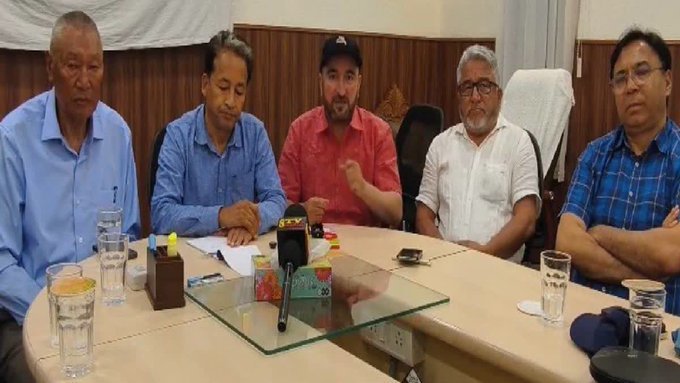
The Leh Apex Body and Kargil Democratic Alliance had expected Wednesday’s talks to produce a concrete constitutional draft. Instead, they said, the Centre presented questions for further discussion, leaving key issues such as executive powers, finances, planning and law and order unresolved.
BY PC Bureau
New Delhi/ September 10: The Centre on Wednesday offered Ladakh a proposed special constitutional provision, Article 371(K), that would create a directly elected governing body with legislative powers over land, culture and language, forests, environment and natural resources. But the proposal failed to satisfy Ladakh’s two main political groups, the Leh Apex Body (LAB) and Kargil Democratic Alliance (KDA), who said the Ministry of Home Affairs did not place even a draft of the proposed provision before them.
Article 371(K) does not currently exist in the Constitution. It is the proposed designation for a special constitutional arrangement for Ladakh, broadly modelled on Articles 371 and 371-A to 371-J, which provide different forms of protection and autonomy to several states.
The existing provisions vary considerably. Some provide for development boards, while others protect customary laws, land and cultural practices. Article 371-A, for instance, provides special safeguards for Nagaland, while Article 371-G does so for Mizoram. Assam, Manipur, Sikkim, Arunachal Pradesh and Goa have their own special constitutional arrangements.
The proposed Article 371(K), however, would be distinctive because it would apply to a Union Territory rather than a state. The proposal discussed so far envisages a directly elected, UT-level body with legislative powers over specified subjects.
It would also differ from extending the Sixth Schedule, which provides for district-level Autonomous District Councils in parts of the Northeast.
In essence, 371(K) is being presented as a constitutional safeguard for Ladakh’s land, identity, culture, languages and natural resources, backed by an elected governing institution. But until the Centre circulates an actual draft, the precise scope of its powers remains unclear.
READ: Heavy Damage to Multiple US Warplanes In Iran’s Strike on Jordan
PRESS NOTE
Leh Apex Body (LAB) and Kargil Democratic Alliance (KDA) met with representatives of the Ministry of Home Affairs today in furtherance of the In-PrincipleUnderstanding arrived at in the meetings dated 22nd May and 3rd July on restoring democracy in Ladakh,… pic.twitter.com/mrrLEfAyWY
— 𝐒𝐚𝐣𝐣𝐚𝐝 𝐊𝐚𝐫𝐠𝐢𝐥𝐢 | سجاد کرگلی (@SajjadKargili_) September 9, 2026
Groups disappointed over absence of draft
The LAB and KDA had come to Delhi expecting the Centre to place before them a draft setting out the proposed body’s structure, powers and constitutional safeguards. Instead, they said, they were given a set of questions for discussion at the next round of talks, expected to be held in Kargil in the first week of October.
LAB member Sonam Wangchuk said there had been “no special progress” since the May 22 meeting.
“People had lots of expectations because four months have passed… But today the draft also did not come in front of us,” he said.
KDA representative Sajjad Kargili said the groups had expected the negotiations to move forward from the earlier broad understanding on an elected UT-level body.
“Unfortunately, we were disappointed,” he said.
Government officials reiterated that the proposed Article 371(K) would provide for elections following delimitation and the creation of constituencies, besides safeguards relating to land, mining, identity, culture and languages.
But the Ladakh groups said such assurances would have to be translated into legal text before they could assess their significance.
Executive powers, finances and police remain unclear
The biggest unresolved issue is not merely the creation of an elected body, but how much power it would actually exercise.
The LAB and KDA said there was still no clarity over whether the proposed institution would have executive authority, control over budgets and development planning, or any role in police and law-and-order matters.
The May and July rounds of talks had produced an in-principle understanding on restoring an elected form of government in Ladakh under a special constitutional arrangement. Minutes of the May 22 meeting were subsequently revised to refer to the elected body’s control and supervision over officials dealing with subjects falling within its jurisdiction.
Wednesday’s meeting, however, did not translate that understanding into a draft constitutional provision, the groups said.
Ladakh Chief Secretary Ashish Kundra struck a more positive note, saying the “broad contours of a sui-generis model of governance under Article 371” had been discussed and that “deepening democracy is the goal.”
Groups seek legislation in Winter Session
The LAB and KDA have demanded that a bill incorporating the proposed constitutional safeguards be introduced in Parliament as early as the Winter Session.
They have also sought an assurance that no major irreversible changes in governance or land transfers would be undertaken before the proposed 371(K) body is constituted.
Wangchuk said the demand had been submitted in writing and warned that agitation could resume if major decisions were taken before the new constitutional mechanism was established.
The Centre also indicated compensation for those killed or injured during the September 24, 2025 violence in Leh. The Ladakh groups, however, rejected a phased withdrawal of cases linked to the violence and demanded that all such cases be withdrawn together.
Those issues remain separate from the larger and still unresolved question of what Article 371(K) will actually provide.
For now, the central point of contention is simple: the Centre has outlined the idea of a special constitutional arrangement, but Ladakh’s political groups are still waiting to see the law on paper.