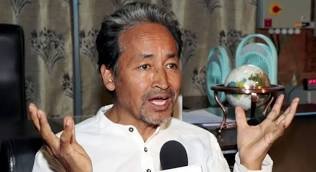


Announcing a region-wide protest on November 12, Wangchuk has demanded justice for those killed in the September 2025 Leh violence, resolution of cases against 70–80 injured people and postponement of the elections until May or June.
BY PC BUREAU
New Delhi/ November11:
Climate activist Sonam Wangchuk has strongly opposed the Ladakh administration’s decision to hold elections to the region’s eight Autonomous Hill Development Councils (LAHDCs) on December 4, questioning the urgency of conducting the polls during the harsh winter and warning that the schedule could disenfranchise a substantial section of the population.
Addressing a press conference in Leh on November 10, Wangchuk said elections to such important local governing bodies had never before been held in December in Ladakh. He questioned why the administration was rushing through the electoral process when large parts of the region become difficult to access during winter.
“Never before in history have elections been held in December,” he said, asking why there was such urgency to conduct the crucial elections at a time when temperatures plunge, snowfall blocks roads and mountain passes become inaccessible.
Wangchuk argued that the timing could prevent many residents from exercising their democratic rights. According to him, around 40 per cent of Ladakh’s population leaves the region during winter, while nearly 20 per cent of its young people travel to other parts of the country for education. Patients, elderly residents and families also move out during the extreme cold.
He said holding elections when a substantial section of the electorate was away would undermine the representative character of the councils. He proposed that the polls be conducted in May or June, when weather conditions are considerably better and more residents are present in Ladakh.
READ: Where Is Alice Huang? Chinese Woman Linked to Nvidia CEO Remains Untraceable
Questions legality of election schedule
Wangchuk also questioned the time allowed for the nomination process, raising concerns about the legal validity of the election notification.
According to the legal counsel advising the protesting groups, the notification does not provide adequate time for filing and withdrawing nominations. Wangchuk said only 11 days had been allotted for the process, making the schedule legally untenable and potentially inconsistent with the provisions of the Representation of the People Act.
He called on the administration to reconsider the notification rather than push ahead with what he described as a hurried electoral exercise.
The Ladakh administration has scheduled polling to all eight councils for December 4, with November 17 as the last date for filing nominations, November 18 for scrutiny and November 20 for withdrawal of candidature. The entire process is scheduled to be completed by December 8.
#WATCH | Leh, Ladakh: Activist Sonam Wangchuk says, “This concerns the announcement of Hill Council elections across the eight new districts of Ladakh. Never before in history have elections been held in December… Why is there such an urgency to hold these crucial elections in December? Furthermore, according to our legal counsel, the election notification does not provide adequate time for the nomination and withdrawal processes. Only 11 days have been allotted, which is, in a sense, legally untenable. This goes against the Representation of the People Act. We are, therefore, calling for a reconsideration of this decision…. In light of this, a protest is scheduled for November 12, when the entire community will gather. We will continue our sit-in protests until our demands are met. We seek justice for those who lost their lives. We also demand a resolution for the 70 to 80 injured individuals who are currently facing legal cases. Furthermore, we propose that the elections be held in May or June, when weather conditions are favourable, and people are actually present in Ladakh…” (10.11)
— ANI (@ANI) November 11, 2026
Protest announced for November 12
Wangchuk announced that a large-scale protest would be held on November 12, with people from across Ladakh expected to participate.
He said the sit-in demonstrations would continue until the demands of the people were addressed. The agitation, he indicated, was not confined to opposition to the election timetable but was also linked to unresolved demands arising from the September 24, 2025 violence in Leh.
The protesters are seeking justice for those who lost their lives during the violence and a resolution of the legal cases involving around 70 to 80 people injured in the incidents.
Wangchuk said those injured should not continue to face legal proceedings without a satisfactory resolution of their grievances. The protesters have also demanded the release of the judicial inquiry report into the September 24 incidents.
The violence had intensified tensions between the administration and groups campaigning for constitutional safeguards, democratic rights and greater political autonomy for Ladakh.
Opposition extends beyond election timing
The opposition to the December 4 polls has been building across Leh and Kargil. The Leh Apex Body (LAB) and the Kargil Democratic Alliance (KDA), which have been spearheading the movement for constitutional safeguards and greater autonomy, have raised concerns over the election process and the administration’s handling of issues affecting the region.
Apart from the winter schedule, concerns have also been raised about the delimitation of constituencies following the creation of six new districts out of the erstwhile Leh and Kargil districts.
The creation of eight districts has expanded the number of LAHDC constituencies to 100 across Ladakh. Critics have questioned aspects of the delimitation exercise and demanded greater consultation with local stakeholders.
The opposition also reflects wider dissatisfaction over the Centre’s response to Ladakh’s demands, including constitutional safeguards under the Sixth Schedule, statehood and protection of land and employment rights.
The November 12 protest is therefore expected to bring together several strands of the ongoing political movement, including demands for accountability over the September 2025 violence and opposition to decisions taken by the administration.
Administration defends winter elections
The Ladakh administration, meanwhile, has defended the decision to hold the elections in December, arguing that the timely constitution of elected councils is important for governance and budgetary planning.
Chief Secretary Ashish Kundra said the newly constituted councils would need January, February and March to prepare the budget for the next financial year. He also said the administration had instructed deputy commissioners to ensure adequate arrangements at polling stations, including heating facilities and separate queues for senior citizens.
The administration has maintained that the elections are part of efforts to strengthen democratic institutions in the newly created districts.
However, Wangchuk and other representatives of the regional movement argue that the exercise should not be rushed at the cost of meaningful public participation.
They want the elections postponed until May or June, when voters can participate without the logistical and climatic difficulties associated with Ladakh’s winter.
The confrontation over the election schedule comes at a sensitive time for the Union Territory, where the demand for constitutional safeguards and greater political representation remains unresolved.