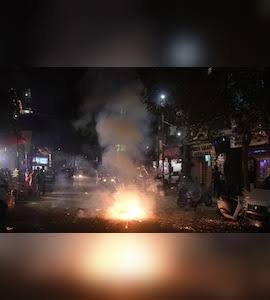
Delhi’s AQI briefly improved to 299 on Tuesday before climbing back to 302, with lingering firecracker emissions continuing to pollute the air. IITM data showed fireworks contributed nearly 30% of the pollution load during the early morning hours.
BY PC Bureau
NEW DELHI: Firecrackers accounted for more than 80% of Delhi total pollution load on Monday, a day after Diwali, according to modelling by the Indian Institute of Tropical Meteorology (IITM), highlighting the overwhelming impact of fireworks on the capital’s already poor air quality.
Delhi air quality improved marginally on Tuesday, with the Air Quality Index (AQI) standing at 299 at 4 pm, bringing the city into the ‘poor’ category from the ‘very poor’ range a day earlier. However, the relief was short-lived, as the AQI climbed to 302 by 6 pm, pushing the capital back into the ‘very poor’ category.
Pollution from Diwali fireworks continued to linger in the atmosphere on Tuesday. IITM data showed that firecrackers accounted for 29.9% of the pollution load between 1 am and 9 am in Delhi, while secondary organic compounds, formed through chemical reactions involving gases and particles in the atmosphere, contributed another 17.5%.
READ: A Love Affair That Cost Nvidia $470 B in Market Value in Two Days
The India Meteorological Department (IMD) attributed the temporary improvement in air quality to favourable wind conditions, which helped disperse accumulated pollutants. The winds also limited the impact of smoke from stubble burning in neighbouring states.
Vehicular emissions were the third-largest contributor to Delhi pollution on the day after Diwali. Despite a significant number of farm fires being reported in Punjab, stubble burning did not emerge as a major source of pollution in the capital on Monday, according to the air quality decision support system.
Breaking:
# Firecrackers accounted for 80% of Delhi’s #AirPollution hours after #Diwali night, steadily declining between 1 and 9 am.Super work by @iitmpune for sharing this real-time source apportionment data.
🙏 @Priyanshi50 for the alert https://t.co/0tqEQXv4AN— Chetan Bhattacharji (@CBhattacharji) November 10, 2026
The findings point to firecracker emissions as the principal driver of the immediate post-Diwali pollution spike, rather than a substantial influx of smoke from agricultural fires.
The sharp rise in pollution followed a deterioration in air quality during the festival itself. Delhi recorded an average AQI of 376 on Diwali, November 8, the highest level for the festival in five years. The situation worsened further on Monday, when the city remained in the ‘very poor’ category, with a thick layer of smog enveloping several neighbourhoods and multiple monitoring stations reporting severe pollution levels.
IITM’s source-apportionment estimates for November 9 showed that secondary organic compounds contributed 5.8% of particulate pollution, making them the second-largest source, while vehicular emissions accounted for 4.4%, ranking third.
The extent of the improvement in the coming days will depend largely on weather conditions, particularly wind speed and direction, as well as continuing emissions from vehicles and other routine sources.