Rahul Gandhi’s address focused on individuality, independence and breaking social restrictions, as young women raised concerns over safety, early marriage, moral policing and economic freedom.
BY PC Bureau
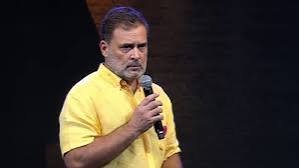
August 22: Congress leader and Leader of Opposition in the Lok Sabha Rahul Gandhi on Saturday urged young women to reject social constraints, assert their individuality and take complete ownership of their lives, delivering a strong message against patriarchal norms at a women-only edition of his student outreach programme, Chhatron Ki Goonj.
Held at the AISSMS College Ground in Pune, the event was the fourth edition of the outreach programme after sessions in Kota, Dehradun and Prayagraj. Organised around the theme “the girls will speak, and the country will listen”, the programme brought together thousands of young women for an open discussion on identity, freedom, safety, education, careers and social expectations.
Gandhi told the gathering that India’s women represent one of the country’s greatest sources of strength, pointing to the diversity of their aspirations, experiences and ambitions.
“People ask me, what is India’s biggest strength? … Our biggest asset and that strength is 70 crore unique journeys, unique imaginations, unique dreams that the women of India are living,” he said.
He argued that women’s contribution to India’s future could not be measured only through traditional family roles and called for a broader understanding of women’s identities and ambitions.
The idea behind this evening is “𝗕𝗿𝗲𝗮𝗸 𝘁𝗵𝗲 𝗖𝗮𝗴𝗲”.
If there’s one thing I want you to remember from this evening, it is this: Every single one of you is unique in this universe.
• You are unique.
• You are special.
• You are an individual.And you have your own… pic.twitter.com/hE0cKBzOSN
— Congress (@INCIndia) August 22, 2026
‘Your identity cannot be only daughter, wife or mother’
A central theme of Gandhi’s address was his criticism of the tendency to define women primarily through their relationships within the family.
“There is nothing wrong with being seen as a wife, daughter or mother. Nothing wrong with it. But this cannot be your only identity,” he said.
He said women should be free to define themselves as professionals, entrepreneurs, sportspersons, artists, creators and individuals pursuing aspirations of their own.
Gandhi also referred to a verse traditionally associated with the Manusmriti, which describes women as being under the protection or authority of their fathers, husbands and sons at different stages of life. Rejecting the underlying notion that women cannot be independent, he called such thinking a “shame”.
“You belong to nobody. You do not belong to anybody except yourself,” he told the audience.
While acknowledging the importance of relationships with fathers, brothers, husbands and sons, Gandhi argued that such relationships should not determine a woman’s identity or dictate the choices she makes about her own life.
I am from Pune, Maharashtra. I completed my Master’s in Culture, Media and Governance from Jamia University, Delhi. I lost my father three years ago after he was diagnosed with cancer.
Whenever I ask for my share of the property, or for anything else as a woman, it becomes an… pic.twitter.com/ds9x8suYQ8
— Congress (@INCIndia) August 22, 2026
‘Break the cage’
The evening was built around the theme “break the cage”, with Gandhi repeatedly stressing the importance of individuality.
“Every single one of you is unique in this universe. You are unique. You are special. You are an individual,” he said.
He urged the young women to recognise their individual talents, aspirations and ways of viewing the world rather than allowing social expectations to determine what they should study, whom they should marry or what careers they should pursue.
The interactive format of the programme gave participants an opportunity to discuss issues they encounter in their everyday lives. Questions and conversations touched on restrictions presented as concern, early marriage, moral policing, personal safety, limitations on mobility and unequal attitudes towards property and family rights.
One participant spoke about the frustration of being reduced to “just a girl”, with her appearance and marriage prospects treated as more important than her ambitions.
Folk singer Neha Singh Rathore also spoke about her experiences with online trolling, character attacks and alleged police harassment after speaking out publicly.
Gandhi cited concerns over women’s economic independence and property ownership, arguing that financial dependence often reinforces social restrictions and limits women’s ability to make independent choices.
From student issues to women’s rights
The Pune programme represented an expansion of Chhatron Ki Goonj, which had previously focused primarily on issues affecting students, including examination irregularities, alleged paper leaks, rising education costs and unemployment.
The women-only edition broadened the conversation to include social, economic and personal-security concerns, with Gandhi positioning women’s voices at the centre of the discussion.
Ahead of the event, he had invited women across the country to share their experiences of being Indian women. Responses highlighted concerns ranging from patriarchy and violence to fear, social restrictions and limited choices.
Gandhi wore a “Girl Power” badge during the programme and said the event was intended less as a conventional political gathering and more as an opportunity to listen to young women and provide them with a platform to speak.
READ: Sacred’ in Delhi, Optional in Nagaland: BJP’s Vande Mataram Contradiction
Political tensions around the event
The programme was held amid political tensions on the Pune campus. Police permission for the event reportedly came with around 30 conditions, including restrictions concerning banners, drones and noise levels.
The previous night, clashes were reported between NSUI/Youth Congress and ABVP workers at a college hostel over allegations relating to pressure or intimidation concerning attendance.
The Congress accused its political opponents of attempting to disrupt the programme and target young women online, while the BJP alleged that the gathering involved paid crowds and influencers and dubbed it “Paise Ki Goonj”.
Despite the controversy, the event went ahead, with the focus returning to the concerns raised by the young women participating in the programme.
Gandhi’s Pune address ultimately sought to frame women’s freedom as central to India’s broader social and economic progress. His message was that women should not inherit identities imposed on them by family, tradition or society but should have the freedom to define themselves.
“You belong to nobody. You do not belong to anybody except yourself,” was the central thrust of his message—a call for young women to reject restrictive identities, believe in their own abilities and make their voices heard.
For Gandhi, the larger challenge was not simply to give women a greater voice but to create the conditions in which they could exercise that voice freely, independently and without fear.