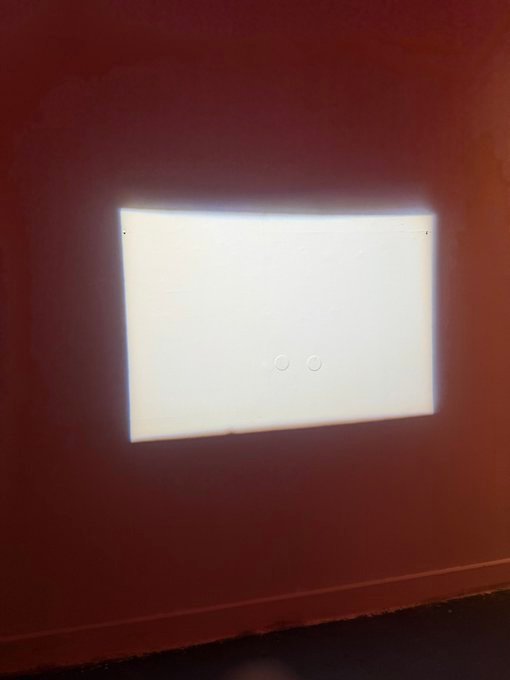
Raihan Vadra has objected to the last-minute removal of a substantial part of his photography exhibition, saying he had submitted the show’s layout well in advance. Priyanka Gandhi has criticised the move as censorship, while the exhibition continues with a reduced collection.
BY PC Bureau
October 21: A photography exhibition by Raihan Rajiv Vadra, son of Congress leader Priyanka Gandhi Vadra and businessman Robert Vadra, was partially dismantled at Bikaner House in New Delhi after the venue’s management reportedly objected to photographs documenting recent youth protests in the capital.
The exhibition, titled No Idea Is Final, was previewed on Wednesday, October 21, and was scheduled to open to the public on Thursday. According to reports, more than 70 photographs were removed at short notice, leaving only around 40 works on display.
Raihan said he was informed at approximately 3.30 pm that the photographs had to be taken down by 5 pm or the exhibition would be cancelled. The works reportedly included street photographs documenting recent Gen Z demonstrations in Delhi, including protests demanding the resignation of the Chief Election Commissioner.
The venue’s management reportedly described the images as “political” or “objectionable”. It also asked him to remove two photographs featuring the Indian national flag, a demand he refused to accept.
READ: Godse Portrait at Bengal Durga Puja Pandal Sparks Row
Protest photographs at the centre of dispute
The exhibition brings together photographs taken over the past three years and is organised into five sections: Breathe, featuring wildlife, primarily from Rajasthan; Move, capturing collective energy at concerts and gatherings; Speak, documenting public movements; Listen, presenting abstract images of the physical world; and Change, exploring the inward transformation that precedes public action.
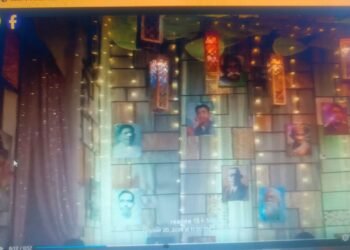
Raihan said he had submitted a detailed proposal and layout well in advance, making the last-minute demand to remove a substantial part of the collection unfair. The removal reportedly left sections of the gallery walls bare, with exposed nails and empty spaces beneath the spotlights.
Defending his work, Raihan argued that documenting contemporary events was part of an artist’s responsibility. He maintained that the photographs were visual records of events, without commentary or derogatory content, and reiterated his belief that “all art is political”.
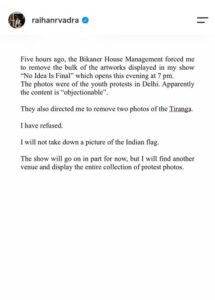
The exhibition is continuing in a reduced form. Raihan has indicated that he will seek another venue where the complete collection, including the protest photographs, can be displayed.
When even the Tricolour isn’t safe from the censor’s scissors, perhaps the problem isn’t the art. It’s the regime.
Just hours before @raihanrvadra was to open his art show ‘No Idea Is Final’ 74 artworks – nearly half the exhibition – were taken down for being “political”, by the Bikaner House.
The photographs merely documented protests, and not one was derogatory or inflammatory. So what exactly was the offence?
One of the works Raihaan had to ‘fight’ to retain was a photograph of the Indian flag. Otherwise, the walls meant for art were left with nothing but exposed iron nails, gleaming under the spotlights – a chilling metaphor for censorship.
Imagine a government so threatened by ideas that not just protests, but even photographs of protests – and the Tricolour itself – have become intolerable.
The end must be close.
— Pawan Khera 🇮🇳 ಪವನ್ ಖೇರಾ (@Pawankhera) October 21, 2026
Priyanka Gandhi alleges censorship
Priyanka Gandhi Vadra publicly criticised the reported removal of the photographs, calling the action “ridiculous” and “the next level of censorship”. She also questioned the state of democracy and accused the authorities of attempting to silence young voices.
Congress leader Pawan Khera echoed the criticism, arguing that even the Tricolour had not been spared the “censor’s scissors”. He alleged that the government appeared threatened by photographs documenting public protests.
The episode has raised questions about the boundaries between a venue’s authority over exhibitions and the freedom of artists to document contemporary political and social developments.
Questions over the venue’s decision
Bikaner House functions as a major cultural and exhibition venue in the national capital, with administrative responsibilities involving the Rajasthan government and the relevant cultural authorities. However, a detailed public explanation of the specific grounds for removing the photographs was not available in the reports reviewed.
The dispute centres on the reported classification of the protest images as political or objectionable, despite the artist’s claim that the photographs were documentary in nature.
With the exhibition continuing in a curtailed form, Raihan’s plan to find an alternative venue could allow the complete collection to be shown. For now, the removal of the photographs has turned No Idea Is Final into a wider debate over artistic expression, political documentation and censorship in public cultural spaces.