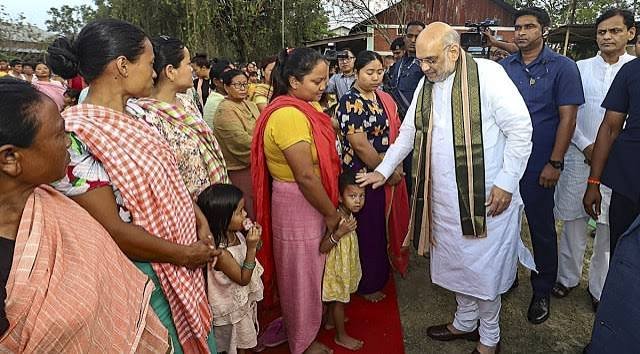
For the Kuki-Zo community, Shah’s visit will be judged not by development announcements but by whether the Centre addresses allegations of selective action, the humanitarian crisis caused by blockades and the unresolved questions of justice and political demands.
By Navin padhyay
The embattled Kuki-Zo community should not expect too much from Home Minister Amit Shah’s long-awaited return to Manipur in October. The visit is being presented as a developmental push, with Shah expected to lay the foundation stone of a medical college in Senapati and review ongoing projects. But with the Assembly polls only six months away, the timing inevitably raises a larger political question: is the visit really about development, or is development being used as a smokescreen for a broader electoral strategy aimed at consolidating a Meitei-Naga understanding?
Shah is expected to visit Manipur in the first week of October. The decision was taken during his meeting with Chief Minister Yumnam Khemchand Singh in New Delhi on Wednesday. The Chief Minister’s Secretariat said Shah had assured him that the Centre remained committed to addressing the aspirations and concerns of the people of Manipur.
The proposed Senapati Medical College is certainly a welcome development. The predominantly Naga-inhabited hill district has long needed better healthcare infrastructure, and the project could expand medical services, create opportunities for medical education and generate employment. Shah is also expected to review other development projects and has praised the state government for restoring bus services and ensuring free movement along National Highway-2.
For ordinary residents, the return of affordable bus services is a tangible improvement after years of disruption. It offers an alternative to expensive air travel and makes movement easier for families, students, traders and workers.
But development projects cannot obscure the much larger question of political trust.
For the Kuki-Zo community, the record of the Union Home Ministry offers little reason for optimism. The ministry has done remarkably little to ensure justice for Kuki-Zo victims of the prolonged ethnic conflict. In many cases of rape and murder, no arest has been amde even after three yars. Not a single person has been convicted in cases resulting out of May 3, 2023 mayhem.
The manner in which forensic agencies under the Home Ministry have sought to cast doubt on evidence in the alleged explosive tape case involving former Chief Minister N. Biren Singh, despite the private laboratory Truth Labs reporting a high probability of a voice match, has only deepened suspicions that the Centre is unwilling to take any action that could alienate the majority Meitei community.
READ: Amit Shah to Visit Manipur in October Amid NRC Push
READ: Nepal Flood: 400 Kailash Pilgrims Out of Contact; 77 From Sadhguru’s Group in Tibet
The Home Ministry has also virtually abandoned the political dialogue with Kuki-Zo armed groups under the Suspension of Operations (SoO) agreement. The talks, which concern the Kuki-Zo demand for a separate Union Territory with a legislature and other related issues, have effectively stalled, with the last round held nearly four months ago.
The prolonged silence is significant because the SoO framework was intended to provide a structured political route to address the grievances and aspirations of the Kuki-Zo groups. Instead, the apparent lack of urgency from the Centre has further fuelled the perception within the community that New Delhi is unwilling to engage seriously with its core political demands. The Centre had resumed talks with the Kuki-Zo groups in June 2025 after a prolonged hiatus, and the SoO pact was subsequently renewed in September 2025 with revised ground rules.
And the electoral arithmetic is difficult to ignore. Of Manipur’s 60 Assembly seats, 40 are in the Imphal Valley, while the hill districts account for the remaining 20. Any party seeking to form the government must therefore pay close attention to the political mood in the Valley.
This is where the choice of Senapati, a Naga-dominated hill district, as the location for the medical college becomes politically significant. At a time when the Centre is seeking to recalibrate its relationship with the Naga community ahead of the Assembly elections, the project offers Shah an opportunity to make a visible development intervention in an area that has often felt neglected by successive governments.
The timing is unlikely to be lost on the Kuki-Zo community. With the Nagas holding 10 Assembly seats and potentially playing a decisive role in government formation, the decision to launch a major project in Senapati can be read not merely as an administrative choice but also as part of a larger political outreach to the Naga electorate.
That arithmetic also raises questions about the Centre’s approach to armed groups.
The National Investigation Agency’s handling of cases involving Arambai Tenggol, a powerful Meitei radical organisation, has been a particular source of criticism. Despite cases involving allegations such as arms looting, attempted murder, arson and attacks on security forces, questions remain over why the agency has not moved more decisively against its senior leadership. Critics see a stark contrast between the treatment of Meitei armed groups and Kuki-Zo militants.
The Home Ministry’s failure to take effective steps to end the prolonged blockade associated with the United Naga Council has further fuelled Kuki-Zo resentment. The disruption of essential supplies to Kangpokpi, a predominantly Kuki-Zo district, has contributed to a serious humanitarian crisis. Yet the Centre, despite having thousands of security personnel deployed across Manipur, has appeared reluctant to confront the political forces behind the blockade.
The reason may again lie in electoral arithmetic. The Nagas control 10 Assembly constituencies and could play a decisive role in determining whether the BJP returns to power. If the Centre is attempting to forge a Meitei-Naga understanding ahead of the polls, the Kuki-Zo community could find itself further marginalised.
Shah’s proposed visit comes at another politically sensitive moment, with the debate over updating the National Register of Citizens before the next Census gaining momentum.
A section of Manipur’s legislators has travelled to New Delhi to press the demand with Central leaders and Union ministers. At the same time, a delegation representing 14 civil society organisations, led by convenor Shanta Nahakpam and comprising representatives from different communities, has also been meeting Union ministers and Central officials.
Both delegations are seeking citizenship identification before the Census and delimitation exercises. Their parallel efforts underline the growing political importance of the issue, but also expose the competing anxieties that the Centre will have to navigate.
Those demanding an NRC before the Census argue that citizenship must first be established so that population figures and subsequent delimitation reflect the genuine citizen population. Others oppose such sequencing and warn of its potential consequences for particular communities. Any citizenship-verification exercise involving population data and political representation will therefore require a lawful, transparent and credible framework capable of addressing concerns across Manipur.
The NRC debate cannot be separated from the demographic anxieties that have fuelled much of Manipur’s politics. Nor can it be divorced from the question of delimitation, which has the potential to alter the political balance between the Valley and the hills. In such an atmosphere, every decision by the Centre will inevitably be viewed through an electoral and communal lens.
Shah’s October visit will be his first trip to Manipur since April 15, 2024, when he addressed an election rally in Imphal. His previous extended visit came from May 29 to June 1, 2023, shortly after ethnic violence erupted. During that visit, he met representatives of different communities, political parties, civil society organisations and other stakeholders in an effort to address the escalating crisis.
More than three years after the violence began, Manipur remains deeply divided. The conflict has claimed at least 260 lives and displaced thousands. Following the prolonged violence and the resignation of N. Biren Singh, President’s Rule was imposed on February 13, 2025. It was lifted almost a year later, on February 4, 2026, when Yumnam Khemchand Singh became Chief Minister.
The state government has since pointed to improving road connectivity, restored public transport and renewed development activity as evidence of gradual normalisation. But physical connectivity is not the same as social reconciliation. A bus service can reconnect two towns; it cannot by itself reconnect communities that have been separated by violence, displacement and deep mistrust.
That is where Shah’s visit will face its real test.
The Kuki-Zo community is unlikely to judge the Home Minister’s visit by the number of projects announced or inaugurated. It will judge it by whether the Centre is prepared to address the questions of justice, security, political demands and humanitarian relief that have remained unresolved for more than three years.
If the Centre wants to restore confidence, it must demonstrate that the law applies equally to armed groups regardless of community, that humanitarian blockades will not be tolerated for political convenience, and that citizenship, Census and delimitation will be handled transparently rather than as instruments of electoral engineering.
Shah’s return to Manipur is therefore both an opportunity and a test—an opportunity to engage directly with a state still struggling to emerge from one of its worst crises, and a test of whether the Centre can move beyond assurances to meaningful action.
The foundation stone at Senapati may mark the beginning of a medical college. But the far more difficult foundation remains to be laid: trust, inclusion, dialogue and lasting peace among Manipur’s deeply divided communities.