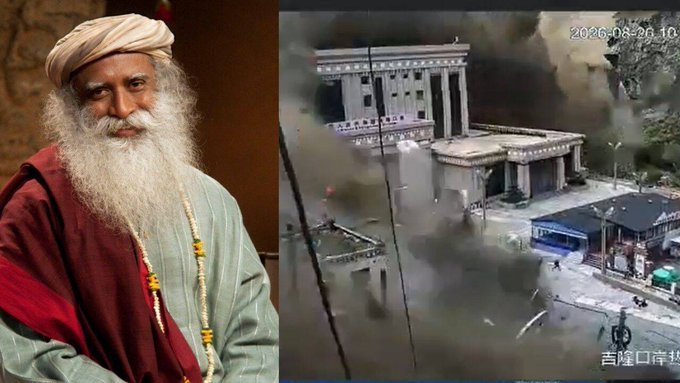
The flash flood severed the Nepal-China route to Kailash Mansarovar, leaving pilgrims stranded as rescue teams battled damaged roads, bridges, poor weather and communication failures.
BY PC Bureau
August 26, 2026: Nearly 400 Kailash Mansarovar pilgrims, including 93 Nepalis and a large number of Indian travellers, were reported out of contact on Wednesday after a devastating flash flood swept through Nepal’s Rasuwa district, damaging roads, bridges and communications along the key Nepal-China border route.
The pilgrims were near Rasuwagadhi, preparing to cross into Tibet through Kerung (Gyirong), when the sudden flood hit. The Nepal-China Friendship Bridge at Rasuwagadhi, a crucial overland crossing, was washed away, cutting the main route at the height of the pilgrimage season.
The Kathmandu Post quoted Bashu Kumar Adhikari, managing director of Kathmandu-based Touch Kailash Travels & Tours, as saying that 390 pilgrims were scheduled to cross the border on Wednesday. “Except for a few, we have not been able to establish contact with the pilgrims as of 3pm,” he said.
The pilgrims were travelling through several operators, including Samrat Tours and Travels, Leaf Holidays, Kathmandu Holidays, Kailash Journey, Explore Vacation, Trekkers Society, Richa Tours, Fishtail Tour and Travels, Himalayan Glacier and Alpine Eco Trek.
Later in the day, the Nepal Tourism Board put the number of travellers out of contact at 384, comprising 291 foreign nationals and 93 Nepalis. Among the foreign nationals were 105 Indians and 37 non-resident Indians, while others were from the United States, Malaysia, the United Kingdom, South Africa, Australia and the Netherlands. Officials said the figures were still being verified.
The flash flooding along the Lhende Khola and Bhotekoshi Rivers near the Nepal,China border was triggered by a cascade of geological events:
Ice-Rock Avalanche:
A massive ice-rock avalanche detached from a glacier high on the Himalayan slopes.Landslide Dam Creation:
The… pic.twitter.com/E7QluW7K5L— Cio (@LoveLigth7) August 26, 2026
The flash flood struck Rasuwa at around 9am after a sudden surge in the Bhote Koshi River. Preliminary satellite analysis indicated that a rock-and-ice landslide about 20 km northeast of the Rasuwagadhi border area had triggered a debris-laden torrent that swept down the Lhende River into the Bhote Koshi and subsequently the Trishuli.
The disaster severely damaged settlements and infrastructure in the border region. Roads were cut, bridges were damaged or washed away, and mobile and fibre communication links failed, making it difficult for tour operators and authorities to establish contact with guides and travellers near Timure and Rasuwagadhi.
Sagar Pandey, president of the Trekking Agencies’ Association of Nepal, said agencies and authorities were working to establish contact with the affected groups and assess their condition.
The Nepal Police, Armed Police Force and Nepali Army deployed search-and-rescue teams across Rasuwa and neighbouring Nuwakot. Helicopters were also deployed from Kathmandu when weather conditions permitted. The Kathmandu Post reported that the army had rescued 88 people by Wednesday afternoon, with 13 taken to Tribhuvan University Teaching Hospital. Poor weather disrupted some helicopter operations.
Timeline of the catastrophic flash flood on the Nepal–China (Tibet) border, 26 August 2026 (all times in Nepal Standard Time / NST = UTC+5:45).
This reconstruction draws from contemporaneous news reports (Reuters, BBC, The Diplomat, AP/Nikkei, CNN, India Today, etc.), official…— अन्टसन्ट विज्ञ (@8Kaal) August 27, 2026
Those reported missing or out of contact included not only pilgrims but also customs officials at Timure, border security personnel and workers at hydropower projects, including the 20-megawatt Langtang Khola project.
The Rasuwagadhi-Kerung route has served as the principal overland gateway for Kailash Mansarovar pilgrims travelling through Nepal since the 2015 earthquake severely damaged the Kodari-Tatopani route. Pilgrims generally travel from Kathmandu through Syabrubesi and Timure before crossing into Kerung and continuing towards Lake Mansarovar and Darchen. More than 13,500 religious tourists used the crossing during the last fiscal year.
READ: Satellite Analysis Traces Nepal Floods to Ice-Rock Landslide
The Indian government’s official Kailash Mansarovar Yatra through Lipulekh and Nathu La does not pass through Nepal. The private Nepal-based route through Rasuwagadhi, however, was disrupted by Wednesday’s disaster.
On the Tibetan side, Chinese authorities also reported damage and missing people in Gyirong. Separately, Isha Foundation founder Sadhguru said 77 members of one of his Kailash pilgrimage groups were at an immigration centre in Gyirong when the flood struck. The group was on the Tibet side and was separate from the Nepal-based travellers reported out of contact near Rasuwagadhi.
As rescue operations continued, tour operators and authorities focused on accounting for every traveller on Wednesday’s lists. With roads, the border bridge and communication networks severely disrupted, rescue teams were relying on helicopters, security personnel and information from the few travellers and guides who had managed to establish contact.
The Indian Embassy in Kathmandu issued emergency contact numbers for assistance and information concerning Indian nationals affected by the floods.