The pleas seek restoration of the traditional two-stanza Vande Matram version, arguing that compelling citizens to sing the full composition could violate freedom of conscience and undermine constitutional secularism.
BY PC Bureau
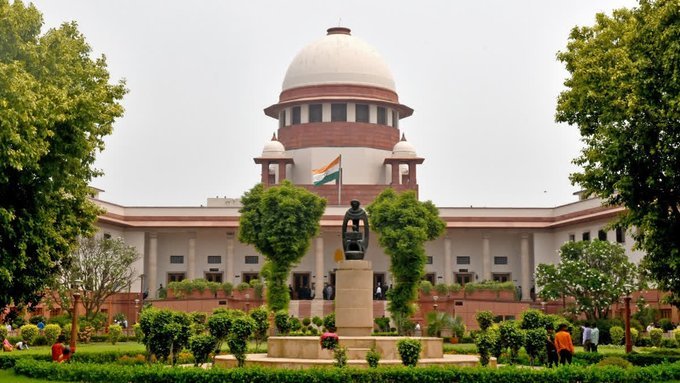
October 27: The Supreme Court on Tuesday sought the Centre’s response to two petitions challenging Ministry of Home Affairs (MHA) orders requiring the singing of all six stanzas of Vande Mataram at formal state events, raising questions over religious freedom, secularism and constitutional fraternity.
A Bench comprising Chief Justice of India Surya Kant and Justices Joymalya Bagchi and V. Mohana issued notice on the petitions filed by Buddhist and civil rights activist BD Borkar and former IAS officer Balakrishnan Sathyabhama Mavoji in BD Borkar v. Union of India and Balakrishnan Sathyabhama Mavoji v. Union of India.
The petitions challenge two MHA orders dated January 28 and July 9, 2026, concerning the singing or playing of the National Song and the National Anthem.
Borkar has described the orders as Islamophobic, arguing that they replace a long-established practice of singing a standalone, non-theistic two-stanza version of Vande Mataram with the complete six-stanza composition, whose later verses, he contends, contain religious and anti-Muslim references.
According to his petition, the two-stanza version, composed in the early 1870s, predates Bankim Chandra Chatterjee’s novel Anandamath and celebrates the country’s natural landscape without invoking religious deities or sectarian conflict. The remaining four stanzas, which appear in the novel, invoke Hindu goddesses Durga, Lakshmi and Saraswati. Borkar argues that the full text, read in the context of the novel’s portrayal of Muslims as adversaries, carries religious and communal overtones.
Compelling citizens to sing the entire composition, he contends, undermines national fraternity and risks deepening communal divisions.
Mavoji has raised similar objections, arguing that making the six-stanza Vande Matram version mandatory violates freedom of religion and conscience and runs contrary to the constitutional principles of secularism and fraternity.
Mavoji, who chairs the Anupathika Prathinidhya Prakshobha Samithi, an organisation working for the upliftment of Scheduled Castes and Scheduled Tribes, says he belongs to a Hindu Scheduled Caste community that rejects Vaishnavite, Shakteya and other sectarian theistic practices associated, in his account, with Anandamath and the full version of the song.
His petition also questions the legal basis for replacing the two-stanza version traditionally used at state functions. It argues that, although there was no express historical decision formally conferring national-song status on Vande Mataram, the two-stanza version acquired recognition through longstanding custom and practice. By 2026, he claims, that practice had attained the force of a legally binding custom that the MHA could not unilaterally replace with the six-stanza version.
Mavoji has sought the quashing of both government orders and a declaration that the two-stanza version constitutes India’s National Song.
The petitions were filed through advocate Vaibhav Choudhary and drafted by advocates G. Mohan Gopal, Vaibhav Choudhary, Mayank Singh Rawat and Zaid Ahmed.
READ: Former Miss Switzerland’s Rape Charge Against Trump Resurface
The proceedings are linked to a separate challenge filed by Carnatic vocalist TM Krishna against a 2026 amendment to the Prevention of Insults to National Honour Act. The amendment makes intentionally preventing the singing of the National Song, or disrupting an assembly engaged in singing it, punishable with imprisonment of up to three years.
Krishna’s petition was heard last month. At the request of Solicitor General Tushar Mehta, the Court refrained from issuing formal notice at that stage, saying it wished to avoid sensationalising the matter, but directed the Centre to file its response within two weeks.
During the hearing, the Bench orally observed that a conscientious objector who declined to sing one or more stanzas of Vande Mataram should not face criminal prosecution.
Krishna’s petition and the two fresh challenges to the MHA orders are scheduled to be heard next on November 30.