Gandhi linked youth unemployment and India’s data economy to what he described as a growing concentration of wealth, citing the dramatic rise in Gautam Adani’s fortune as an example.
BY PC Bureau
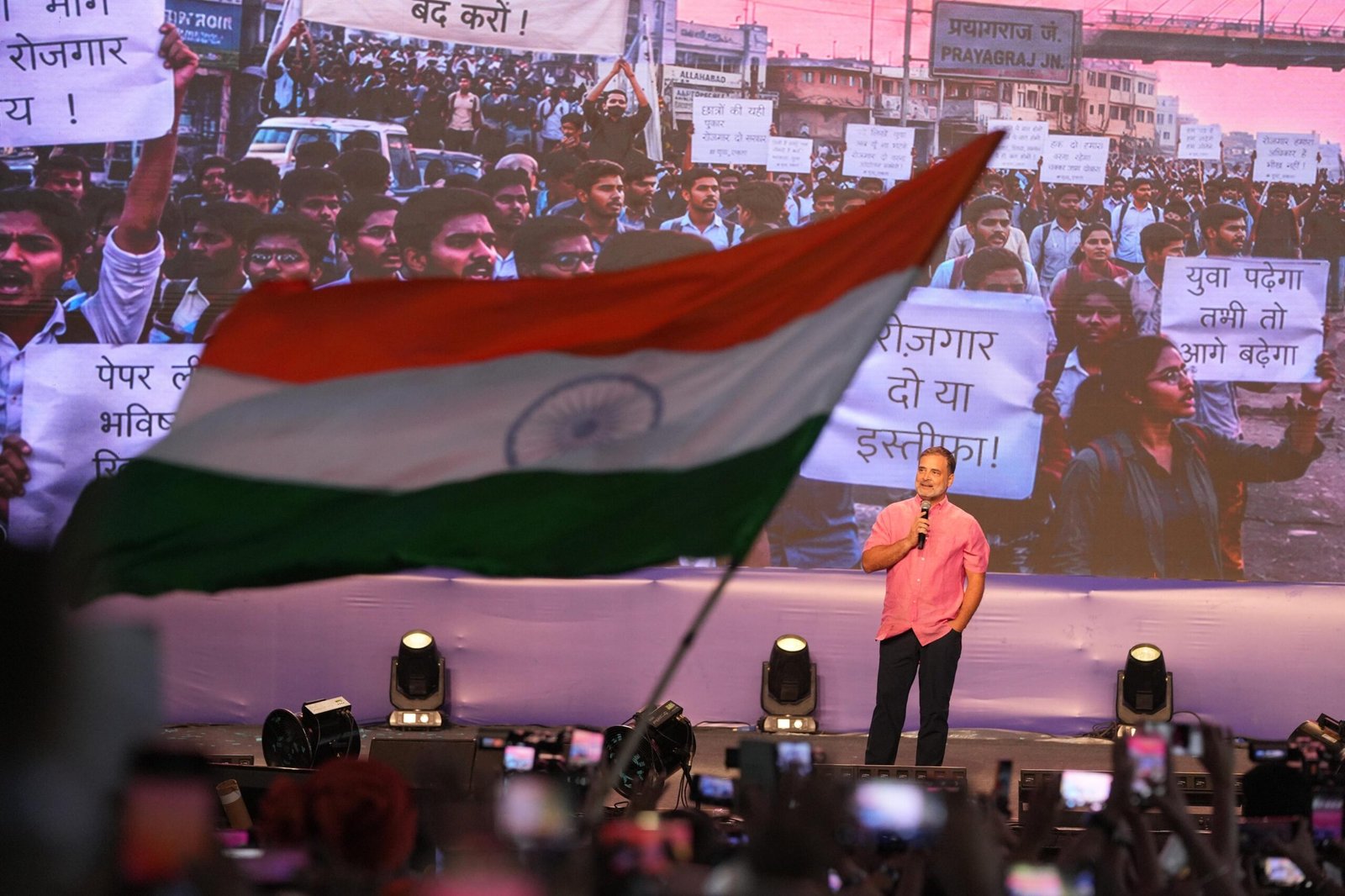
August 8, 2026: Congress leader and Leader of Opposition in the Lok Sabha Rahul Gandhi on Saturday turned his focus to India’s youth and their growing frustration over unemployment, competitive examinations and alleged irregularities in recruitment, telling a large gathering of students and job aspirants in Prayagraj that the country’s young population remains its greatest untapped strength.
Addressing the ‘Chhatron Ki Goonj’ (Echo of Students) programme at K.P. Ground, Gandhi said India has nearly 40 crore young people whose potential, he argued, gives the country an advantage unmatched by most nations. He structured his speech around three words—“dard” (pain), “data” and “daulat” (wealth)—using them to frame what he described as the growing disconnect between India’s youthful population and its economic opportunities.
“You are the power and pride of India,” Gandhi told the gathering, saying that his reference to the country’s strength extended to every Indian.
Gandhi also returned to one of the central themes of his political attack on the Modi government—the extraordinary rise in the wealth of industrialist Gautam Adani.
Referring to what he described as a roughly 30-fold increase in Adani’s wealth, Gandhi questioned how such a dramatic accumulation of wealth could occur alongside the economic difficulties confronting millions of young Indians.
देश के छात्रों ने system के फैलाए अंधेरे के बीच, अपने डर का सामना कर, रौशनी की मशाल जलाई है।
ये मशाल अब पूरे देश को अपने अधिकारों का रास्ता दिखा रही है।
BJP-RSS और अडानी के System को अब खतम, tata, bye-bye कहने का वक्त आ गया है। pic.twitter.com/MqFtLgMgUg
— Rahul Gandhi (@RahulGandhi) August 8, 2026
He presented Adani’s rise as part of what he called a broader economic and political system in which wealth and opportunity were becoming increasingly concentrated in the hands of a few powerful business groups.
The backdrop to Gandhi’s argument was the close political association that he has repeatedly alleged between Adani and Prime Minister Narendra Modi. The BJP and Modi have consistently rejected allegations of preferential treatment or crony capitalism.
Gandhi also placed his criticism within the wider political and ideological landscape surrounding the Modi government, including the influence of the RSS and its chief, Mohan Bhagwat.
His larger argument was that India’s economic direction cannot be separated from the political architecture that has governed the country for more than a decade.
While young Indians struggle with unemployment, examination scandals and shrinking job opportunities, Gandhi argued, a small number of powerful corporate groups have accumulated enormous wealth.
He argued that while global attention is often focused on the economic and strategic competition among the United States, China and Russia, India possesses two resources that could determine its future: its large young population and the enormous volume of data generated by its citizens.
According to Gandhi, Indians consume roughly one gigabyte of data a day, creating an enormous digital resource with growing economic value. He linked this data to the future of artificial intelligence and the digital economy, arguing that AI cannot develop without access to vast amounts of information.
“AI can be made from data, but data cannot be made from AI,” he said, stressing that the data being generated belongs ultimately to citizens.
Gandhi then turned the argument into a political criticism, alleging that ordinary Indians generate the data while large corporations increasingly benefit from its economic value.
“Data is yours, the pain is yours, and the wealth is theirs,” he said, accusing the existing system of trapping young people in what he described as a chakravyuh—a labyrinth from which they struggle to escape.
Education Without Jobs
A major part of Gandhi’s address focused on the growing disconnect between education and employment.
He argued that academic qualifications were losing their value because degrees and certificates increasingly failed to translate into secure employment.
“Today, education certificates have no meaning in India because they cannot give you a job,” he said, arguing that young people were facing an employment system in which opportunities remained scarce even after years of education and preparation.
Gandhi cited a range of problems confronting job aspirants, including alleged examination-paper leaks, delays in recruitment, difficulties in obtaining loans, inadequate employment opportunities and the increasing use of artificial intelligence in ways that could potentially replace human labour.
He also criticised what he described as the decline of India’s manufacturing base, arguing that products made in China and Bangladesh were more visible in the Indian market than domestically manufactured goods. He linked the difficulties faced by small traders and manufacturers to policies including demonetisation and the implementation of the Goods and Services Tax.
Gandhi cited figures suggesting that only a small proportion of young Indians obtain permanent employment, putting the figure at around 12 out of every 1,000 youth.
LIVE: LoP Shri @RahulGandhi | Chhatron Ki Goonj | Prayagraj, Uttar Pradesh https://t.co/lmdLurllIy
— Congress (@INCIndia) August 8, 2026
Read: Hapur: Auto Driver Killed in Alleged Assault by Kanwariyas
Paper Leaks and Recruitment Delays
The Congress leader also highlighted the repeated protests by students and competitive-examination aspirants in different parts of the country.
He referred to recent demonstrations in Kota, Dehradun and Delhi, where students have raised allegations concerning examination irregularities, recruitment delays and paper leaks. Referring to police action against protesters, Gandhi alleged that young demonstrators in Delhi had faced baton charges and even pellet guns.
He praised students who had taken to the streets despite the risks, saying they had confronted fear and raised their voices against what they considered an unjust system.
“The youth of Hindustan faced their fear and changed the country,” Gandhi said, urging them to continue their struggle without resorting to hatred.
‘Change the System With Love’
Gandhi repeatedly emphasised non-violence during his address, presenting the student movement as one that should draw upon India’s traditions of truth and ahimsa.
He urged young people not to allow anger and frustration to turn into hatred, arguing that the system could be challenged through peaceful mobilisation.
“We will never resort to hatred or violence. We will change the system with love and affection,” he said.
The message was significant given the increasingly confrontational atmosphere surrounding student protests over examinations, recruitment and unemployment.
Prayagraj as a Strategic Choice
The choice of Prayagraj was also politically significant. The city is one of Uttar Pradesh’s major centres for competitive-examination preparation and has a large population of students preparing for government recruitment examinations.
The event was part of the Congress’s wider ‘Chhatron Ki Goonj’ campaign, which has already taken the party to other education and examination hubs, including Kota and Dehradun.
Students attending the Prayagraj programme raised complaints concerning hostel conditions, recruitment examinations and problems faced by aspirants. Many had hoped to bring their grievances directly before Gandhi.
The gathering was held despite waterlogging and muddy conditions at the venue following recent rains. Dance and musical performances, including appearances by rappers from Mumbai, preceded Gandhi’s arrival.
Ahead of the programme, Uttar Pradesh Congress president Ajay Rai led a motorcycle rally through the city.
The event itself had faced uncertainty after the Kayastha Pathshala Trust initially withdrew permission, citing a High Court order and waterlogging. Permission was subsequently restored, while police clearance was granted subject to conditions. The Congress claimed that more than two lakh people had registered for the programme.
Gandhi’s Prayagraj appearance comes as the Congress intensifies its outreach to students and young voters in Uttar Pradesh. By placing paper leaks, unemployment, recruitment delays and the perceived erosion of the value of education at the centre of his address, Gandhi sought to turn the frustrations of India’s vast aspirant population into a broader political argument about the country’s economic and governance model.
His central message was that India’s youth are not the country’s problem but its greatest potential—and that the political system must create the jobs, opportunities and institutional reforms needed to convert that potential into economic strength.