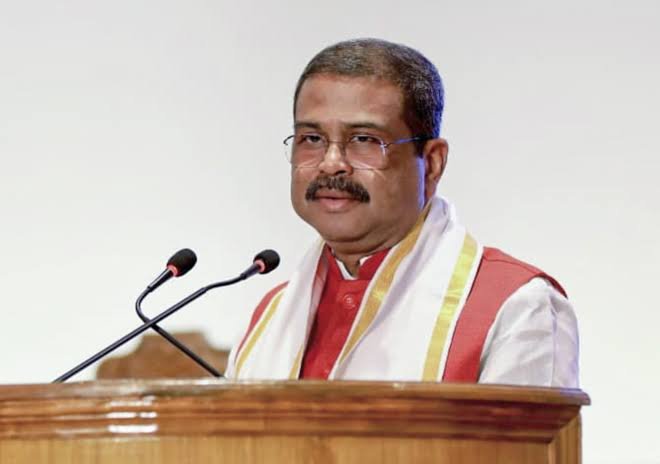
Speaking at a felicitation programme for Padma awardees in Sambalpur on Saturday, Pradhan said he had personally approached Prime Minister Narendra Modi and urged him to acknowledge the genuine concerns of young people rather than allow the growing anger among students to be converted into a political confrontation.
Pradhan’s remarks are his first detailed public comments since he stepped down as Education Minister on July 25, following weeks of protests over allegations of question-paper leaks and other irregularities surrounding the May 3 NEET-UG examination. The controversy had developed into one of the biggest political challenges facing the government, with student groups demanding accountability, examination reforms and action against those responsible.
READ: Rahul Gandhi in Prayagraj: Youth, Jobs and the Adani Question
‘I Have Been a Victim of Gen Z’
Reflecting on the episode, Pradhan described himself as a “victim of Gen Z”, while arguing that the younger generation itself had been caught up in a campaign driven by interests beyond the immediate examination controversy.
“For some time, the way this whole episode unfolded, I felt some people tried to mislead the children of the new generation,” he said.
Pradhan said he subsequently met Modi and asked the Prime Minister to recognise the concerns expressed by young people.
“I met the Prime Minister and requested him to agree to the desire of Gen Z. I told him to allow me to acknowledge this in front of the children. I never staked my personal honour in the matter,” he said.
According to Pradhan, Modi agreed with his approach and subsequently addressed the concerns of students himself.
“Modi accepted this, and later he himself spoke about it in front of the children,” Pradhan said.
His remarks appear aimed at drawing a distinction between the genuine grievances of students and what he portrayed as attempts by political or other vested interests to exploit the controversy.
Why Pradhan Resigned
Pradhan’s resignation letter had provided a different but related explanation for his departure. He had said the decision was necessary to ensure that the agitation was not exploited by “anti-national forces”, while stressing that the future of students should not become entangled in prolonged legal and political battles.
He had also insisted that the issue was not about his personal prestige.
The wording of his resignation was significant. Pradhan did not explicitly describe the protesting students themselves as anti-national. Instead, he warned that forces he described as anti-national could take advantage of the agitation.
The former minister also defended the government’s handling of the examination controversy, arguing that action had been taken after irregularities came to light.
The Central Bureau of Investigation was brought in to investigate the allegations, the original examination process was followed by corrective measures, a re-test was conducted on June 21 and the results were subsequently declared on July 16.
“From the very first day, I took responsibility for this, and I never turned away from this situation,” Pradhan said.
His defence is likely to remain politically contentious, however, because the protests were not confined to the question of whether the government acted after irregularities were detected. Students and opposition parties also questioned the broader integrity of India’s examination system, the safeguards against paper leaks and the accountability of institutions responsible for conducting high-stakes competitive examinations.
Gen Z Emerges as a Political Force
Pradhan’s reference to Generation Z also reflects a broader political reality that has become increasingly difficult for Indian political parties to ignore.
India has one of the world’s largest young populations, and the NEET controversy demonstrated how quickly an examination-related grievance can spread beyond campuses and become a national political issue.
The former minister sought to place that demographic reality in a larger context.
“Every year, around two crore children are born in India. If we look at those between the ages of 15 and 25, within a period of 10 years, there will be 20 crore children of the new generation on whose shoulders India will become a global leader,” he said.
The political importance of Gen Z lies not simply in its numbers but in the way the generation communicates and organises itself. Unlike earlier student movements that depended heavily on universities, political organisations or traditional media, younger protesters can mobilise through social-media platforms, messaging applications and short-form video networks within hours.
That creates a new challenge for political parties and governments. A local grievance can rapidly become a national campaign, while official explanations can struggle to compete with emotionally powerful online narratives.
The NEET controversy illustrated precisely this dynamic. Students who may have had no direct connection with one another were able to share information, organise demonstrations and maintain pressure on the government across geographical boundaries.
It also showed that young voters are not necessarily responding to politics through traditional ideological labels. Issues such as examination integrity, employment, competitive examinations, corruption, transparency and institutional accountability can become politically potent in their own right.
Modi and Bhagwat Also Reach Out to Young Indians
Pradhan’s comments come against the backdrop of growing political attention to Gen Z.
Prime Minister Modi has increasingly sought to engage young Indians on issues ranging from education and employment to technology and entrepreneurship. RSS chief Mohan Bhagwat has also spoken about the need to engage with younger generations.
The political lesson from the NEET agitation is therefore broader than the controversy surrounding a single examination.
For the BJP and other political parties, India’s young population represents both an enormous electoral opportunity and a potential source of political discontent. A generation that is highly connected digitally can amplify dissatisfaction far faster than traditional political structures can contain it.
BJD Rejects Pradhan’s Explanation
Pradhan’s account has drawn a sharp response from the opposition in Odisha.
Biju Janata Dal Sambalpur district president and former minister Rohit Pujari rejected the former minister’s claim that vested interests were responsible for the criticism he faced.
Pujari argued that Pradhan’s political difficulties stemmed primarily from the government’s response to the protests.
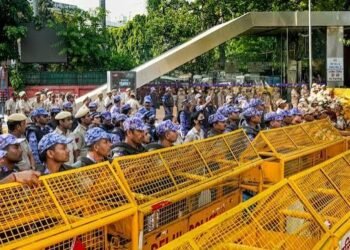
“Nobody had defamed Pradhan. His party and government have defamed him by police resorting to lathi-charge, tear gas and atrocities during the peaceful student agitation at Jantar Mantar,” Pujari said.
He maintained that the former minister’s resignation was ultimately a consequence of the government’s handling of the protests rather than any campaign by outside forces.
Pujari also alleged that more than 20 students had died by suicide in connection with the controversy and accused the BJP government of adopting policies that damaged Pradhan’s public image.
The competing narratives underline the political significance of the NEET controversy. While Pradhan portrays himself as a minister caught between the genuine concerns of young people and attempts to exploit those concerns, the opposition argues that the government’s own decisions and the treatment of protesters created the political crisis.