West Bengal has witnessed a fresh wave of post-election violence, with TMC offices vandalized and party supporters allegedly attacked in multiple districts, triggering alarm over deteriorating law and order.
By PC Bureau
May6, 2026: In a brazen and deeply disturbing wave of post-poll violence, West Bengal has once again descended into turmoil, with offices of the Trinamool Congress (TMC) allegedly targeted and its supporters subjected to brutal attacks across multiple districts. Reports emerging from the ground, backed by eyewitness accounts and widely circulated videos, suggest a pattern of coordinated aggression that unfolded in full public view — raising serious questions about the state of law and order.
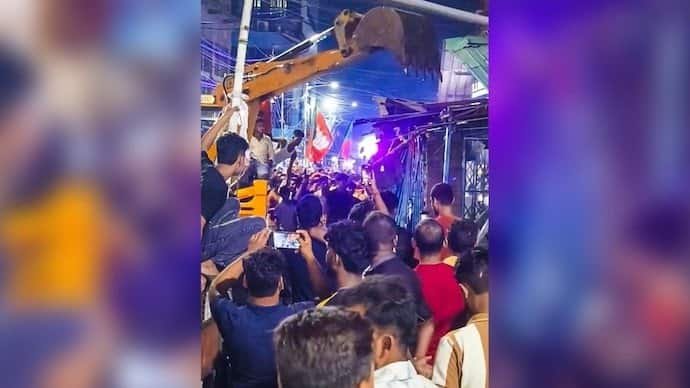
In one of the most shocking incidents, a TMC office was reportedly demolished using a bulldozer in broad daylight, with visuals showing the structure being reduced to rubble as onlookers watched in disbelief. Simultaneously, party workers and supporters were allegedly chased, beaten, and threatened in several locations. The scale and audacity of the violence have intensified concerns about whether these were isolated incidents or part of a broader, orchestrated campaign of intimidation following the elections.
Just hours after the BJP’s major win in the West Bengal Assembly elections, videos of alleged bulldozer action near Kolkata’s historic New Market and Hogg Market area went viral. Bulldozers were reportedly used to demolish structures linked to a TMC union office, triggering panic… pic.twitter.com/J8CLCl5F6k
— The Logical Indian (@LogicalIndians) May 6, 2026
What has drawn even sharper criticism is the alleged inaction of law enforcement agencies. Despite the presence of substantial deployments of central and state security forces — brought in specifically to prevent post-poll unrest — many incidents reportedly occurred without timely intervention. Eyewitnesses have claimed that police personnel at some locations remained passive, failing to disperse mobs, detain attackers, or provide immediate protection to those under assault. If verified, such lapses point not merely to administrative failure but to a breakdown of institutional responsibility.
READ: ‘Every Sixth BJP MP Won Through Manipulation’: Rahul Gandhi
Equally troubling is the broader political response. Critics argue that there has been a conspicuous lack of strong, unified condemnation from across the political spectrum. While allegations and counter-allegations have long defined West Bengal’s post-election landscape, the absence of urgent calls for accountability in the face of such serious claims risks normalizing violence as a political tool. The silence, or muted reactions, from key stakeholders has only deepened the sense of unease.
The incidents have once again brought into focus the recurring cycle of post-poll violence in the state — a phenomenon that has persisted across electoral cycles, regardless of which party is in power. Analysts note that the combination of intense political rivalry, grassroots-level polarization, and weak enforcement during sensitive periods often creates conditions where reprisals and targeted attacks become distressingly common.
TMC office was vandalised and set ablaze in Asansol, Bengal
The Police & CRPF are under Gyanesh Kumar
Look at all these crimes are happening and no action is being taken
While the Godi Media turns a Blind eye
This is a blot to democracy!! pic.twitter.com/RrpJwn7knr
— Nehr_who? (@Nher_who) May 5, 2026
At the heart of the controversy are critical, unanswered questions: Who authorized or enabled the use of heavy machinery like bulldozers in politically sensitive areas? Why were preventive measures insufficient despite prior warnings and heavy security deployment? And most importantly, will there be an impartial investigation to establish accountability and restore public confidence?
For many citizens, the issue transcends party lines. The alleged targeting of political workers, destruction of property, and perceived inaction of authorities strike at the core of democratic functioning. Elections are meant to be a peaceful expression of the public will — not a trigger for retribution and fear.
As tensions continue to simmer, there is a growing demand from civil society groups and observers for an independent probe, swift legal action against those responsible, and clear assurances that such incidents will not be repeated. Without decisive intervention, the risk is not just immediate unrest but long-term erosion of trust in democratic institutions.
The unfolding situation in West Bengal serves as a stark reminder: when violence goes unchecked and accountability is delayed, the damage extends far beyond political parties — it undermines the very foundations of democracy itself.